Thursday, October 30, 2014

Political Compass Revised The Comparison between the Old and the New, Left and Right wing --- Part 3

... previous

... previous


6. New Right-wing
The New Right-wing represents Neoliberalism, Utilitarianism, Objectivism, and the developmental dictatorship. This is the political ideology which many human individuals love to hate, and the previously introduced New Left-wingers regard of as their arch-enemy. Unlike the other political ideology groups on the other sides of spectrum, the New Right-wing does not offer any sweet-sounding dream song.

The other political ideology groups on the other sides of spectrum may provide them with some instant satisfaction for promoting their superstition and their rights to act and acquire something. However, these ideologies are less likely to induce the prosperous consequence they would want to induce. These individuals only believe that their believing policy induces the prosperous outcome meanwhile they are not practically guaranteed at all.


The New Right-wing supports the justice determined by the equitable reward and punishment rather than the principle. The incentive to reward for something profitable and comfortable and to punish for something deteriorating the living standard and violating fairness is effective in order to keep the stable and productive distribution and the stable and progressive order. In addition, the principle base of law and contracts should be simple but flexible and practical rather than an ideal abstract one.

As same as the Old Left-wingers, they think highly of the responsibility of acquiring right and liberty and the inevitable conditions imposed by the objective realities so that they insist on the equitable reward and punishment instead of protecting the unconditional right based on the abstract principle. Their difference from the Old Left-wingers is whether they regard of liberty as an impregnable natural right or a useful tool to derive a desirable consequence.

The New Right-wingers regard of the social class as an inevitable factor under. But, unlike the Old Right-wing, the class stratification shall not be based on the zealous worship of superstition and the rigid social norm and value. This stratification process needs to be formed under what the objective realities such as the natural resource limitation, mathematical and scientific factors, and the market mechanism, of the world instruct as.

There is no need of law & order and any structured institutes such as family, company, government, and nation unless there is no resource limitation. Furthermore, there is no norm and value naturally impregnable and rigid in the world: All norms and values are artificially created so that should be flexibly transformed, altered, newly created, and deleted. This change may occur either he nature, the antinomy of artificial concepts, or technology, the mixed factor of nature and artificial, evolves.

Instead if either a human sovereign, such as monarchy and dictator, or an unproductive illogical superstition, individuals ought to be directed by these objectives and treated differently owing to the exogenous objective realities which are based on either the interaction effects of various individuals and the nature or the technological evolution not fully controllable by each one human individual’s effort. Then, individuals can optimise their resource distribution, the incentive to encourage them contributing to increase the greatest sum of the aggregate utility, and cohabit together under an agreeable contract with each other.

The level of both the law enforcement authority and the government intervention into economy depends upon different material and spiritual development of each civilisation and individuals themselves living there. When majority of individuals are rational enough to understand the previously mentioned objective realities and the mechanism to be adapted to, any authority over distribution system and contract creation and management is less likely to be demanded. By contrast, when either majority of individuals are ignorant and immature enough to be unable to understand he previously mentioned objective realities and the mechanism to be adapted to, then some rational paternalistic guardian selected by means of the feasibility to adapting to the objective realities to guide the majority.


Wednesday, October 22, 2014

The IS-LM Model is wrong!

* Preface *

Many students of economics may have studied about the IS-LM model, and then tackled with various homework assignments requiring to solve the excessively complex formulas and understand the theoretical reasoning behind them. These macroeconomic teachers always expect students to consume their precious time and energy to solve a ton of equations and memorise the theory to explain what these algebras denote. The mathematical formulas applied to this model are mostly linear and straightforwardly simple but all equations are interconnected to all the others. As long as they are familiar with economics in general, it should not be a big problem to understand the theoretical bases. But, these teachers require these students to interlink all the necessary theories which textbooks show to all equations. In addition, when the interpretation of these students differ from what the textbooks and the teachers expect, their mark tends to be lowered. Therefore, studying the IS-LM model is very exhausting.

Nevertheless, despite their efforts and well-understanding, there is a big scepticism about the IS-LM model. There are still many debates about whether or not this model successfully explain the real world economy. Of course, there is always a residual gap between what the prediction model estimates and what the real world phenomenon is in real. This is why the IS-LM model is a problem because of its complex tangle of a bunch of the equations. Especially in social science, when many mathematical equations are used and interlinked together, the total sum of the residuals tends to be significantly magnified, and the bias and the inconsistency of the model also tend to take place much often. Furthermore, these estimate mathematical models are not statistically tested as their formulas are merely based on the literature of economic theories. Therefore, it is really a natural fact that the IS-LM model often fails to fit into what really happens in real.

Even in the pure literature based economic theories and the logical economic theories also counter to the IS-LM model. This report introduces some significant counter-arguments against the IS-LM model as follows.


1. The Ricardian Equivalence


This theory implies that providing economic agents with extra income by the stimulus package does not successfully induce them to spend enough to stimulate their economy. When they prefer consuming/invest less and saving more at the present time to the extra consumption&investment, the extra income available by the tax cut and/or the government expenditure rather causes the negative impact on economy than the positive impact. The cost incurred by the tax cut and/or the government expenditure at the present time period has to be paid back in the future. As the economic stimulus becomes unsuccessful due to their preference of spending less than expected, the tax revenue in the future time period is lowered meanwhile the cost remains.

Those who disagree with the Ricardian Equilibrium argue that there are many economic agents with the low income insufficient to satisfy their needs and wants during the recessionary period so that they happily spend their extra income provided by the stimulus package to stimulate economy.

However, their extra income spent for consumption/investment is eventually transferred to owners of the means of production who produce the consumptions and own the assets invested. These owners will rather want to shift their income earnt from their capital investment to their assets in this downward market to either saving in their bank account or investing more active foreign markets.

When an economy become at the point that even these owners of the means of production become deprived enough to cling to the extra income provided by the stimulus package, the national government is less likely to be able to issue their bonds to incur the debt as the bond credibility is substantially lowered.


2. Liquidity Trap


The stimulus package by the monetary policy channel still does not work due to the liquidity trap. As mentioned in the Ricardian Equivalence, economic agents tend to be reluctant to spend their extra income available during the recession. Even the monetary policy is less likely to incur the cost like the previously mentioned fiscal policy channel, the result is identical to the previously mentioned scenario.

This phenomenon is explained as the liquidity trap. As shown in the graph above, although the extra money supply becomes available to transform to the extra income available for economic agents to spend, the effect is substantially low or even nothing under a very low liquidity level i.e. the investment motive is very low. The little effect on the interest rate reveals little impact of the money supply increase on economy. This means that the factors determining the interest rate such as the price indices, the business activity rate, and the value of this money currency in the foreign currency exchange market hardly changed by this monetary policy.

On the other hand, this interest rate shown in this LM graph merely implies the central bank interest rate, and this only partially affect on the banks' interest rate setting for their borrowers. The rest of this report explains the effect on these interest rates. The IS-LM model neglects explaining the following factors because the IS-LM model assumes all these factors are positively correlated to what it indicates in the model. Nonetheless, the more real economy is obviously different from this false assumption.


3. Under the Banking Monopoly in case of Risk Neutral


The supporters of the IS-LM model assume that their margin rate tends to be always positively correlated to the central bank interest rate so that the final interest rate for both investment and saving is always controlled by the central bank interest rate affected by the fiscal and monetary policy.

The IS-LM model is based on the assumption that all or majority of private banks and the other financial institutes are under the perfectly competitive market. By contrast, the real world economic situation is even not close to this assumption and actually far away from it. They are in the less competitive market due to the nature of the financial industry and market.

The interest rate is the price of money rent and borrowed. So, the private banks and the other financial institutes need to add the extra rate on the central bank interest rate after borrowing from the central bank to rend their money to their customers in order to compensate for the renders' service cost and reward.

Also, in a market economy, the characteristics and the quality of the financial service is heterogeneous to each other, and the demand is severely affected by their geographical situations e.g. access to customers and clients (both quantitative and qualitative), cultural attitudes toward finance, and the infrastructure for obtaining information and technology available there.

On the top of the service quality issue, the service users are difficult to change their service providers often as much as the mainstream economists assume due to the contract binding them together and the transaction cost to close and open their bank accounts. So, these service users are more likely to be bound to their already contracted financial services.

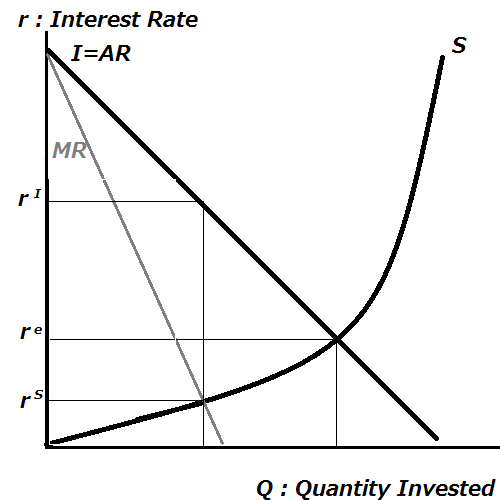
All in all, the market nature is far more monopolistic owing to these aspects. Then, the interest rates are set at the quantity of money invested where the marginal revenue becomes equal to the cost which is the interest payment for savers for this case. So, the quantity invested is lower than the quantity at the investment and saving intersection, and the interest rate charge for borrowing is always significantly way higher than the interest rate payment for savers.

The interest rate payment for savers may be affected by rise of the central bank interest rate increase but not often by fall of the central bank interest rate unless the market is very competitive. These financial service providers take advantage of this situation so that the interest rate payment for savers often tend to be notably lower than the interest rate charge to borrowers.

The following charts explain the different situations to set the final interest rates.

3.1. When the Central Bank Interest Rate is high


When the central bank interest rate is high, then the interest rate paid to savers is adjusted to be equal to the central bank interest rate.

The quantity of money invested is adjusted to the point where the marginal revenue from the return from investment intersects with the central bank interest rate, and then the interest rate charged for investment becomes higher as the central bank interest rate becomes higher.


3.2. When the Central Bank Interest Rate is low


When the central bank interest rate is low enough to be able to split from the investors' profit margin, then no change of both interest rates tends to take place as shown in the graph above.

This aspect completely contradicts what the IS-LM model assumes. As the market is less competitive, the monopoly power is stronger enough to maintain their high interest charge for investment payment unchanged.


3.3. The extreme case: The Central Bank Interest Rate is either zero or minus


In this extreme case which seems to occur frequently under the world economic crisis period nowadays, many central banks of this world have set their interest rate notably close to zero. Even some claim that they should set the rate zero.

Nonetheless, as shown in the previously mentioned mechanisms, the previously mentioned interest rate setting under the low liquidity, the money supply offered by the central bank with a sizably low interest rate hardly stimulates economy.

The interest payment for savers cannot be set below zero because they will no longer save in these banks or any other financial institutes setting such a negative interest rate.


4. Risk Taking Patterns

On the top of the gap between the interest rates, the IS-LM model over-simplifies the investment pattern influenced by the psychological characteristics of banks, investors, and other financial administrators.

What should be concerned is that the interest rate setting based on the investment volume is not always counter-cyclical to the business cycle, and not all economic agents are risk neutral as many mainstream macro-economists tend to assume.

The following examples are based on the situation of the fiscal and monetary policy is tightened to repress the economic boom or the recession repressing the aggregate income level.

The Y_t denotes the aggregate income invested to economy by these investors, and X_t denotes the investment safety (A higher value indicates the lower investment risk).


4.1 Risk Neutral: The IS-LM Curve assumes all agents are as such


This is the way which the risk neutral agents regularly react to the business cycle downturn causing the aggregate income shrinking.

They simply reduce the investment volume, and passively react to the investment risk change.

The IS-LM model may work as long as all the economic agents act as such.


4.2. Risk Averse


The risk averse economic agents put priority on their investment safety to their nominal income gain from their investment volume.

When their investment opportunity becomes more limited, they tend to take this situation warning of losing their business opportunity and potential collapse of their investing clients.

Even in the case where the fiscal and monetary policy represses the booming economy, they imagine about the negative side effect of the over-expansion which the policy alerts, and then they prefer preparing for the worst case scenario.

In particular during the recession, more agents tend to become the risk averse because their perspective tends to be more pessimistic about the future.

All in all, the income downturn exaggerates the investment discouragement furthermore.


4.3. Risk Lover


What the mainstream macro-economists supporting the IS-LM model ignores is this psychological characteristics of economic agents the risk loving attitude toward investment.

When the macroeconomic level of the aggregate income goes down during either the policy tightening or the recession, these risk loving investors start investing more in order to compensate for their loss by the downturn. Even though their action notably increases, they tend to be willing to invest a lot for increase the nominal investment return furthermore.

Their prior objective is to maximise the gross income growth despite the high risk reducing the average expected investment return. So, they will either maintain the current investment volume or even increase the volume in spite both the investment risk, the high central bank interest rate, and the high tax and/or the less government expenditure.

In particular during the economic bubble, an euphoria severely affects people's mind enough to lose their rationality. So, they often tend to become the risk lovers while the economic bubble.


5. Risk Premium in case of the Perfect Competition

Even in the Perfect Competition Model fails in the real investment mechanism because it ignores the interest rate influenced by the risk premium of investment. When renders invest, they add the extra interest rate charge on the top of the risk free interest rate which the mainstream economists supporting the IS-LM model use in the macroeconomic model.

The graph indicates the interest rate setting of a bank under the monopoly:

Under the monopoly or a less competitive market, these firms simply takes the cost incurred by the investment risk by spiriting the expense from their profit.

By contrast, in the perfect competition, it is very complicated to explain with only the saving=investment curves so that the graph will be a overly complicated mess if it attempts to explain the risk premium rate setting under the perfect competition.

So, this analysis introduces the cost denoted as C, which indicates the cost of attracting savers, the interest payment to the central bank, and then the risk premium all together.

The graph below sets the saving motive and the central bank interest rate as rigid so that takes account of only the investment motive and the risk premium.


In this case, the interest rate is not guaranteed to be counter-cyclical to the business cycle, and it can be acyclical or even possibly pro-cyclical to the business cycle.

Some economists argue that the risk premium factor may affect the investment cost more than the other factors such as the central bank interest rate, the saving ratio, and the aggregate income/productivity level.

So, the final interest rate influencing the investment volume may rather rise during the recession because the risk premium rises meanwhile the rate may fall due to the lower risk premium during the stable or booming period.

Monday, October 20, 2014

Political Compass Revised The Comparison between the Old and the New, Left and Right wing --- Part 2

... previous

... previous


4. Old Left-wing
After civilisation of human individuals became matured enough to preserve the record of their knowledge and wisdom, they started thinking differently and the notion of individualism was born among these human individuals. They started realising that they are able to overwhelm the fear and improve their living standard by developing technology and individuals’ voluntary will under right procedures. They researched and developed the procedures from learning about the objective realities such as resource limitation in the substantial world, the market mechanism, and mathematical and scientific factors. They became also enlightened to know that their social norm and value can be flexibly changed by not sticking to their rigid tradition and loyalty to their human authorities. This enlightenment has enabled them to act and think by means of their own invincible will and mind influenced by neither their authority and superstition nor any others.

Various liberation and revolution in the early modern period originated from this enlightenment movement. These revolting individuals became sceptical about their old common sense basing their old ruling traditional status quo, and then started claiming that they would form and develop their civilisation far better than their traditional status quo. Then, they also started believing that there is an impregnable individual right naturally endowed to all individuals equally, and then started claiming for abolition of any social class.

Under this revolutionary ideal, technically speaking, all individuals must be treated equal as long as the distributable resource is available and these individuals claiming for their right bear responsibility to negotiate with the others. In addition, their freedom of speech, thoughts, and choices is widely permitted as it is their right. Those who believe in this ideal expect that the material and spiritual development is eternally unlimited as long as the power of their imagination prevails. But, many of them also affirm that there is a limitation to provide individuals with their right and require, and it is required to spend sufficient time to increase the resource to offer a higher degree of liberty for individuals. Therefore, individual right and liberty are mandate but highly conditional to provide under the natural restriction.


5. New Left-wing
Meanwhile some of these revolutionaries affirm that right and liberty for all individuals are conditional, the other newly emerging revolutionaries argue that they shall be unconditional. These new radicals explain that their scientific ethical theory enables individuals to acquire their ultimate freedom of living as long as they follow the required ethical code. These revolutionary radicals, collectively called the New Left-wingers in this essay, insist that individuals with their unlimited ethical imagination and aspiration rooted on it may overwhelm the barrier of the objective realities, and eventually control over these objective realities. Moreover, they claim that distribution of the rights and protection of individuals’ life security must unconditionally be a top priority over anything regardless of the disequilibrium condition of the resource distribution.

According to their idea, their logical inference to conceive what has been claimed as the objective reality is a false hypothesis deserving their enemy camps. They also claim that which fundamental principle, equivalent to a mathematical axiom, they refer to is far more important than the logical inference for deriving their desiring outcome. According to this theorem, all the logics are subjective because there is no unified objective measure like a mathematical axiom enabling their logical inference to self-contradict and self-verify itself. Therefore, they “invented” an axiom for ethics like an axiom of mathematics which, they think, leads individuals to preserve their unconditional human right. Then, they express that this invented ethical axiom ought to be enthrone in order to alter the whole world natural and social structure.

However, even though they say their new alternative principle shall be objective but this principle is invented from their mere faith which is equally subjective and irrational as much as the superstition maintained in the Old Right-wing world. The mathematical axiom is merely the mathematical theorem which is used in mathematical procedures and their theoretical application. This only exists, as a rule set by the peer groups, to enable the applied theories based on mathematical modelling to self-verify and self-contradict so that it only affect their validity of theories and hardly directly affects the decision making processes of daily politics and individuals’ personal lifestyle. By contrast, their claiming ethical principle as the axiom of our politics and personal life directly affects decision making processes and daily life choices. The fundamental concern is who and how to determine what the leading universal ethical principle is. The universality of moral is still debatable to judge whether the moral validity measurement is universal and relative. Therefore, even though they claim that their claiming ethical principle is an ultimate objective and universal, it still sounds hypothetical by means of the perspective of majority others who are either not familiar with the study of ethics or sceptical about their logical deduction.

It is also the matter of who control the resource distribution to adjust it to their claiming ethically desired state. It requires a huge degree of controlling both moral and material distribution in order to accomplish their desired state. First of all, it ignores the equitable reward and punishment for individuals to motivate to increase their productivity, discourage from causing civil-disorder, and maintain the stable and productive equilibrium of the distribution. When the justice is determined by the principle rather than the equitable reward and punishment, these peer groups who sound more plausible to these peer groups taking the actual controlling power over the court of judgement. In order to keep the stable and productive distribution and the stable and progressive order, then the positive equitable law is more desired. But, these New Left-wingers deny this aspect to zealously cling to their claiming ethically correct state which is merely a utopian dream world. They believe that, even though their claiming ethic base order may disturb the short term instability and unproductivity, the human individuals’ aspiration of pursing their ethics enables individuals to resist against the temporary harms. Thus, rather than the fairness, these New Left-wingers cling to expecting individuals’ genuine patience and collective responsibility based on altruism i.e. sacrificing individuality for collectively protecting all individuals’ survival and morally well-being.

... continue reading:

Wednesday, October 15, 2014

Political Compass Revised The Comparison between the Old and the New, Left and Right wing --- Part 1


1. The Critique of the Original Political Compass
The original political compass based on the Left/Right (Collectivism/Capitalism) axis of the economic and the Authoritarian/Libertarian axis succeeds in explaining about the complex characteristics of political ideologies which are not enough to be explained by the single linear political spectrum. Nevertheless, this political compass analysis seems to over-simplify the philosophical backgrounds of these political theories. Firstly, it easily equalise Authoritarian to Theocracy, and Secularism to Libertarian. Secondly, it lacks differentiating between the teleological focus (consequence first) and the deontological focus (Duty/Will first). Overall, this cannot distinguish the philosophical intention, the rationality behind determining the degree of intervention.


First of all, this neglects considering about the necessary law enforcement whose principle is rational enough to be fair, and about the critical difference between chaos and self-governance. Many political philosophers affirm that, in order to secure liberty for individual citizens, the rule by law and its enforcement are essential. For instance, Montesquieu argued that liberty and equality require significance of law. The original political compass seems to mix up the rule by law with the law by rule.

Secondly, this original compass equalises the theocratic regimes to the authoritarian left. It can be easily imagined that these two camps, the secular authoritarian left and the theocratic authoritarian left, would strongly condemn its labelling based on this compass. Even though both Authoritarian-Leftists are anti-capitalism and highly authoritarian, their philosophical principle is completely opposite to each other.

Thirdly, the original political puts an excessive emphasis on distinguishing their policy practice and ideal, which majority of the New Left-wing nowadays believe in, from the state socialism imposed by the socialist nations under various Communist party regimes. Nonetheless, even though their external characteristics is different, their quality is still essentially identical to each other in both good and bad way. Both are fundamentalistic secular as though it were a fundamentalist monotheism without God, and supporting revolutionary subversion of the world. Only the difference is their process and the tools they apply to their aim.

2. How the Revised Political Compass is Revised
The revised compass presented here takes account of both the consequence they aspire to induce and the duty they are obliged to. Unlike the original political compass, the axis introduced does not mention about the scale of intervention by either government or any other autocratic institute such as a feudal lord, religious organisation, or private corporation into both economic and social schemes. By contrast, this revised compass based on these axes representing political thinkers’ action planning and mind principle enables to analyse how the intervention is applied more or less by means of their philosophical objective.
The vertical axis represents political thinkers’ action planning. It measures whether political thinkers focus on individuals’ right and duty or the overall consequence induced by individuals’ actions. The Deontologists on the left hand side scale claim that politics must put the highest priority on the universally absolute principle, basing individuals’ right and duty, all individuals ought to follow over any hypothetical estimation and thought. By contrast, the Teleologists on the right hand side scale think that politics has to be functional as a whole part so that the hypothetical estimation and thought to draw the big picture of their governing state are essential. Then, the Teleologists argue that fundamentally sticking to the absoluteness of moral right and duty is meaningless because these measure vary across different times, places, and occasions in order to form a stable functional structure in each different situation.

The horizontal axis represents political thinkers’ mind principle basing their action planning. It measures how the principle individuals’ actions and mind are base on. The bottom scale indicates the principle which individuals pursue in by means of their subjective wish, emotional attachment, and fear of the others. Those who obey this principle follow what individuals are taught or commanded to believe or what is wished to become true in real. The top scale indicates the principle guided by the objective realities such as resource limitation in the substantial world, the market mechanism, and mathematical and scientific factors. Those who understand this principle use analyses based on logical inference to determine their decisions and establish their rule.

3. How the 4 Category groups are characterised on this compass
- Old Right-wing
When the technological development and the civility of individuals are at the primitive level, politics tends to be a primitive form as the simplicity, more than the complexity, prevails to satisfy their needs and wants. These individuals living there are often under the constant threat of harsh disasters, fatal endemic diseases and persistent lethal assaults by neighbouring tribes. They have little methods to protect themselves from these threats because technology and civility of individuals living in this kind of world are significantly insufficient enough to prevent these threats. Then, their mind tends to dominated by fear, and their priority is to prevent their haunting fear. Furthermore, such a situation is less likely to enable individuals to form their rational mind set and voluntarily fairly compete and cooperate together. Therefore, the first political priority is establishing a strong cohesion bundling individuals to one community group.

In this case, resource distribution is too limited to distribute equally among all individuals, and there tends to be little technology and wisdom to develop their rationality encouraging fairness. So, the wealth and the opportunity are inevitably unequally as well as unfairly, and majority individuals tend to take their situation for granted. Under the substantially low resource and technology level, this unequal distribution prevented from a competition is an effective way to concentrate all the resources available to one authorised institute to use them for sustaining one strong figurehead charisma and mature the cultural standard within one family or religious organisational structure. In such a world, majority subordinates obey and unconditionally contribute to their powerful minority such as feudal lords and religious authorities because of the majestic charisma as an authority figure of their belonging community. These individuals strictly follow their retained tradition and worship a superstition which they are emotionally attached to. They feel secured under an umbrella of one cohesive community even with a sacrifice of their material well-beings and their individual rights.

... continue reading:

Monday, June 16, 2014

The Western ethics, Asian Life, Japan, and Libertarianism: Part 3

8. Concern on the interventionists’ view on the free market economy
Without a doubt, the free market economy is the most productive form of economy. The free market economy promotes individuals’ free voluntary will motivating them to do what they are the best at doing and/or they desire to do. It also allows individuals to freely trade their goods and services so that they offer the best possible rewards for their best possible efforts and merits put into practice. Therefore, this economy naturally encourages individual humans to provide their best possible commitments increasing the aggregate productivity without any artificial forcible enforcement.

The majority of nations nowadays have partially adopted the free market economy to their national economy to a certain degree because they have realised its previously mentioned huge benefits especially since the fall of the command economy in the socialist collectivist nations. The USSR-style socialist/collectivist economy, the big historic experiment using several national economies themselves, failed. Then, this historic event has proven that the command economy is materially and ethically failure.

Some of these nations experienced in the radical political transformation in which their mainstream political regime was replaced by another. The other nations sustained the regime of their status quo by simply replacing their command economy with the mixed economy. Only Cuba and North Korea are the nations remaining their staunch command economy. But, North Korea is still suffering from crucial despairs such as famine, high mortality, and considerably low standard of cultural living. Cuba has gradually been adapting the market economy so that her economy should be categorised more as the mixed economy nowadays.

The mixed economy, the blending of the command economy and the free market economy, seems to be the popular form of national economies nowadays. The reason why most of the all nations do not encourage the pure free market economy is the misguided scepticism created by Marxist and the self-proclaimed Keynesian economists. Even though there are critical theoretical failures and deluded judgements in their theories, their teachings were cogent enough to convince many people to believe as though they were true. The contemporarily popular Reactionism against the virtue ethics and individuals’ free voluntary will also reinforced the cogency of these theories.

Their scepticism is based on their prejudice about the world economic crisis in 1929. As mentioned in the previous chapter, both Marxists and the Keynesians disagree with the pure market economy. So, as soon as they observed the world economic crisis, they seriously thought that their predicted failure of the free market economy became true, and they were happy to observe that event. In addition, regardless of their diagnosis, their prescription was deluded as explained in the previous chapter. But, they thought that the crisis was just the opportunity to advertise their prescription to put it into practice in the real world. This is a typical repugnant personality of theoreticians explained by Lev Tolstoy in his novel War and Peace. These theoreticians expect to observe that the world encounters with troubles when the world does not follow their theory. Then, they take an advantage of this situation to promote their theory as the right salvation.

In 1929, the spirit of the free market economy was already deteriorated due to the epidemic influence of the previously mentioned Reactionism originated from Kantian philosophy and innovated by the other modern idealists and the nihilists. Even though the contemporary world still partially retained the free market economic structure, the free market economy was compromised under the decaying spirit of the virtue ethics and the free voluntary will. The other forms of economic policy do not necessarily require individual citizens’ voluntary participation into sustaining and developing their economy because their appointed authorities and specialists manage handling their economy and politics. By contrast, the free market economy requires individual citizens’ competence and commitment are unavoidable to sustain and develop economy further as well as stabilising their politics.

These interventionists, supporting the mixed economy, who are nihilistic about the free market economy blame the market structure of the pre-crisis period where the monopoly by few big enterprises prevailed. They argue that the reason why the contemporary Anglo-Saxon countries the USA and Great Britain experienced the crisis was due to their free market economy. They insist that the monopoly, causing the unequal distribution and the deprivation of majority citizens, naturally takes place in the free market economy in the pre-crisis world economy.

Nevertheless, this is totally a fallacy because no monopoly can be naturally created as long as individuals’ free voluntary will is largely permitted. When the monopoly dominated in the pre-crisis period, the free market had already being compromised since the state government in these Anglo-Saxon countries operated the protectionist policy preventing their enterprises from the world free market competition. This protectionism prevented their citizens from the opportunity to purchase the inexpensive products from abroad. Furthermore, the state governments’ recommendation for their favourite enterprises to do their public work projects caused the discrimination between suppliers in the domestic market. Even before the New Deal programme started, the government subsidy and the government assisted privilege for a certain social status existed to artificially prevent the new market entrants. All in all, the monopoly was artificially created by the government intervention in these countries at the pre-crisis periods.

In addition, these anti-free market interventionists tend to assume that all economic agents in any market participate into their economy with a passive attitude. They hardly realise that economic agents often become very proactive to influence their market situation. For example, they create their product advertisements to attract customers when they consider about newly entering into a particular market. The blockage of the information flow disrupting these new market entrants’ advertisement is not a free market mechanism. Therefore, when the market entrants struggles to enter the market, it can be because either their goods and services are not attractive to the potential customers or the market freedom is disrupted by the tyranny of authority or mobs.

These interventionists also excessively focus on the real market whereas they tend to neglect focusing on the capital/financial market mechanism in the free market economy. The investors are willing to invest to the assets whose future growth expectation is at least positive, and avoid concentrating on investing to the safety assets and the already high value assets. These assets’ value tends to have already reached at the significantly low marginal growth rate. By contrast, the asset value of some small and medium sized enterprises and the low value assets still have a potential to increase their value with a high marginal revenue of investment. So, even though some new entrants do not have their own saving enough to spend for their initial investment cost, the rich investors will be willing to invest to them as long as their business looks becoming prospering.

Regarding to the ethical issue about the monopoly, it is really questionable to categorise the monopoly as the cause of the stagnation. For example, the contemporary market share of the oil industry was significantly small that the monopoly of this market share was not significant to the market competition. Also, this industry required the big scale enough to diminish the marginal total variable costs so that the investment needed to be concentrated into one or few companies into this kind of industries. When several companies participate into to that kind of industries, the total cost per company will be high because their business scale is too small to diminish the marginal costs. Therefore, the monopoly by one or few can occasionally offer more reasonable prices than the competition by many.

Moreover, when the product price becomes high relative to income, this simply means that the demand exceeds the product supply capacity, which causes the price rise, and/or the excess supply of the unproductive labour force, which causes the income down fall. The excess demand and the unproductive labour supply are also related to the excess human population relative to the natural resource available. After the industrial revolution, the human population has been exponentially growing meanwhile the technological growth offering the high product supply has been only growing arithmetically. Since then, the labour supply has become more exceeding the product supply capacity. In the free market economy, individual citizens are allowed to bargain their wage in order to match their need and want as they are no longer enforced to participate into economic activities as slaves with the fixed wage. Only in the command economy, of either feudalism or socialism, the slave labour exists because they are commanded to work under the wage fixed by the tyranny.

The naiveness discouraging the self-esteem of individual humans prevents the liberalisation of both market structure and personal life style. Their false belief imprinted by both the modern idealism and the postmodern nihilism. The current compromised form of the world market and political economy remain to be stagnated. The haunting economic and communal stagnation is bad for not only the material wealth but also the mental/spiritual state. This stagnation induces people to suffer from boredom, which is the true root of all the evils (Kierkegaard, 1813), and the loss of their means of living which results in the anomie causing people committing suicide and many kinds of dysfunctional behaviour (Durkheim, 1897).

In order to expect the growth i.e. the progress whose level was seen in the ancient Greco-Roman civilisation and the early modern Western world, the following two conditions are needed. The world market needs to be more liberalised. The virtue ethics motivating individuals’ self-confidence in their free voluntary will needs to be reincarnated. Thus, the ethical counter-revolution against the mixed economy promoted by the interventionists, the materialistic nihilist against the free individualism, shall be held out.

9. Population: Rising British Industrialisation and Failing Japan
Thomas Malthus, the remarkable British classical economist, thus had warned of discouraging the excess population growth during his time period when Britain enjoyed their material prosperity in her post industrial revolution time periods. Socialists whinge how miserable deprivation the contemporary working class citizens were in then. However, their analysis to conclude as they whinge is very questionable and sound awfully superstitious.

The socialist mythology about the industrial revolution and the post industrial revolution world is simply a propaganda scripture. Pseudo-intellectuals and irrational mobs are frustrated due to their madness but want to believe they are suffering from a conspiracy plotted by some others. So, this socialist propaganda accusing the post industrialisation world is based on the conspiracy these mad people wish to believe in. Then, they have become socialists after being deluded by socialism i.e. the anti-industrialisation. This is also called the historical revisionism because these socialist revisionists revise the interpretation of the world history to translate into their favourable way of understanding. This is why their anti-industrialisation perspective contains plenty questionable stories and illogical superstitious fallacies.

The working class population was dramatically rising even at the level that Malthus warned of the excess population growth. The infant mortality dropped down due to the notable aggregate productivity after the industrial revolution. Human-beings in civilisation feel secured to reproduce when they are optimistic about future. It is the same rationale as the financial investment. These people at the contemporary time period were so optimistic about the future of their prospering nation that they were relieved enough to manipulate their population fast.

The poverty existed inevitably because of the previously mentioned population overgrowth in the contemporary Great Britain. Even in the prospering moment, the error such as an excess population growth relative to the production supply capacity so that there always needs some spontaneous error correction. The poverty inevitably takes place when the population becomes excess compared to the productivity capacity and the natural resource storage. Furthermore, the working class citizens tend to reproduce more than the middle and the upper class counterparts. The working class citizens tend to spend their energy and time for their sensual pleasure because their cultural standard is too low to pursue in the other forms of amusements. Therefore, the working class citizens were more likely to suffer from the poverty than the middle and the upper class counterparts. But, this problem would have eventually been solved by knowing they needed to correct their own error, the excess reproduction.

All the other negative interpretations about the industrialisation by socialist historical revisionists are misguided. In Great Britain, the rapid productivity growth stimulated by the market liberalisation and the philosophical enlightenment liberalising individual citizens’ mentality has improved the living standard for all British citizens. The sanitary condition was dramatically improved from the pre-industrialisation to the post-industrialisation. The literacy rate rose up due to the flexible information flow and the freedom of speech and competition in the free market economy. Despite the falling down working class wage, their real wage went up dramatically due to the average price decline caused by the aggregate productivity increase. The property right and its equal legal application to all the citizens, the fundamental complements of the market economy development, has been highly emphasised. So, all individuals in all the classes have been benefitted and enjoyed their freedom and autonomy.


The reverse case scenario has taken place in Japan after the economic bubble burst. Since the economic bubble burst in 1990s, Japanese population has been notably declining due to Japanese citizens’ pessimism about their future. This downfall has occurred due to the inevitable economic decline after the artificially stimulated economic growth in the post-WW2 era. Afterward, since this economic collapse only the remaining national debts and the loss in the future political direction have been left out, and all the other Asian nations’ productivity level were catching up with Japan. So, Japan has lost its initiative in the global economy and its uniqueness in Asia. Due to the lack of the virtue ethics and the individuality in Japan explained in the precious chapter, majority of Japanese have lost their own will to improve and enrich their life. All these aspects induced Japanese to feel a strong pessimism about their future.

The population decline itself is beneficial to a nation and individual citizens living there. Because Japanese life expectancy and health condition are high enough to be the world top level, the mortality rate is considerably low. Then, the birth rate should be rather restricted in order to avoid the excess population by comparison with the capacity of the natural resource reserve and the available technology. The negative aspect of the decreasing birth rate is that the working population is declining against the growing retirement population so that the tax contribution per capita of the workforce for looking after the retired elders has become painfully high. But, the low population implies less unemployment and more demand for the workforce. So, the average income per capita may rise unless the productivity goes down. Therefore, the population decline is not the cause of the fall of the productivity: The negative perspective about the expected future productivity growth decreases the motivation of reproduction. The productivity loss is fundamentally caused by the philosophical and political structural background.

The poverty in the current Japan takes place due to the dramatic fall down of the aggregate productivity whose speed is faster than the population decline. Japan used to maintain its noble ethics retained from the political transformation inspired by the Western legal philosophies and the Continental Confucianism in 19th century. This noble ethics has been the key engine to enable Japanese to become able to create their own objectives i.e. their life goals. But, as time passed, their competence of preserving this ethics became gradually deteriorated. Then, their aim to live something productive has been lost so that the power of their voluntary will is also lost out. Therefore, the nihilism has been spread among Japanese citizens, and their mental level has turned back to be primitive.

As long as a nation rely on the philosophically inconsistent mixed economy, the overall productivity capacity will be gradually ebbing. The voluntary will and the self-esteem of individuals are fundamentally necessary to enable them to be self-governable and self-sustainable to raise their own national economy themselves. In order to encourage the sustainable and active economic growth, each individual citizen must have their own voluntary will to create and follow their own clear objectives to achieve what they are good at. The currently ongoing ethical nihilism perpetuates the lack of strong mind growing their voluntary will. Unless Japan introduces a political economy encouraging Japanese self-governability based on a strong voluntary will, innovation and proactivity, the essential keys to stimulate their economy and their personal freedom, will stay stagnated.

The unavoidable problem of the whole Asia is that these Asian nations will inevitably import this harming characteristics of Japanese political economy when they imitate Japanese political economic model. Unfortunately, almost all Asian nations have adopted the Japanese style mixed economic model to their national economy, and the epidemic of the nihilism hindering the current Japanese political economy will gradually be spread.