Showing posts with label Ethical Principles explained by Mathematical Logic. Show all posts

Friday, April 29, 2022

Synthesis and Conceptualism


According to a certain historical perspective , social progress is derived from the aftermath of the conflict of two opposing ideological forces.  When the thesis of the status-quo is challenged by its antithesis, through their conflict, the new contradictory ideal, the synthesis eventually arises. 

The synthesis often sounds like facing a logical contradiction at its emerging state: This is something neither A nor no-A by means of the mathematical logics.  However, such as in mathematics, there are several elements like something neither A nor No-A when their fundamental criterion such as mathematical axiom varies their existence.  For instance, where the real numbers R (A) and 0 (0R), the nothingness of A (zero R i.e. No-A), exist, there are the infinity (R (A) divided by 0R: Their composition becomes neither R nor 0R) as well as the complex number (the root of negative R transforming it to neither R nor 0R) by the mathematical rule based on the axiom. The mathematical axiom verification enables their existence.

In terms of social science and ethics (political philosophy), this statement holds whereas the pure reasoning based on the pure logics without the ethical principle often neglects focusing on the synthesis because it is imply judged as contradiction. By contrast, by following the ethical principle as an individuals' guideline leading themselves by correcting their pathway, it may eventually guide them to something optimum to achieve their ethical ideal.

It does not have to be perfect as their pathway can be fluctuating and often deviating from their guideline principle. Nevertheless, it is important for not only politics and social ethics but also each individual's business and career plan to stick to their initial motivation and life-long dream. Whenever there is an exogenous force or an endogenous change caused by natural phenomena and/or oppressive antagonistic forces, the guideline principle corrects their pathway. 


It is neither the realism (accepting the reality as it is) nor the idealism (expecting the perfect ideal state to be accomplished): It is the conceptualism offering a feasible concept in the terrestrial world even it is not perfect as what the idealists claim for. Individuals' pathway in their own private life and their social activity participation can be drifting in their imperfect shape. However, this imperfection encourages these individuals to discover their own optimum way to make them happy while referring to the ethical principle as their guideline.

Overall, human society must keep evolving to tackle with various issues challenging individuals and their surrounding environments. The external transcendental super-being such as one called the unmovable mover, our creator, God, or something else in someone's own language defines the existing terrestrial beings as imperfect to encourage them to exert their own power of solving their problems and improve themselves as well as their surrounding environments with their own struggles.  At the same time, it defines some criteria required for survival and improvement which are taught and retained as the wisdom for a relative long term. Thus, the concept based on discovery and wisdom may work as a hint for individuals to achieve the transcendental synthesis of their social interests.

Sunday, February 10, 2019

Ethical Principles explained by Mathematical Logic Pt5


5.1. Universality
In the previous chapters, various mathematical logics are introduced in order to explain various ethical theories. Their views are in conflict with the others by means of their unique different way of verification process of their logical formulae. The ancient and medieval philosophers affirm that the experienced reality and rationally derived knowledge at the present situation are truths. Locke and both classical and modern liberalists influenced by him insist that there is a possibility and a complexity which are not yet experienced but will be true at some point. Kantian and various modern ethical theorists claim for an absolute universal ethical principle which ultimately defines the validity of any ethical formulae regardless of present existences, already accumulated experiences and knowledge, and the controversy about possibility and complexity.
On the other hand, there is a fundamental similarity among these already introduced ethical theoretical logical analyses and their principles. Despite their conflicting perspectives, all of them assume that all human individuals are supposed to share the identical world view and there ought to be a universal standard of the objective principle for self-verification processes for all these logics. This aspect traps all the thinkers into the dogma of the ethical principle not being able to understand the others and condemn their opposing or unknown ideas and phenomena by accusing them as error, illogical, and illegitimate.


The trouble of these philosophers is that they assume their ethical logics are resemblance to mathematical formulae, and the critical point is that ethical logics and principles are not mathematics. Mathematical logics merely exist in the world of mathematics where mathematical axiom. Logics derived in mathematics can maintain their logical universality verified by a universally accepted valid universal principle called axiom.

The universality of logics depends on the universality of principle, and mathematics prevails to be universal because individuals applying mathematics admit mathematical axiom and rules based on it as the universal principle. By contrast, unlike mathematics which has an axiom defining validity of its logics by self-evaluation and defining contradiction, logic itself does not have an objective measurement for valid self-evaluation and valid definition of contradiction like mathematical axiom.

5.2. World view A
Their problem is that there are still many humans living without understanding their ethical theories and logical composition. Although their ethical theory might be able to lead the world to a utopia by convincing majority individuals of their logics and principle, it will take almost an eternally long time period and effort to transform both individuals and the world. The fundamental challenge is how to define who is more logical more the others.


There is no such an existence as an illogical human individual! As long as the consciousness of individuals remains, they always derive their thoughts and actions by means of their own way of logical construction based on their own logical principle. The validity of logic and its principle are justified by means of how an individual perceive their world as.

In mathematics, the validity depends on its principle called mathematical axiom which is shared among those who apply mathematics. In ethics, human individuals do not share the same universal principle for all their actions and thoughts in their daily life even though they are living in an identical cultural, ethnic, geographic, and political back ground. Validity of reality, possibility, complexity, and anything imaginable things and ideas depends on how an individual images and believes how the world is formed and functions, and then this principle should be called the world view.

The world view is not only based on their experience and knowledge. Memories of experiences are always subjectively modified by an individual with their own interpretation, prejudice, and faith. Information forming knowledge is passed onto the others is never perfectly passed because there is always an inevitable obstacle such as language barrier, memory lapse, false understanding, and anything spontaneously occurring external noise disrupting an information transmission. The vilification of these experiences and knowledge is thus determined by the capacity of an individual perceiving and understanding their living world.

5.3. World view B


The reason why the others criticise thoughts and actions of this particular individual as illogical is because the logic of this individual is just different from their standard. When some individual cannot be rational to understand what the others insist on, there is no vilification process of the logics provided by these others so that these logics are automatically contradicted in this individual’s mind.

Furthermore, there are individuals who tend to derive some unfamiliar answer for an action and a thought which can sound ridiculous or even odious and suspicious for the others. Then, the others will question or contradict this individual’s logic, but here is no absolute answer for evaluate this logic. There can be some new discovery of ideas in this unfamiliar logic. Even if it is not productive enough to be accepted by the other majority, this unfamiliar logic can be helping this particular individual to live in the life by believing it.

The matter is not about whether one’s word view is logical/right or illogical/wrong/deluded: It is about whether an individual would like to accept and share the world view of the others. As long as human individuals are humans, there is always something shared among their world views because human beings are naturally social as Aristotle said. So, it is impossible not to share some part of the world view together. Nevertheless, at the same time, it is impossible to share the entire world view together due to the aforementioned description.

Therefore, human individuals need to cohabit together by understanding each other to the certain extent while accepting the difference among them. Yet, individuals ought to have a right to say some other is wrong when their actions and thoughts do not sound either right or even plausible by means of their world view.

When it comes to the conflict due to the differences in the world view, the feasible option is not trying to convincing them by a hard logical talk. Many moral universalists argue that individuals may have talks to negotiate each other to derive their peaceful optimum solution. However, this tends to rather perpetuate an argument of conflict by justifying which side is right. In these occasions, it is often common that both sides of conflict do not share the core world view for solving this conflict so there is no objective measurement mediating their argument.

For example, someone may say a particular green coloured objective looks blueish whilst the other may say it looks yellowish green. This can depend on their optical ability and characteristic of individuals, the concepts taught in their cultural they are brought up, the light strength and angle touching this object in this environment.

It can be a showing off how a better life i.e. a happier life one individual enjoys. It should not be right or wrong/deluded to justify one’s choice because there is no absolute universal principle determining the ethical principle. It should rather be one’s happiness to determine the validity of ethics. As long as the others do not invade one individual’s happiness, it is none of one’s business to interfere to the others’ life choice. Then, it is more likely to avoid any unnecessary conflict with each other.

5.4. World view C
There is a trend of unconditionally trusting natural science, and it should be warned. It does not mean to defy natural science meanwhile unconditionally trusting it does not open the horizon of human individuals’ knowledge and wisdom of understanding the world. Although those who support progressive modern secularism defy dogmatism of traditional religion and exotic superstitions, they simply seem to have just replaced them with a new dogmatic belief in modern science. It is also critical to acknowledge that natural science does not enable human individuals to perfectly perceive and understand the entire natural world characteristics.


Like ethical theories introduced last chapters, scientific theory is interpret by human individuals, and the principle of scientific theory is not guaranteed to match with the principle of how the natural world is constructed. The natural world was created something far superior to humans, and there are still undiscovered mysteries of the natural world whose existence unimaginable. Therefore, it is still unreachable for human individuals to discover the way to even estimate the unimaginable undiscovered feature of the natural world.

In order to understand the others, it requires understanding the world view of the others, which should be called the fundamental principle of their construction of mind. In order to fully understand how the natural world is constructed, then it inevitably requires understanding the fundamental principle of how the natural world of this universe is constructed. Nonetheless, the life span of human individuals is extraordinarily small compared to the life of this universe.

If this becomes possible for one human individual by understanding the fundamental principle of forming the natural world of this universe, this individual will become a perfect being who is now able to understand and apply the universal principle of this world, individuals and various creatures, and their mind. This individual will then be able to analyse characteristics and problems of these existences in this world like solving mathematical formulae by understanding axiom, the universal principle of mathematics. Such an individual should no longer be called human-being; this should be possibly called God.

It looks like an instinct of human individuals to pursue knowledge of the world and their own existence and right guidance of their life choice. At the same time, they tend to falsely assume that they have understood the right principle which is universally valid across all individuals and their living environments. This tends to induce an unnecessary conflict among them and falsely provide some individuals with an exceeding privilege whilst others with an unfortunate misery.
It is important to recognise it is hypocritical to assume having understood the universal principle and one’s world view is universal. Concurrently, it is important to continue interacting with various other unique human individuals, atmosphere, and concepts to open one’s own world view to improve one’s life.
It is ultimately incapable for one individual to understand the fundamental principle of the world like God. On the other hand, pursuing experiences, knowledge, and spiritual enlightenments will lead an individual to perceive a bigger part of the world construction, and this can be an extraordinarily tiny step toward the creator of the existence of individuals and their world who shall be God.


Saturday, October 19, 2013

Ethical Principles explained by Mathematical Logic Pt4


4. The counter-revolution


4.1 The aftermath of the modern idealism:

.... The age of the absolute morality came into the 20th century, and still influences this world in this 21st century. The idealism dominating in this era has motivated human-beings to aspire in creating their ideal world which is beyond what they could imagine within their knowledge and experience as well as the resource limitation which this earth contains. The imagination of this modern idealism is something which the idealism of Plato was not able to inspire human-beings to think and believe in. Aristotle would have been shocked by the bizarre imagination of the modern idealism which the idealism of his teacher Plato had even never gone beyond to. The new methodology of drawing the new idealist principle completely deviates from the philosophical axiom and the wisdom of life which were invented by these two great ancient philosophers. The achievement of the human race motivated by the modern idealism was astronomical enough to encourage the technology to be developed and the scientific endevour to be expanded as seen in our currently living world. John Locke said a big ideal dream is an effective engine for us to encourage us to devote ourselves to put an enormous effort of innovating a new technology and establishing an advanced world structure into practice. But, John Locke would not imagine that human-beings started claiming that their dream "will/must come" in the near future, and their project is in their hand as though they have already transformed themselves to become God.

Nevertheless, this modern idealism also has brought various kinds of havoc and unrest which human-beings could ever been able to predict to happen. In the world politics, the modern idealism inspired by Kant and Hegel caused this world to create the devout human right movement as well as the fanatic ethnocentrism and the socialist empire. Even though some political philosophers would disagree, these three big political movements are rooted from the same transcendental idealism imagined by Kantian deontology. The core members of Nazis actually fundamentally believed that their ethnocentric policy was an absolute necessity after having thought and evaluated their own thought again and again, and then they came to draw the conclusion to declare that their planned policy corresponds to what the absolute morality suggests for the future of the human race. As explained in the previous chapter, the idea of socialism was inspired by the human right theory. These socialists believe that we will finally achieve in establishing the utopia where all human-beings can become equally rich materially and spiritually, and no longer have to worry about the conflict for obtaining the natural resource in this planet. Plato's idealism regarded that the inequality of possession and the mind level is inevitable even in the fairly administrated political system, and this new idealism born in the modern era would have astonished Plato for being way too much idealistic more than Plato was. Pragmatism and Logical-Positivism, the philosophical theories inspired by Kantian metaphysics, have made any academic subject to be over-specialised, and then started demanding all human-beings to seek their verification of their reasoning processes by the authorised validity established by the peer assessment by these academic and political authorities. Also, these two theories regard what we judge things as is relative to how it is measure by a particular measurement chosen to be used. So, it has become nonsense to have our own unique reasoning process and stick to our own belief in something we would like to keep pursuing in our entire life span. We have never know how the world wide political movement based on the ethics based on the belief in the absolute morality will turns up to affect the life of human-beings. But, there are already some alerts of the dangers which the right idealism inspired by Kantian deontology will bring over to this world. ... As they say "Atlas shrugged" when the expectation of human-beings is heavily burdened on the earth which Atlas sustains.


4.2 Rise of the counter-revolution: Re-evaluating the antiquity and the new progress

There is a strong counter-revolutionary act against the natural right theory which was initially created by John Locke and modified and advanced by Immanuel Kant. Of course, we may have our own ideal as our objective goal we would like to keep pursing and aspire in achieving it. But, this ideal should be considered to be an achievable, and must be something balancing humans' want and need and the resource limit this world can afford. There are several schools of ethics challenging against both the traditional natural right theory and those ethical principles influenced by Immanuel Kant who was influenced by the natural right.

Both of the ethical principles introduced in the previous chapters regard that human-beings can reincarnate something we have imagined as long as the process follows the right rigorous principle like a mathematical axiom. By contrast, there is a strong scepticism about their belief in the ethical principle existing like mathematical axiom. The ethical principle should not be rigorous as much as mathematical axiom, and we should be free from the unified moral entrepreneurship. Because the amount of knowledge, experience, and strength of sensation which human-beings are endowed with are too small to be capable enough to collectively cooperate to establish the ideal world, to create the one unified moral code, and predict the availability of resources and technologies in the future.

Not all mathematical theorems are based on what the axiom implies. For example, the Pythagorean theorem was discovered by Pythagoras's own observation of actual objects in the real world, and was not referred to the mathematical axiom to create his own theorem. Statistics deals with the data collected from survey and experiment with people and actual objects. Statistics is less axiomatic as it rather deals with how the real world actually is. Both the infinity and the complex number are valid to exist in the world of mathematics by means of the axiom. But they are rarely used in statistics. All in all, these stories show that the universal fundamental principle is not applicable to all the situation for both mathematics so that it should not be for ethics either.


4.3. Choice

Because ethical theories cannot prove their validity based on the self-deduction process like mathematics and natural science, the validity of the morally right actions which the moral code of these theories suggest to take cannot be proven. So, only what we can do is allowing all different individuals to freely choose their action and decision making process according to their need and want required and the things available for them to take to use at the current moment, and then burden the responsibility for what they have chosen on them. Their responsibility should be to pay the various internal costs incurred by their action and compensate for the external costs and the pain caused to the others.

The moral judgement should be based on how the consequence derived from their action deserving themselves at most and the exchange with the others which maximises the mutual benefit of both the parties turns up to be. When the consequence turns up to be beneficial to them, their choice deriving this consequence should be continued. When the consequence turns up to be undesirable, they should amend their decision making process and reforming the outcomes to be more desirable.

All individuals in this world have got their own various different cultural codes and their own unique individual situation. These different individuals are easily offended by subjectively judging their own belief and reason to live by following their own will. So, in order to live with mutual respect among individual human-beings, we should neither judge the morality of their action with our prejudice nor impose one universal ethical principle even though it is claimed to be secular and neutral. The optimum solution is to let them live with their life style unless they invade ours.

Human-beings should feel positive about their choice based on their rationality to predict the outcomes. But, it is also important to realise and accept that their choice is also affected by many surrounding situations which these individual human-beings cannot control. These situations externally affect their choice in spite of their need and/or want, and then inevitably divert their choice from their own initial will. The modern idealists introduced in the previous two chapters have ignored about this fact. So, this is one of the reason why both aspiring to establish the ideal world and imposing the universal moral principle cannot be perfectly fulfilled. Then, it is not a productive way of living to regret about our choice; We should repent and improve it instead. Furthermore, it may cause human-beings to always feel like miserable when they live by always expecting the future to be better than the past and the present. It can be more mentally healthy to appreciate their past as well as their present to be enjoyable.


4.4 Reality and Consciousness:

We human-beings are enabled by the facility called the the consciousness (Someone translates as spirit) to observe and sense actual objects existing in real, and then memorise our experience in them. Locke admitted that we rely on the consciousness to understand about the world we live in. But, he suggested to consider the imaginable unreal factors which the consciousness enables only to imagine but does not guarantee to enable to produce in real. Kant, and those who have been influenced by him, seemed to suggested to be highly sceptical about the consciousness because anything the consciousness enables to experience, feel, infer, know, and reason can be biased (irrational and/or superstitious), or simply deviate from the categorical imperative (Morally valid) (i.e. it can be hypothetical). By contrast, both the principle in the antiquity and this principle newly explained in this chapter claim that the consciousness of us, human-beings, must be the fundamental principle of understanding the world we live.

Consciousness (Someone translates as spirit) and Conceptualisation. For instance, rather than we are told to think a board with a wide, plane, and shallow shape, which stand on the ground with 4 legs as a table for the interest of others, we conceptualise this kind of things as a table for our own convenience. Many sorts of conceputalisation can be hypothetical, which Kant defined as ethically nonsense. But, hypothesis itself is a very important tool of our life. It can be right or wrong. But, we have never known until we observe the consequence.

Moreover, when we rely on the fundamental principle outside our consciousness, we are more likely to reduce our honest feeling about beauty and sublime. When this happens, we may start saying "Oh, that's nice, and I'll never forget about it", people started saying "Why?" Do we actually need to think why about such a feeling? Those who are influenced by Kant always say "But, that's not true", and treating anything challenging the mainstream perspective as deviants. This is very dangerous to undermine the honest feeling about beauty and sublime coming from the consciousness. When we start sticking to the unknown abstract universal fundamental principle instead of the direct feeling coming from consciousness, it will be the cause of the havoc and the unrest mentioned in the first part of this chapter to occur.


4.5. The alternative logic:


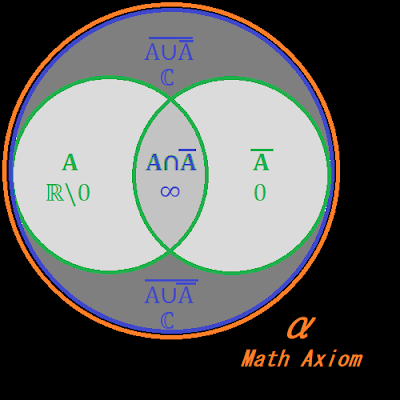
The alternative ethical principle explained by mathematical logic is as shown by the venn diagramme above. This is essentially same as the one shown in the chapter 1, and this one explains about it with more details.

In the formula of this mathematical logic, any A (A1 and A2) denotes what exists, or what we can observe and sense, in the reality, i.e. ∀A = ℝ\0, and A denotes non-existence i.e. A=0 (zero). As explained in the previous two chapters, both Locke and Kant claimed that there are more than A=ℝ\0 A=0, and there is the ideal which we have to aspire to make it possible outside what we can observe in the reality.


Unlike John Locke's world view, this principle separates the imaginable world from the substantial world. This regards that the imaginable world is created of the knowledge gained from the substantial world and the records of the imaginary world such as books, pictures, and music.

These sets of knowledge are denoted as Ai where i∋(1,2,...,r). Then the combination of knowledge can be denoted as the interaction of A1 and A2 i.e A1 ∩ A2, and the union of A1 and A2 i.e. A1 ∪ A2. Then, these combination may create A1 ∪ ( A1 ∩ A2 ) and ( A1 ∩ A2 ) ∪ A2, and then it may create the furthermore sophisticated idea of A1 ∩ A2 to create an alternative new idea of A e.g. A'.

In order to make this newly designed idea, obtained from this logical inference process, possible in the substantial world, then this process has to be put into practice by scientifically experimenting, constructing as an architecture or an artifact, implementing as policy in practice, drawing/painting on a campus board, or playing with musical instruments.

In this process, there are several possibilities that the imagined thoughts cannot be put into practice, or there can be an unexpected incidence to obtain the new knowledge during the attempt of this practical experiment.

A1 and A2 cannot be compatible i.e. A1 ∩ A2 cannot exist in the substantial world.

A2 may simply imply A1 i.e. A1 ∩ A2 = A2 itself.

Suppose there is a case that A1 and A2 can be combined i.e. ∃ A1 ∪ A2, but it is not known how the part A1 ∩ A2 looks like. When both A1 and A2 are experimented to be combined i.e. showing A1 ∪ A2 in the substantial world, then A1 ∩ A2 might accidentally come up as a distinctive form of the substance.

When A1 ∪ A2 was wanted to be created, and the imagination showed that something like A1 ∩ A2 was required to create A1 ∪ A2, but nobody had not yet found what A1 ∩ A2 exactly was. Then, the inventor started looking for a substance which would work as A1 ∩ A2 the bond of A1 ∪ A2. Then, when the inventor finds out a substance which works as the bond A1 ∩ A2, then A1 ∪ A2 will become to be the real in the substantial world.

Therefore, the infinity, the phenomenon that any real number powered by zero becomes 1, and the complex number exists in the mathematical world, one of the imaginable world, but have not been proven in the substantial world.


The fundamental moral principle which Kant and those who are influenced by him will restrict the new discoveries shown above.

Even though the consequence desired to be induced is denoted as A', but the process to discover A' from A1 and A2 such as A1 ∩ A2 and A1 ∪ A2 can be against the categorical imperative i.e. morally invalid.

The action of A1 ∪ A2 which induces A1 ∩ A2 can fulfill what the categorical imperative suggests i.e. the moral duty. But, the consequence which is naturally and unintentionally induced from combining A1 and A2 may eventually leads to some undesirable consequence. For example, suppose A' is an undesirable consequence, and a part of A1 ∩ A2. Even though A1 ∪ A2 fulfills the categorical imperative, the result from creating A1 ∩ A2 from this action may induce the outcome A' which is the element of A1 ∩ A2.


4.6 The counter-Revolutionary Ethical Principle and Legal Positivism

Legal Positivism is different from Logical Positivism. Both philosophies follow positive/objective statements. E.g. When the combination of A1 and A2 holds, then A’ “does exist” / “will exist”. The difference between them is that their principle of their logic.

As explained in the last Chapter (Ch3), the logical positivism regards that there is an absolute universal principle which verifies the validity of our actions and thoughts, and it often refers to some natural scientific factor like the brain cell function as the root cause of the motivation of actions and thoughts. Also, the logical positivism claims that believing our own cause, and described that having our own unique cause, belief, reason, and ideology are pathetic because it describes senses as merely biological functions and/or illusions.

By contrast, Legal Positivism provides more freedom of choices and will in its logics by detaching its logics from the absolute universal moral principle. This ethics regards of its principle is what individuals select as an objective measurement to determine their actions and future plans, and this may vary across different time periods, places, and occasions. The objective principle can be maximising the utility of them (their greatest sum of pleasures minus their lowest sum of pains), their own cultural norm and value, and their sense of beauty and sublime. They are free to choose their own principle owing to their want and their surrounding situation as long as they are ready to bear their responsibility to face the consequence induced by their action. The feasibility of choosing their action and future plan will be determined by competition, negotiation, and trade. So, it allows ethics to be more flexible while it still remains its discretional logics like shown in the Venn diagram shown above.

On the other hand, the statements Locke, Kant and those who are influenced by them frequently use are very normative E.g. A’ must/ought to be achieved so that A1 and A2 should be combined. (Then, categorising Locke, Kant and those who are influenced by them as the Normativists here) In addition, these Normativists would accuse the way Legal Positivists define their principle because it is hypothetical i.e. morally invalid. But, the valid universal principle which they would admit to verify seems to require a sizably long term to achieve in where it may face various unexpected obstacles externally affecting humans’ mind on the process of achieving it.

If the process to induce A’ is not found, then they may need to spend tremendously long time, huge amount of resources, and enormous efforts to convince the others. If combining A1 and A2 is sure to induce A’, then, if the combination of A1 and A2 does not fulfil what their moral principle, they suffer from the severe dilemma of choosing their action and plan. Furthermore, even though the combination of A1 and A2 fulfils the moral principle and is predicted to induce A’, because A’ is something rarefied as much as these Nomativists aspire to accomplish in, there is a proportionally high possibility that the process of heading toward A’ diverts from the initial goal of A’ due to its sizably costly process and/or some unexpected obstacles.


The legal positivism suggests the process of pursing the objectives has to be prudential enough to maintain the aim to be clear and achievable, avoid diversion from the objective, and refrain from wasting time, resource, and efforts of clinging to the ideal morality of the actions and the plans unlike the abstract costly rarefied universal moral principle. In a liberal democratic civilisation, the flexibility of the Legal Positivist ethical principle prevails to deserve citizens there because they are open to negotiate to whether preserve or modify their law by means of their favour. The objective of citizens has to be providing them with liberty and life security, and the law is simply a tool to achieve in this objective purpose.

Nevertheless, when the law becomes rigid in the long term as the Normativists want rather than the tool flexibly changing over time, place and occasion, citizens may have to sacrifice a substantially high degree of freedom in exchange for accomplishing what the universal moral principle demands for. Then, the law will turn to become the bodiless authority which preaches over citizens to conduct how their life style to be and command their economy to be morally right rather than traded freely with a prudential fiscal policy. Therefore, even in a liberal democratic civilisation, the rigid universal morality seems to reincarnate an autocracy in the system.

Even a vile oppressive dictatorship, if this regime wishes for its long stable regime, needs to preserve the consistent legal codes which secure the stability of the order. Also, it is extremely costly to keep pointing sword or gun at the masses back i.e. fearing them with violence to enforce them to obey all the time. So, this regime needs to provide their obedient masses with pleasures and the life security in exchange for their obedience. Then, both the oppressive legal code and the rule of the trade between the dictator and the obedient masses should be clear, easy to understand, prudential, and achievable. When the measurement of their trade agreement is hypothetical as the legal positivism suggests i.e. detaching legality from morality in this case, there tends to be a limit on fulfilling the desire of both powerful and powerless parties. The powerful members’ hypothetical desire faces its limit of increasing when the marginal utility gained from its privilege is maximised. This oppressive regime needs to secure the utility of powerless members at least to let them survive and to maintain their obedience.

When a vile oppressive dictatorship adapts the moral universalist principle like the Normativists introduced in this essay, the dictator will use the good moral objective as her/his false promise to manipulate the obedient masses. The desires detached from morality such as handling corruption exchange for seeking pleasure and creating unfair rules deserving only a particular cohort of her/his peers, have a limit to satisfy their desire, and visible for the masses to observe even enough to become able to question their authority if the exploitation becomes excessively harsh. By contrast, when a morality is attached on this regime, because the oppressive dictator is the leader of this political system, when the masses think of their belonging political system as divine (moral-oriented), they may start obeying their oppressive leader not only as a leader of their divine state but also as a guardian of its divinity itself under a misapprehension. Then, the dictator takes an action or plan for the future can be taken under the name of morality, and then the excess power usage will be hidden under the curtain of morality.


The legal positivism tends to be considered as the base logic of the civil law (The Roman Law). Because the Civil Law is the “code-base” law, the law makers apply their positivist logics to constructing the consistent law codes of the Civil Law, and then their statements written in the law have to be positive; not normative.

The philosophy of Legal Positivism was also developed by British philosophers such as Hobbes, Bentham, and Austin in 18th and 19th century in order to create the new principle of the moral and legislation in Great Britain. In the contemporary Britain, these progressive philosophers attempted to create the new political movement to detach British legal system from the dominance of morality and traditionalism. The moral code was too abstract and superstitious to calculate the level of rewards and punishment which is equitable to what individuals have provided themselves and the others with. They expected the judgments to become able to focus more on the future rather than sticking to referring to the past cases. Therefore, they invented the new progressive legal philosophy which adapted the hypothetical but objective measurements of judgements to the legal system. This reform has enabled the justice to provide individuals with the equitable exchanges of trades and legal sanctions. Also, their invention of various forms of the algebra in this system has enabled individuals to calculate their cost and benefit in the time serious which forecasts their expected future outcomes i.e. the consequence of their actions and thoughts.

Saturday, July 20, 2013

Ethical Principles explained by Mathematical Logic Pt3


3. Deontology = Human Right, Socialism, and Nihilism

In late 18th century, the most influential but extremely controversial ethical principle was invented by a very eccentric philosopher called Immanuel Kant. He had learnt from the ethical principle of John Loch which claimed that the ethical imagination is dynamic and goes beyond the reality of our currently living world. Then he developed and expanded the ethical principle further deeper and more complex.

He tried to detach ethics from natural science, economics (Social Science), and any popular philosophies (Kant called all ethics theories having existed before his "the pure philosophy" which merely exist to deserve what people and/or an powerful moral entrepreneur seek to fulfil their desire) in order to establish one legitimate philosophy called the "Pure Ethics" which truly contributes our humans' well-being. Kant claimed that there shall be something equivalent to the mathematical axiom for ethics which can objectively determines the validity of logical inferences in ethical theories and the righteousness of humans' action in our daily life. In order to judge whether these inferences and our actions are ethically valid or invalid, ethics needs an axiom which can self contradict these inferences.

Kant attempted to create this fundamental principle which judges the validity of our knowledge, action, and logical inference, and then our world really is. He called it the Categorical Imperative which insists that there is always something we must or at least ought to do regardless of what our experience tells, what logic implies, how we are pleased and pained, what the others want, and how the reality shows and treats us. He affirmed that the Categorical Imperative shall exist as the ethical fundamental principle which leads each of us and our world to be the truly virtuous. Furthermore, this principle is an objective measurement which aids us to discover and draw the image various unknown truth of our world and the cosmos. Then, according to this newly invented ethical principle, our own knowledge can be biased, the cause of our actions is merely hypothetical, i.e. not categorical, which means ethically nonsense, logic is a useless tool, and the reality of our world we are currently living can be merely an illusion or against how the world should really be.

First of all, Kant was sceptical about knowledge itself. The knowledge gained from experiences can be easily based by each human-being's own subjective interpretation of the experience. The only objective knowledge of any experience is the immediate memory at a moment. Nonetheless, this memory soon becomes modified by our own subjective prejudice after a few second passes.

The feeling of fear induces human-beings to believe in a superstition whose existence cannot be objectively proven by the fundamentals of physical/natural existences such as vertical axis, horizontal axis, altitude, and time. Kant strongly denied the existence of God in the physical world because God cannot exist in the formula based on these fundamentals of the natural world. John Locke put emphasis on the possibility of existence because the notion of distance and power is infinite so that God cannot be simply discovered in the natural world. By contrast, Kant completely separated the imaginable figure cannot be possible if it is deviated from the axiom. The infinity exists in the mathematical formula but not in the natural world.

Wisdom and history tend to be taught by those who have the power to indoctrinate the others with by means of their own favour. Before this understanding became popular, majority of people believed that the formation of governance and the history of nations were naturally created, and they were naturally born to participate in the function of these social structures differently owing to their innate ability, blood relation, and ambition. Nevertheless, since knowing the knowledge about history can be biased, these histories of social structure can be also hypothetically constructed by means of an interest of the few powerful minorities such as monarchies, moral entrepreneurs such as religions, and lack of knowing the true duty we all human-beings must or at least ought to accomplish.

Natural Sciences are utterly subjective even though majority of natural scientists claim it to be objective. These natural scientists persist that their discovery and their invention are derived from their scientific experiment. However, in the most of cases, the fact is that their scientific experiment is derived from their discovery, and their invention tends to be created from an accident. These scientists also deny the existence of some new discovery when it does not fit in with what their theory claims it to be. They often failed to invent a new practical thing or theory whenever they attempt to innovate a new technology by following their supporting scientific theories. What are introduced as their new inventions are only a few of those which are accidentally found to be able to use practically. Although, these scientists may say their perseverant efforts and their scientific knowledge induce them to achieve in discovery and technological innovation, they often encounter with their success when some accident, which can be called the miracle, happens. In addition, their knowledge is what they interpreted the phenomena of this natural world by means of their favour and fashion.

Kant was highly sceptical about logics itself which is used to infer something not known from either our experience or knowledge. The reason is that the formulas of logical inference are not based on something like a mathematical axiom which enables logic to objectively self-contradict itself. Therefore, there is nothing which can verify logic's validity, and then the reasoning derived from a logical inference is merely a hypothetical which is an ethically nonsense.

Kant explained that mathematics has been an only objective academic science because the axiom enables it to self contradict and verify its validity itself. The reason why mathematics is objective is that the axiom is a rigorous but very subjectively determined rule. This is the rule which mathematicians decide to use in order to create a truly objective science. Therefore, their strong intensive subjective will induces them to create an objective science like mathematics.

Kant aspired to establish the pure ethics as another objective science as mathematics. This fundamental principle of the pure ethics has to be intensively subjective as much as the axiom. As mathematicians agree to create a rigorous but intensively subjective rule to maintain mathematics as objective with their subjective will, he attempted to create a rigorous but intensively subjective fundamental principle. According to Kant's anticipation, this fundamental principle of the pure ethics should be able to objectively self-contradict our actions in our life and our knowledge about this world, and then verify their validity themselves by following this fundamental principle. He insisted that only the legitimate validity of the reasoning based on logical inference can be the fundamental principle of the pure ethics.


As expressed in the Venn diagram above, the validity of the existence of A (A=ℝ\0), no A (denoted A=0), (E.g. the infinity ( ∞ )), and (E.g. The complex number) depends merely on verification by the axiom denoted as " α " here. So, the validity of these existences can be only verified when α, the axiom, verifies. This principle regards that the reality, which we can see, imagine, and feel, in this world, is not necessarily always valid to be the truth as explained in the previous paragraphs. So, the reality (Our knowledge about) is not relevant to our reasoning for living. This implies that some impossibility or unimaginable things might be possible when the fundamental principle verify the validity of their possibility even though both observation and logic deny their possibility. An illusion might be truth and become an alternative reality meanwhile an reality we know can be an illusion and fake.


This theory is called as the Human-Right theory (Also called "Political-Liberalism" by John Rawls), and Kant is called as the father of Human-Right. As same as Natural-Right, Human-Right regards that all human-beings have the naturally endowed rights which should prevail for all humans under any circumstances. The difference between these theories of right is that Natural-Right regards providing people with right is conditional whereas Human-Right regards it must be unconditional. Regardless of the limitation of resource and technology available, there is an action we must do even though whatever the expected consequence turns up to be. Because this theory regards that any estimate based on either experience or logical inference is hypothetical which implies ethically nonsense according to this theory. It commands human-beings to follow what they must or at least ought to do whatever their given condition is in order to lead all human-beings together to accomplish in providing all of them with what the categorical imperative, the fundamental principle of this ethics theory, suggests.

Natural-Right suggests to offer an equality of opportunity and equal distribution of the basic necessities to the all. By contrast, this theory insists on providing some degree of equality in outcome distributed among all people. It regards that, in order to truly accomplish the equality of opportunity, it requires not only ensuring the equal distribution of basic necessities but also the collective responsibility among all people to conduct all people to be the good human-beings. It puts emphasis on ensuring the least fortunate member of the community of humans to avoid being impoverished and being wicked. Therefore, fortunate members of the entire human community must be obliged to contribute some proportion of their income and properties to the others, and there has to be a sufficiently big proportion of publicly shared properties among all people in this community.

Furthermore, this theory claims that the community of human-beings must have an universal moral duty to conduct all human-beings to be the morally right track of their life. Kant was also sceptical about the freedom of choice. He argued that the true freedom for human-beings shall be the freedom of living, and the freedom of choice restricts the true freedom. Because this theory regards that human-beings have to make their choice which the categorical imperative suggests to choose, and they may make a mistake of choosing the right pass, there always needs to be restriction on the hypothetical freedom in order to guide them to the true freedom. This moral error correction process should not forced to be done by a violence of moral entrepreneur; It has to be encouraged by the reason based on the fundamental principle of the pure ethics which is called the categorical imperative. An order by violence is against the categorical imperative because it allows human-beings to be cruel and vicious when any violent action is permitted.

This theory regards highly of the cultural and ethnic pluralism which admits that all of human-beings can keep their own unique life style following each different custom of their own culture. However, it insist on imposing an universal moral law on all humans and their communities in order to establish a harmony among all different kinds of humans and their different life styles. It suggests that this universal moral law has to be a moderator/guardian of their community so that it must be fair (By means of this theory implies) and neither religiously influenced nor based on one particular cultural standard. This universal law has to be secular because it has to be religiously and culturally intermediate. All in all, this pluralism is permitted to exist under one unified universal guardianship by the a secularist law enforcement agent. Meanwhile Kant denied the existence of God and condemned religious teachings, he seemed to have established one God-less monotheism and the moral teaching which is a resemblance to Christian moral teaching. This characteristics has attracted many individuals who were disappointed by Christianity for some reason, and provided them with an alternative belief which is different from Christianity but whose characteristics is similar to Christianity.


Kant only hoped that human-beings can only achieve in aspiring to keep acting according to what the categorical imperative implies to. Nevertheless, he did not expect that they can always follow what the categorical imperative suggests them because human-beings are not perfectly rational, and their surrounding environment often spontaneously affects the situation to be difficult for accomplishing in their rational action.

Georg Wilhelm Friedrich Hegel modified Kantian theory to be a furthermore idealistic and a progressivist ideology. Meanwhile Kant did not expect humans and their world to be perfectly rationally oriented by perfectly following what the categorical imperative suggests, Hegel assumed that humans can gradually become able to accomplish in establishing what the categorical imperative suggests. Hegel applied his believing Luther Christianity, the Nordic Liberal Christian, to his own ethical theories hinted from Kantian philosophy. Unlike Kant's atheist view, Hegel indicated that the fundamental principle which Kant taught was actually the way God expects humans to be. So, he explained that, as the development of humans themselves and their world progresses, they gradually become evolved to what God expect them to be, and their world becomes more likely to be the heaven i.e. the utopia. Karl Marx interpreted Hegelian philosophy and historical view, and he invented his own political philosophy claiming that socialism is the necessary step to the utopia.


There is another big stream of Kant's influence which is totally different from Hegelian perspective but based on Kant's principle. These philosophies are different from Kantian perspectives but they are heavily influenced by Kantian philosophical principle.

Pragmatism took over the perspective which regards that there should be an axiom verifying the validity of both knowledge from experiences and answers induced from logical inferences, and justifying the righteousness of any decision making. However, it focuses on a much shorter perspective than Kant's and Hegel's philosophy. Kant and Hegel believed that there shall be a universal principle which prevails at any times, in any place, and on any occasion. By contrast, Pragmatism only regards that there are various different principles across different times, places, and occasions. It attempted to create a practical philosophy which combines both the idealistic philosophical rationale and the natural scientific analysis which Kant described as hypothetical. For example, Mount Everest is considered to be high and big by means of earth geological view whilst it is considered to be short and small by means of astrological view. So, how things are measured varies across a different fundamental applied to any measurement. Pragmatism approves a hypothetical decision making process as long as a fundamental principle basing this decision making process verifies it. Pragmatist ethical principle has encouraged a specialisation of academic subjects since it became influential. Before its influence, academics studied various different subjects and dissolved sets of the knowledge into their own philosophical theory which was used for reasoning their own cause and belief in their life. Nevertheless, since both Kantian philosophy, and then Pragmatism, started influencing over the world, the reasoning process of our own cause and belief in our life has started being seen as nonsense, and majority of academics have no longer pursued their own cause nor created their own unique philosophy. Since then, majority of academics have specialised in studying one particular subject by following the principle given from their chosen academic. The fundamental principle for each subject is determined by an academic peer group, and it has become taboo to deviate from this already created principle verified by this peer-assessment.

There is a philosophical theory, called Logical-Positivism, which deeply regards highly of natural science and a hypothetical decision making process. It is yet under a strong influence from Kant who was sceptical about natural science and condemned a hypothetical decision making process. The common perspective between Kantian philosophy and Logical-Positivism is the perspective regarding that there is an absolute universal principle which verifies the validity of experience, knowledge, and logical inference, and determines the righteousness of any justification and decision making process. Logical-Positivism also copied the idea of denying not only the existence of God but also believing our own cause, and described that having our own unique cause, belief, reason, and ideology as pathetic. This philosophy describes senses as merely biological functions and/or illusions. So, owing to this philosophical perspective, knowledge from experiences and inference, feeling, and sense of reasoning and belief have to be examined by a scientific experiment and theory in order to verify their validity.


This caused individuals to become apathetic to hold their own cause and reason, and then nihilism has spread as epidemic since then. I rather follow Aristotle's perspective which regards that we constantly suffer from ignorance, and then we have never known the absolute truth or principle. Kant and all those influenced by him started arguing that ignorance is sin, and there shall be a measurement which leads us to know the absolute truth. The converse effect of these previously mentioned philosophical theories of pursuing the absolute truth has created Nihilism which regards both the truth and the reality are nonsense because these people are simply taught to think there is only one absolute reality = truth. But, they become too tired of pursing it, and then become apathetic about pursing it even though they still remain the existence of an abstract image of the absolute truth in their mind. Furthermore, they are also already too castrated to have a pride to create and emphasise on their own interpretation of the reality. Then, they have eventually run away to the illusion.


All in all, those who are influenced by Kant always say "But, that's not true", and treating anything challenging the mainstream perspective as deviants.


Saturday, June 22, 2013

Ethical Principles explained by Mathematical Logic Pt2


2. Natural Right:

This mathematical logical foundation invented by Aristotle had been a dominant ethical principle of the Western philosophy as well as the law principle of Catholic church. Nevertheless, in 17th century, a historically remarkable philosophical rebellion against Aristotlean ethical principle which had dominated for approximately 2 millenniums (2,000 years)! John Locke, a physicist as well as the father of Liberalism, challenged against Aristotle's foundation of ethics.

The name of this most remarkable rebellious philosopher is John Locke who was mathematician and physician as well as an ethical philosopher. He pointed out that our living world is composed of not only all what are already existing (A=ℝ\0) and nothing (A=0) but also something not discovered yet.

He criticised that the perspective of Antiquity only regards of the physical substances already discovered in this natural world and then ignores both those which have not yet discovered and those which can be invented. For instance, Schliemann was motivated to discover the ruins of Troy by assuming that Troy was not purely a mythological city and so existed in real.

Furthermore, from his physician's perspective, he argued that engineers and scientists often try to invent something they want it to exist but does not really exist yet. At this process, they always have an imagination of what they wish to invent. Therefore, without any imagination of something which have not existed, any new invention will not be created. For instance, when we wished if we could have an instant verbal communication with people living in the place which is several miles away from where we live, the motivation to create an international telecommunication tool was born, and then this wish became true.

Of course, the new innovation will be created as long as it is possible to exist in the reality of this natural world. So, the resources and the tools, these inventors can use to use the new substance which has never existed, must be the physical substances which are existing. But, without their imagination of something which has never existed, their motivation to discover and invent cannot exist. All in all, Locke insisted that it is essential to have an imagination of anything unreal and mythological which we wish if it can exist. But, he also claimed that this desired discovery or invention will become to really exist in this natural world as long as the already existing resources and tools are used and the law of nature allows it to exist.

John Locke was also famous as a progressive Christian. He challenged against the scholar philosophy of Catholicism as well as tried to conserve teachings of the holy bible. He insisted that stories written on the bible are unreal and superstitious, but they are important to remember them as the source of our imagination. He also argued that some of the moral teachings in the bible might not be helpful and should be amended or even ignored, but these teachings have provided us with the chance to think and discuss about these issues. For example, sex outside marriage is considered as sin by means of the original bible teaching meanwhile it is largely tolerated and even encouraged in the current world. Without this bible's teaching, human-beings would even not have think and discuss about the morality concerning sexual acts. In various savage cultures where the holy bible was not introduced to the inhabitants there, these inhabitants passively commit their sexual acts without considering about the meaning of their sexual acts.

This ethical principle can be explained as shown in the graph below:


When A exists, there is A. In the logical analysis, as there are A and A, the interaction of A and A which is denoted as . Furthermore, the existence of neither A nor A which is denoted as may exist.

When the knowledge of the world is limited to only the surface of the earth, the longest distance possible to know is limited within the earth. But, when the existence of both the outer space and the cosmos is discovered, the longest distance possible to know becomes way much longer. Furthermore, when people realise that the solar system is only the part of one galaxy and there are several galaxym, the longest distance they know become further longer. Then, it is imaginable to think that there can be a further longer distance which has yet not discovered, and it may become possible to discover by inventing a new technology to measure it. Therefore, the possibility of discovery is infinite, and the infinite length is imaginable as well as maybe possible to discover.

When the knowledge of the world is limited what can be seen in an unaided eye, it is very difficult to imagine or even unimaginable to know what cannot be seen in an unaided vision. But, when the tool which enables to see very small things which can be measured by micrometre is invented, the shortest length possible to know and imagine become further shorter.

As we know that we know A=ℝ\0 and A=0 exist as true, we can infer the existence of the infinity. By means of mathematical axiom, any real number ( ℝ ) divided by zero ( 0 ) is the infinity ( ∞ ). This is inferred by the theorem that the number becomes bigger when it is dividing by smaller number. So, as we know that we know there is nothing ( 0 ) and a very long length may be possible to exist, the existence of the infinity is imaginable, and then it is plausible to denote that the infinity might exist in real. All in all, the infinity should be denoted as , the interaction between A and A.

As we know that A x A = A2, the square root of A2 is A. So, the square root of + (positive) A ( √A , √+A ) exists. In mathematics, there is the number called "Complex Number" which is the root of a negative real number i.e. √-A. The complex number is neither A nor A, but still composed of A and A. So, it should be denoted as .

By means of mathematical axiom, the complex number is definable, and imaginable to create the formula. However, it is very difficult to imagine and draw a picture of its existence, and it is unimaginable to figure out how it exists in our real world. So, the complex number only existed in mathematics, and there was no physical substance really existing in this natural world.

The complex number has become to be used to draw computer graphics shown on the screen, and the mathematical model indicating the wave of earth quake. The computer graphics, the technicians frequently use the complex number as a part of their mathematical formulas creating their complicated computer graphics. In order to show the graph of the complicated movement such as the waves of earth quake, it requires a unique formula composed of the complex number to model this trend. All in all, the complex number enables to draw the computer graphics showing a virtual world more real like this natural world than it used to be able to show, and then draw the mathematical models showing the trend of the scientific observations which are complicated to describe.


John Locke applied this principle to his ethics in order to claim that we should aspire to establish a fairer, more equal, and peaceful world which is imaginable as well as practically possible establish. The utopia may be impossible to become true in our natural world due to the limitation of natural resources and knowledge available for us in this natural world, and the barrier by the law of nature. However, he suggested that we should keep an utopia as our ideal world we wish if we could create. He admitted that we constantly suffer from the dilemma between what is available and what is wanted. But, he strongly insisted that we must always attempt to invent the new methodology of establishing a more ideal world than how the current real world is by using the resources available which the law of nature permits to use.

The idea of Natural Right was born of this theory. Natural Right regards that all human-beings have the naturally endowed rights which should prevail for all humans under any circumstances. It claims that the very basic right which can be protected even within a very limited availability of resources and technology must be provided for all civic individuals who can cohabit together under a consensus of social contract among them. During the time when the fathers of Natural Right, most notably John Locke and Thomas Paine, these rights for civic individuals were the equality of opportunity, freedom of choice within the limit of availability, and property right, must be provided to all human-beings. As the time passes and available technologies become more advanced, the categories of which were claimed to be considered as the natural rights increased.

There are two mainstreams of Natural Law ethical theory. The one regards of the freedom of choice and protecting the private property right as the fundamental Natural Right, and claim for a very small size or even none of government, state's authority, and any form of public sector intervention to individuals' choice and life style. Another supports for an optimum size of government, state's authority, and any form of public sector, and their intervention to individuals' private life in order to support them living well at the best possibility, and preserving the public property as well as, or even more than. the private property right. The former became the principle of Libertarianism, and the latter became the principle of Modern-Liberalism.


Sunday, May 26, 2013

Ethical Principles explained by Mathematical Logic Pt1

The mathematical logic of the Western ethical principle

1. Birth of the the Western ethical principle and its mathematical logic

1. 1. Introductory to the Western ethical principle:

This chapter explains how political philosophers (Ethical theorists) have developed their ethical theory by means of mathematical logic. There are many academic writers who have described the characteristics of these theories and difference among them. However, there are not so many academic writers who have explicitly explained by means of an explicit mathematical formula. It is critically essential to mention the fundamental principle, such as their world view, basing their ethical theories. These western philosophies are very logically constructed like a mathematical formula, and there is always a sort of mathematical axiom basing their theories.

The axiom in philosophical logic is their fundamental principle which can be called their metaphysics or their world view. These Western philosophers, except majority of Postmodernists, always attempt to create their theories to be rationally constructed and objectively explaining human-characteristics and the world as though they were mathematical formulas. The mathematical formula requires an mathematical axiom in order to keep their theory consistent and being able to objectively self-contradict itself. Therefore, these Western philosophies mentioned over here also require something equivalent to the mathematical axiom.

Almost all academic writers who have written about this staff have already known this mechanism of these Western philosophical theories. But, they tend to need to write one book to explain about it. Perhaps, this is because there are not so many individuals who studied both social science and mathematics simultaneously. Only how majority of them demonstrate their knowledge is explaining with words like writing one literature. Therefore, majority of these books tend to consume a lot of pages with a huge volume of words in order to describe these characteristics and their differences.

This project attempts to explain what axiom, i.e. their world view, they had used to set their formulas within one chapter of one book. By referring to how these formulas were set up, it also explains how the theories created later were developed from the theories having existed earlier.


1.2. Birth of the first Western ethical principle:

During the antiquity, the foundation of Western philosophies was born. When Socrates started thinking about what we actually know about ourselves and our world, ethics was established. Before Socrates came into this world, knowledge about truth and social justice were not considered to be an important to think about. At this time, people hardly questioned about biased knowledge and justice existed to deserve for those who were only physically strong, wealthy, and/or good at using rhetoric to intrigue others. Socrates provoked a spiritual revolution against the world without a righteous justice! Socrates then introduced the idea of pursuing knowledge of truth, having cause and reason which make human-beings virtuous, and obtaining the skill to analyse how our physical world and our spirituality (Soul) are formed. This Socrates' contribution was the most significant event to start developing the Western philosophies such as ethics.

Plato took over the works of Socrates, his master, to develop Socrates' philosophy further. Plato succeeded in transforming Socrates' philosophy to the philosophy which provides a strong guidance for us, human-beings. His philosophy was a revolutionary concept which enabled we, human-beings, to think about how our world is formed and how we should seek to become in order to enjoy happy life. Of course, it is still debated to discuss what the way to enjoy happy life is. But, Plato was the first pioneer who started thinking about it, and attempting to discover the universally absolute way. This is the beginning of the Western ethics.

At this time period, Plato provided a method to analyse what the reality and how the reality should be. The way Plato thought of the world was dichotomic unlike the Eastern philosophies. This method succeeded in explicitly distinguishing between something existing and something not existing in reality as well as between real or unreal. For instance, when there is a substance called A, there are A and not A in reality. This can be considered as a very simple idea nowadays. But, at the ancient time period, this was a very revolutionary concept which has enabled an individual to contradict those who say "not A" as A. It also evolved individuals to start thinking what and why A really is and how A ought to be. There is a famous quite of Plato which is "If government is not how government ought to be, this is not a government". This quote helps us to understand why he put emphasis on what is, or supposed to be, A, and what is not, or suppose not to be, A. Furthermore, Plato provided us with our strong objective to live, which has spiritually strengthened us, human-beings, since then.


1.3. The mathematical logic of the Antiquity:


Aristotle, the most famous student of Plato, developed Plato's philosophy to create a furthermore systematic theorem. Aristotle's philosophy focuses more on the consistency than Plato's counterpart, and introduced an algebraic way of philosophical analysis into the Western ethics. Unlike Plato who argued about whether or not an A is really an A, Aristotle rigorously stated that when a substance A exists as A, this is how A naturally is.

For example, meanwhile Plato believed there is one universally absolute form of how government should be, Aristotle thought that each form of government has its own advantage and disadvantage. Plato claimed that there is one ideal perfect government. By contrast, Aristotle argued that there will not be any perfectly ideal government, and there are only various different optimum choices of forming government at different time periods, regions, and occasions. Thus, when a government consequently resulted in how this government now is, this is an inevitable outcome to become like it under the given circumstances.

Aristotle was also known as a mathematician who created a very discrete (clear cut) logic which leads us to clearly understand and explicitly analyse things in our world. E.g. When only A exists, there are only the component composed of A, A itself, and no A. He tried to prevent any confusing abstract concepts in order to offer clear, consistent, and imaginable analyses. He distinguished between pure mathematics studied in academia and applied mathematics frequently used in our daily life. He had already understood that the imagination and the mathematical estimation are detached from our real world. Even Plato said that the mathematical estimation is merely a tool to lead us to the idea and not quite related to our real world. Thus, if we can neither measure the infinity and complex numbers by a physical tool nor discover the real existence of infinity and complex numbers as a physical form in reality, that both the infinity and complex numbers cannot exist. So, in reality where we human-beings live, there are only A=ℝ\0 (A is any real number except for zero) and so A=0.

Since this ethical principle was formed, it has become a logical foundation of the law from the antiquity to the Renaissance and the mainstream economics. Both the law and the economics attempt to solve problems in our daily life within the limit we are facing in reality. When there is an A supplied, then the demand available for an A is an A or zero. When there is no A supplied, but there is the demand for an A, then we may eventually incur the debt to pay back for -A (Negative A). Otherwise, both the demand and the supply remain to be zero i.e. not A. When a case contains the element of A, then A implies to this case so that this cause is A. Otherwise, this cause is not A. In terms of Civil Law, an A varies across time, place, and occasion. This condition of Civil Law is determined by means of the normative in culture and law makers' interests under a prudent measure. In terms of Natural Law, an A changes overtime but always remains in our world universally regardless of different time, place, and occasion. The condition of Natural Law is determined by referring to this unremovable condition such as a universally existing fundamental morality and principle, which is frequently referred to making laws.