
Thursday, October 16, 2014


Wednesday, October 15, 2014
Political Compass Revised The Comparison between the Old and the New, Left and Right wing --- Part 1

1. The Critique of the Original Political Compass
The original political compass based on the Left/Right (Collectivism/Capitalism) axis of the economic and the Authoritarian/Libertarian axis succeeds in explaining about the complex characteristics of political ideologies which are not enough to be explained by the single linear political spectrum. Nevertheless, this political compass analysis seems to over-simplify the philosophical backgrounds of these political theories. Firstly, it easily equalise Authoritarian to Theocracy, and Secularism to Libertarian. Secondly, it lacks differentiating between the teleological focus (consequence first) and the deontological focus (Duty/Will first). Overall, this cannot distinguish the philosophical intention, the rationality behind determining the degree of intervention.
First of all, this neglects considering about the necessary law enforcement whose principle is rational enough to be fair, and about the critical difference between chaos and self-governance. Many political philosophers affirm that, in order to secure liberty for individual citizens, the rule by law and its enforcement are essential. For instance, Montesquieu argued that liberty and equality require significance of law. The original political compass seems to mix up the rule by law with the law by rule.
Secondly, this original compass equalises the theocratic regimes to the authoritarian left. It can be easily imagined that these two camps, the secular authoritarian left and the theocratic authoritarian left, would strongly condemn its labelling based on this compass. Even though both Authoritarian-Leftists are anti-capitalism and highly authoritarian, their philosophical principle is completely opposite to each other.
Thirdly, the original political puts an excessive emphasis on distinguishing their policy practice and ideal, which majority of the New Left-wing nowadays believe in, from the state socialism imposed by the socialist nations under various Communist party regimes. Nonetheless, even though their external characteristics is different, their quality is still essentially identical to each other in both good and bad way. Both are fundamentalistic secular as though it were a fundamentalist monotheism without God, and supporting revolutionary subversion of the world. Only the difference is their process and the tools they apply to their aim.
2. How the Revised Political Compass is Revised
The revised compass presented here takes account of both the consequence they aspire to induce and the duty they are obliged to. Unlike the original political compass, the axis introduced does not mention about the scale of intervention by either government or any other autocratic institute such as a feudal lord, religious organisation, or private corporation into both economic and social schemes. By contrast, this revised compass based on these axes representing political thinkers’ action planning and mind principle enables to analyse how the intervention is applied more or less by means of their philosophical objective.
The horizontal axis represents political thinkers’ mind principle basing their action planning. It measures how the principle individuals’ actions and mind are base on. The bottom scale indicates the principle which individuals pursue in by means of their subjective wish, emotional attachment, and fear of the others. Those who obey this principle follow what individuals are taught or commanded to believe or what is wished to become true in real. The top scale indicates the principle guided by the objective realities such as resource limitation in the substantial world, the market mechanism, and mathematical and scientific factors. Those who understand this principle use analyses based on logical inference to determine their decisions and establish their rule.
3. How the 4 Category groups are characterised on this compass
- Old Right-wing
When the technological development and the civility of individuals are at the primitive level, politics tends to be a primitive form as the simplicity, more than the complexity, prevails to satisfy their needs and wants. These individuals living there are often under the constant threat of harsh disasters, fatal endemic diseases and persistent lethal assaults by neighbouring tribes. They have little methods to protect themselves from these threats because technology and civility of individuals living in this kind of world are significantly insufficient enough to prevent these threats. Then, their mind tends to dominated by fear, and their priority is to prevent their haunting fear. Furthermore, such a situation is less likely to enable individuals to form their rational mind set and voluntarily fairly compete and cooperate together. Therefore, the first political priority is establishing a strong cohesion bundling individuals to one community group.
In this case, resource distribution is too limited to distribute equally among all individuals, and there tends to be little technology and wisdom to develop their rationality encouraging fairness. So, the wealth and the opportunity are inevitably unequally as well as unfairly, and majority individuals tend to take their situation for granted. Under the substantially low resource and technology level, this unequal distribution prevented from a competition is an effective way to concentrate all the resources available to one authorised institute to use them for sustaining one strong figurehead charisma and mature the cultural standard within one family or religious organisational structure. In such a world, majority subordinates obey and unconditionally contribute to their powerful minority such as feudal lords and religious authorities because of the majestic charisma as an authority figure of their belonging community. These individuals strictly follow their retained tradition and worship a superstition which they are emotionally attached to. They feel secured under an umbrella of one cohesive community even with a sacrifice of their material well-beings and their individual rights.
... continue reading:
Monday, June 16, 2014
The Western ethics, Asian Life, Japan, and Libertarianism: Part 3
8. Concern on the interventionists’ view on the free market economy
Without a doubt, the free market economy is the most productive form of economy. The free market economy promotes individuals’ free voluntary will motivating them to do what they are the best at doing and/or they desire to do. It also allows individuals to freely trade their goods and services so that they offer the best possible rewards for their best possible efforts and merits put into practice. Therefore, this economy naturally encourages individual humans to provide their best possible commitments increasing the aggregate productivity without any artificial forcible enforcement.
The majority of nations nowadays have partially adopted the free market economy to their national economy to a certain degree because they have realised its previously mentioned huge benefits especially since the fall of the command economy in the socialist collectivist nations. The USSR-style socialist/collectivist economy, the big historic experiment using several national economies themselves, failed. Then, this historic event has proven that the command economy is materially and ethically failure.
Some of these nations experienced in the radical political transformation in which their mainstream political regime was replaced by another. The other nations sustained the regime of their status quo by simply replacing their command economy with the mixed economy. Only Cuba and North Korea are the nations remaining their staunch command economy. But, North Korea is still suffering from crucial despairs such as famine, high mortality, and considerably low standard of cultural living. Cuba has gradually been adapting the market economy so that her economy should be categorised more as the mixed economy nowadays.
The mixed economy, the blending of the command economy and the free market economy, seems to be the popular form of national economies nowadays. The reason why most of the all nations do not encourage the pure free market economy is the misguided scepticism created by Marxist and the self-proclaimed Keynesian economists. Even though there are critical theoretical failures and deluded judgements in their theories, their teachings were cogent enough to convince many people to believe as though they were true. The contemporarily popular Reactionism against the virtue ethics and individuals’ free voluntary will also reinforced the cogency of these theories.
Their scepticism is based on their prejudice about the world economic crisis in 1929. As mentioned in the previous chapter, both Marxists and the Keynesians disagree with the pure market economy. So, as soon as they observed the world economic crisis, they seriously thought that their predicted failure of the free market economy became true, and they were happy to observe that event. In addition, regardless of their diagnosis, their prescription was deluded as explained in the previous chapter. But, they thought that the crisis was just the opportunity to advertise their prescription to put it into practice in the real world. This is a typical repugnant personality of theoreticians explained by Lev Tolstoy in his novel War and Peace. These theoreticians expect to observe that the world encounters with troubles when the world does not follow their theory. Then, they take an advantage of this situation to promote their theory as the right salvation.
In 1929, the spirit of the free market economy was already deteriorated due to the epidemic influence of the previously mentioned Reactionism originated from Kantian philosophy and innovated by the other modern idealists and the nihilists. Even though the contemporary world still partially retained the free market economic structure, the free market economy was compromised under the decaying spirit of the virtue ethics and the free voluntary will. The other forms of economic policy do not necessarily require individual citizens’ voluntary participation into sustaining and developing their economy because their appointed authorities and specialists manage handling their economy and politics. By contrast, the free market economy requires individual citizens’ competence and commitment are unavoidable to sustain and develop economy further as well as stabilising their politics.
These interventionists, supporting the mixed economy, who are nihilistic about the free market economy blame the market structure of the pre-crisis period where the monopoly by few big enterprises prevailed. They argue that the reason why the contemporary Anglo-Saxon countries the USA and Great Britain experienced the crisis was due to their free market economy. They insist that the monopoly, causing the unequal distribution and the deprivation of majority citizens, naturally takes place in the free market economy in the pre-crisis world economy.
Nevertheless, this is totally a fallacy because no monopoly can be naturally created as long as individuals’ free voluntary will is largely permitted. When the monopoly dominated in the pre-crisis period, the free market had already being compromised since the state government in these Anglo-Saxon countries operated the protectionist policy preventing their enterprises from the world free market competition. This protectionism prevented their citizens from the opportunity to purchase the inexpensive products from abroad. Furthermore, the state governments’ recommendation for their favourite enterprises to do their public work projects caused the discrimination between suppliers in the domestic market. Even before the New Deal programme started, the government subsidy and the government assisted privilege for a certain social status existed to artificially prevent the new market entrants. All in all, the monopoly was artificially created by the government intervention in these countries at the pre-crisis periods.
In addition, these anti-free market interventionists tend to assume that all economic agents in any market participate into their economy with a passive attitude. They hardly realise that economic agents often become very proactive to influence their market situation. For example, they create their product advertisements to attract customers when they consider about newly entering into a particular market. The blockage of the information flow disrupting these new market entrants’ advertisement is not a free market mechanism. Therefore, when the market entrants struggles to enter the market, it can be because either their goods and services are not attractive to the potential customers or the market freedom is disrupted by the tyranny of authority or mobs.
These interventionists also excessively focus on the real market whereas they tend to neglect focusing on the capital/financial market mechanism in the free market economy. The investors are willing to invest to the assets whose future growth expectation is at least positive, and avoid concentrating on investing to the safety assets and the already high value assets. These assets’ value tends to have already reached at the significantly low marginal growth rate. By contrast, the asset value of some small and medium sized enterprises and the low value assets still have a potential to increase their value with a high marginal revenue of investment. So, even though some new entrants do not have their own saving enough to spend for their initial investment cost, the rich investors will be willing to invest to them as long as their business looks becoming prospering.
Regarding to the ethical issue about the monopoly, it is really questionable to categorise the monopoly as the cause of the stagnation. For example, the contemporary market share of the oil industry was significantly small that the monopoly of this market share was not significant to the market competition. Also, this industry required the big scale enough to diminish the marginal total variable costs so that the investment needed to be concentrated into one or few companies into this kind of industries. When several companies participate into to that kind of industries, the total cost per company will be high because their business scale is too small to diminish the marginal costs. Therefore, the monopoly by one or few can occasionally offer more reasonable prices than the competition by many.
Moreover, when the product price becomes high relative to income, this simply means that the demand exceeds the product supply capacity, which causes the price rise, and/or the excess supply of the unproductive labour force, which causes the income down fall. The excess demand and the unproductive labour supply are also related to the excess human population relative to the natural resource available. After the industrial revolution, the human population has been exponentially growing meanwhile the technological growth offering the high product supply has been only growing arithmetically. Since then, the labour supply has become more exceeding the product supply capacity. In the free market economy, individual citizens are allowed to bargain their wage in order to match their need and want as they are no longer enforced to participate into economic activities as slaves with the fixed wage. Only in the command economy, of either feudalism or socialism, the slave labour exists because they are commanded to work under the wage fixed by the tyranny.
The naiveness discouraging the self-esteem of individual humans prevents the liberalisation of both market structure and personal life style. Their false belief imprinted by both the modern idealism and the postmodern nihilism. The current compromised form of the world market and political economy remain to be stagnated. The haunting economic and communal stagnation is bad for not only the material wealth but also the mental/spiritual state. This stagnation induces people to suffer from boredom, which is the true root of all the evils (Kierkegaard, 1813), and the loss of their means of living which results in the anomie causing people committing suicide and many kinds of dysfunctional behaviour (Durkheim, 1897).
In order to expect the growth i.e. the progress whose level was seen in the ancient Greco-Roman civilisation and the early modern Western world, the following two conditions are needed. The world market needs to be more liberalised. The virtue ethics motivating individuals’ self-confidence in their free voluntary will needs to be reincarnated. Thus, the ethical counter-revolution against the mixed economy promoted by the interventionists, the materialistic nihilist against the free individualism, shall be held out.
9. Population: Rising British Industrialisation and Failing Japan
Thomas Malthus, the remarkable British classical economist, thus had warned of discouraging the excess population growth during his time period when Britain enjoyed their material prosperity in her post industrial revolution time periods. Socialists whinge how miserable deprivation the contemporary working class citizens were in then. However, their analysis to conclude as they whinge is very questionable and sound awfully superstitious.
The socialist mythology about the industrial revolution and the post industrial revolution world is simply a propaganda scripture. Pseudo-intellectuals and irrational mobs are frustrated due to their madness but want to believe they are suffering from a conspiracy plotted by some others. So, this socialist propaganda accusing the post industrialisation world is based on the conspiracy these mad people wish to believe in. Then, they have become socialists after being deluded by socialism i.e. the anti-industrialisation. This is also called the historical revisionism because these socialist revisionists revise the interpretation of the world history to translate into their favourable way of understanding. This is why their anti-industrialisation perspective contains plenty questionable stories and illogical superstitious fallacies.
The working class population was dramatically rising even at the level that Malthus warned of the excess population growth. The infant mortality dropped down due to the notable aggregate productivity after the industrial revolution. Human-beings in civilisation feel secured to reproduce when they are optimistic about future. It is the same rationale as the financial investment. These people at the contemporary time period were so optimistic about the future of their prospering nation that they were relieved enough to manipulate their population fast.
The poverty existed inevitably because of the previously mentioned population overgrowth in the contemporary Great Britain. Even in the prospering moment, the error such as an excess population growth relative to the production supply capacity so that there always needs some spontaneous error correction. The poverty inevitably takes place when the population becomes excess compared to the productivity capacity and the natural resource storage. Furthermore, the working class citizens tend to reproduce more than the middle and the upper class counterparts. The working class citizens tend to spend their energy and time for their sensual pleasure because their cultural standard is too low to pursue in the other forms of amusements. Therefore, the working class citizens were more likely to suffer from the poverty than the middle and the upper class counterparts. But, this problem would have eventually been solved by knowing they needed to correct their own error, the excess reproduction.
All the other negative interpretations about the industrialisation by socialist historical revisionists are misguided. In Great Britain, the rapid productivity growth stimulated by the market liberalisation and the philosophical enlightenment liberalising individual citizens’ mentality has improved the living standard for all British citizens. The sanitary condition was dramatically improved from the pre-industrialisation to the post-industrialisation. The literacy rate rose up due to the flexible information flow and the freedom of speech and competition in the free market economy. Despite the falling down working class wage, their real wage went up dramatically due to the average price decline caused by the aggregate productivity increase. The property right and its equal legal application to all the citizens, the fundamental complements of the market economy development, has been highly emphasised. So, all individuals in all the classes have been benefitted and enjoyed their freedom and autonomy.
The reverse case scenario has taken place in Japan after the economic bubble burst. Since the economic bubble burst in 1990s, Japanese population has been notably declining due to Japanese citizens’ pessimism about their future. This downfall has occurred due to the inevitable economic decline after the artificially stimulated economic growth in the post-WW2 era. Afterward, since this economic collapse only the remaining national debts and the loss in the future political direction have been left out, and all the other Asian nations’ productivity level were catching up with Japan. So, Japan has lost its initiative in the global economy and its uniqueness in Asia. Due to the lack of the virtue ethics and the individuality in Japan explained in the precious chapter, majority of Japanese have lost their own will to improve and enrich their life. All these aspects induced Japanese to feel a strong pessimism about their future.
The population decline itself is beneficial to a nation and individual citizens living there. Because Japanese life expectancy and health condition are high enough to be the world top level, the mortality rate is considerably low. Then, the birth rate should be rather restricted in order to avoid the excess population by comparison with the capacity of the natural resource reserve and the available technology. The negative aspect of the decreasing birth rate is that the working population is declining against the growing retirement population so that the tax contribution per capita of the workforce for looking after the retired elders has become painfully high. But, the low population implies less unemployment and more demand for the workforce. So, the average income per capita may rise unless the productivity goes down. Therefore, the population decline is not the cause of the fall of the productivity: The negative perspective about the expected future productivity growth decreases the motivation of reproduction. The productivity loss is fundamentally caused by the philosophical and political structural background.
The poverty in the current Japan takes place due to the dramatic fall down of the aggregate productivity whose speed is faster than the population decline. Japan used to maintain its noble ethics retained from the political transformation inspired by the Western legal philosophies and the Continental Confucianism in 19th century. This noble ethics has been the key engine to enable Japanese to become able to create their own objectives i.e. their life goals. But, as time passed, their competence of preserving this ethics became gradually deteriorated. Then, their aim to live something productive has been lost so that the power of their voluntary will is also lost out. Therefore, the nihilism has been spread among Japanese citizens, and their mental level has turned back to be primitive.
As long as a nation rely on the philosophically inconsistent mixed economy, the overall productivity capacity will be gradually ebbing. The voluntary will and the self-esteem of individuals are fundamentally necessary to enable them to be self-governable and self-sustainable to raise their own national economy themselves. In order to encourage the sustainable and active economic growth, each individual citizen must have their own voluntary will to create and follow their own clear objectives to achieve what they are good at. The currently ongoing ethical nihilism perpetuates the lack of strong mind growing their voluntary will. Unless Japan introduces a political economy encouraging Japanese self-governability based on a strong voluntary will, innovation and proactivity, the essential keys to stimulate their economy and their personal freedom, will stay stagnated.
The unavoidable problem of the whole Asia is that these Asian nations will inevitably import this harming characteristics of Japanese political economy when they imitate Japanese political economic model. Unfortunately, almost all Asian nations have adopted the Japanese style mixed economic model to their national economy, and the epidemic of the nihilism hindering the current Japanese political economy will gradually be spread.
Without a doubt, the free market economy is the most productive form of economy. The free market economy promotes individuals’ free voluntary will motivating them to do what they are the best at doing and/or they desire to do. It also allows individuals to freely trade their goods and services so that they offer the best possible rewards for their best possible efforts and merits put into practice. Therefore, this economy naturally encourages individual humans to provide their best possible commitments increasing the aggregate productivity without any artificial forcible enforcement.
The majority of nations nowadays have partially adopted the free market economy to their national economy to a certain degree because they have realised its previously mentioned huge benefits especially since the fall of the command economy in the socialist collectivist nations. The USSR-style socialist/collectivist economy, the big historic experiment using several national economies themselves, failed. Then, this historic event has proven that the command economy is materially and ethically failure.
Some of these nations experienced in the radical political transformation in which their mainstream political regime was replaced by another. The other nations sustained the regime of their status quo by simply replacing their command economy with the mixed economy. Only Cuba and North Korea are the nations remaining their staunch command economy. But, North Korea is still suffering from crucial despairs such as famine, high mortality, and considerably low standard of cultural living. Cuba has gradually been adapting the market economy so that her economy should be categorised more as the mixed economy nowadays.
The mixed economy, the blending of the command economy and the free market economy, seems to be the popular form of national economies nowadays. The reason why most of the all nations do not encourage the pure free market economy is the misguided scepticism created by Marxist and the self-proclaimed Keynesian economists. Even though there are critical theoretical failures and deluded judgements in their theories, their teachings were cogent enough to convince many people to believe as though they were true. The contemporarily popular Reactionism against the virtue ethics and individuals’ free voluntary will also reinforced the cogency of these theories.
Their scepticism is based on their prejudice about the world economic crisis in 1929. As mentioned in the previous chapter, both Marxists and the Keynesians disagree with the pure market economy. So, as soon as they observed the world economic crisis, they seriously thought that their predicted failure of the free market economy became true, and they were happy to observe that event. In addition, regardless of their diagnosis, their prescription was deluded as explained in the previous chapter. But, they thought that the crisis was just the opportunity to advertise their prescription to put it into practice in the real world. This is a typical repugnant personality of theoreticians explained by Lev Tolstoy in his novel War and Peace. These theoreticians expect to observe that the world encounters with troubles when the world does not follow their theory. Then, they take an advantage of this situation to promote their theory as the right salvation.
In 1929, the spirit of the free market economy was already deteriorated due to the epidemic influence of the previously mentioned Reactionism originated from Kantian philosophy and innovated by the other modern idealists and the nihilists. Even though the contemporary world still partially retained the free market economic structure, the free market economy was compromised under the decaying spirit of the virtue ethics and the free voluntary will. The other forms of economic policy do not necessarily require individual citizens’ voluntary participation into sustaining and developing their economy because their appointed authorities and specialists manage handling their economy and politics. By contrast, the free market economy requires individual citizens’ competence and commitment are unavoidable to sustain and develop economy further as well as stabilising their politics.
These interventionists, supporting the mixed economy, who are nihilistic about the free market economy blame the market structure of the pre-crisis period where the monopoly by few big enterprises prevailed. They argue that the reason why the contemporary Anglo-Saxon countries the USA and Great Britain experienced the crisis was due to their free market economy. They insist that the monopoly, causing the unequal distribution and the deprivation of majority citizens, naturally takes place in the free market economy in the pre-crisis world economy.
Nevertheless, this is totally a fallacy because no monopoly can be naturally created as long as individuals’ free voluntary will is largely permitted. When the monopoly dominated in the pre-crisis period, the free market had already being compromised since the state government in these Anglo-Saxon countries operated the protectionist policy preventing their enterprises from the world free market competition. This protectionism prevented their citizens from the opportunity to purchase the inexpensive products from abroad. Furthermore, the state governments’ recommendation for their favourite enterprises to do their public work projects caused the discrimination between suppliers in the domestic market. Even before the New Deal programme started, the government subsidy and the government assisted privilege for a certain social status existed to artificially prevent the new market entrants. All in all, the monopoly was artificially created by the government intervention in these countries at the pre-crisis periods.
In addition, these anti-free market interventionists tend to assume that all economic agents in any market participate into their economy with a passive attitude. They hardly realise that economic agents often become very proactive to influence their market situation. For example, they create their product advertisements to attract customers when they consider about newly entering into a particular market. The blockage of the information flow disrupting these new market entrants’ advertisement is not a free market mechanism. Therefore, when the market entrants struggles to enter the market, it can be because either their goods and services are not attractive to the potential customers or the market freedom is disrupted by the tyranny of authority or mobs.
These interventionists also excessively focus on the real market whereas they tend to neglect focusing on the capital/financial market mechanism in the free market economy. The investors are willing to invest to the assets whose future growth expectation is at least positive, and avoid concentrating on investing to the safety assets and the already high value assets. These assets’ value tends to have already reached at the significantly low marginal growth rate. By contrast, the asset value of some small and medium sized enterprises and the low value assets still have a potential to increase their value with a high marginal revenue of investment. So, even though some new entrants do not have their own saving enough to spend for their initial investment cost, the rich investors will be willing to invest to them as long as their business looks becoming prospering.
Regarding to the ethical issue about the monopoly, it is really questionable to categorise the monopoly as the cause of the stagnation. For example, the contemporary market share of the oil industry was significantly small that the monopoly of this market share was not significant to the market competition. Also, this industry required the big scale enough to diminish the marginal total variable costs so that the investment needed to be concentrated into one or few companies into this kind of industries. When several companies participate into to that kind of industries, the total cost per company will be high because their business scale is too small to diminish the marginal costs. Therefore, the monopoly by one or few can occasionally offer more reasonable prices than the competition by many.
Moreover, when the product price becomes high relative to income, this simply means that the demand exceeds the product supply capacity, which causes the price rise, and/or the excess supply of the unproductive labour force, which causes the income down fall. The excess demand and the unproductive labour supply are also related to the excess human population relative to the natural resource available. After the industrial revolution, the human population has been exponentially growing meanwhile the technological growth offering the high product supply has been only growing arithmetically. Since then, the labour supply has become more exceeding the product supply capacity. In the free market economy, individual citizens are allowed to bargain their wage in order to match their need and want as they are no longer enforced to participate into economic activities as slaves with the fixed wage. Only in the command economy, of either feudalism or socialism, the slave labour exists because they are commanded to work under the wage fixed by the tyranny.
The naiveness discouraging the self-esteem of individual humans prevents the liberalisation of both market structure and personal life style. Their false belief imprinted by both the modern idealism and the postmodern nihilism. The current compromised form of the world market and political economy remain to be stagnated. The haunting economic and communal stagnation is bad for not only the material wealth but also the mental/spiritual state. This stagnation induces people to suffer from boredom, which is the true root of all the evils (Kierkegaard, 1813), and the loss of their means of living which results in the anomie causing people committing suicide and many kinds of dysfunctional behaviour (Durkheim, 1897).
In order to expect the growth i.e. the progress whose level was seen in the ancient Greco-Roman civilisation and the early modern Western world, the following two conditions are needed. The world market needs to be more liberalised. The virtue ethics motivating individuals’ self-confidence in their free voluntary will needs to be reincarnated. Thus, the ethical counter-revolution against the mixed economy promoted by the interventionists, the materialistic nihilist against the free individualism, shall be held out.
9. Population: Rising British Industrialisation and Failing Japan
Thomas Malthus, the remarkable British classical economist, thus had warned of discouraging the excess population growth during his time period when Britain enjoyed their material prosperity in her post industrial revolution time periods. Socialists whinge how miserable deprivation the contemporary working class citizens were in then. However, their analysis to conclude as they whinge is very questionable and sound awfully superstitious.
The socialist mythology about the industrial revolution and the post industrial revolution world is simply a propaganda scripture. Pseudo-intellectuals and irrational mobs are frustrated due to their madness but want to believe they are suffering from a conspiracy plotted by some others. So, this socialist propaganda accusing the post industrialisation world is based on the conspiracy these mad people wish to believe in. Then, they have become socialists after being deluded by socialism i.e. the anti-industrialisation. This is also called the historical revisionism because these socialist revisionists revise the interpretation of the world history to translate into their favourable way of understanding. This is why their anti-industrialisation perspective contains plenty questionable stories and illogical superstitious fallacies.
The working class population was dramatically rising even at the level that Malthus warned of the excess population growth. The infant mortality dropped down due to the notable aggregate productivity after the industrial revolution. Human-beings in civilisation feel secured to reproduce when they are optimistic about future. It is the same rationale as the financial investment. These people at the contemporary time period were so optimistic about the future of their prospering nation that they were relieved enough to manipulate their population fast.
The poverty existed inevitably because of the previously mentioned population overgrowth in the contemporary Great Britain. Even in the prospering moment, the error such as an excess population growth relative to the production supply capacity so that there always needs some spontaneous error correction. The poverty inevitably takes place when the population becomes excess compared to the productivity capacity and the natural resource storage. Furthermore, the working class citizens tend to reproduce more than the middle and the upper class counterparts. The working class citizens tend to spend their energy and time for their sensual pleasure because their cultural standard is too low to pursue in the other forms of amusements. Therefore, the working class citizens were more likely to suffer from the poverty than the middle and the upper class counterparts. But, this problem would have eventually been solved by knowing they needed to correct their own error, the excess reproduction.
All the other negative interpretations about the industrialisation by socialist historical revisionists are misguided. In Great Britain, the rapid productivity growth stimulated by the market liberalisation and the philosophical enlightenment liberalising individual citizens’ mentality has improved the living standard for all British citizens. The sanitary condition was dramatically improved from the pre-industrialisation to the post-industrialisation. The literacy rate rose up due to the flexible information flow and the freedom of speech and competition in the free market economy. Despite the falling down working class wage, their real wage went up dramatically due to the average price decline caused by the aggregate productivity increase. The property right and its equal legal application to all the citizens, the fundamental complements of the market economy development, has been highly emphasised. So, all individuals in all the classes have been benefitted and enjoyed their freedom and autonomy.
The reverse case scenario has taken place in Japan after the economic bubble burst. Since the economic bubble burst in 1990s, Japanese population has been notably declining due to Japanese citizens’ pessimism about their future. This downfall has occurred due to the inevitable economic decline after the artificially stimulated economic growth in the post-WW2 era. Afterward, since this economic collapse only the remaining national debts and the loss in the future political direction have been left out, and all the other Asian nations’ productivity level were catching up with Japan. So, Japan has lost its initiative in the global economy and its uniqueness in Asia. Due to the lack of the virtue ethics and the individuality in Japan explained in the precious chapter, majority of Japanese have lost their own will to improve and enrich their life. All these aspects induced Japanese to feel a strong pessimism about their future.
The population decline itself is beneficial to a nation and individual citizens living there. Because Japanese life expectancy and health condition are high enough to be the world top level, the mortality rate is considerably low. Then, the birth rate should be rather restricted in order to avoid the excess population by comparison with the capacity of the natural resource reserve and the available technology. The negative aspect of the decreasing birth rate is that the working population is declining against the growing retirement population so that the tax contribution per capita of the workforce for looking after the retired elders has become painfully high. But, the low population implies less unemployment and more demand for the workforce. So, the average income per capita may rise unless the productivity goes down. Therefore, the population decline is not the cause of the fall of the productivity: The negative perspective about the expected future productivity growth decreases the motivation of reproduction. The productivity loss is fundamentally caused by the philosophical and political structural background.
The poverty in the current Japan takes place due to the dramatic fall down of the aggregate productivity whose speed is faster than the population decline. Japan used to maintain its noble ethics retained from the political transformation inspired by the Western legal philosophies and the Continental Confucianism in 19th century. This noble ethics has been the key engine to enable Japanese to become able to create their own objectives i.e. their life goals. But, as time passed, their competence of preserving this ethics became gradually deteriorated. Then, their aim to live something productive has been lost so that the power of their voluntary will is also lost out. Therefore, the nihilism has been spread among Japanese citizens, and their mental level has turned back to be primitive.
As long as a nation rely on the philosophically inconsistent mixed economy, the overall productivity capacity will be gradually ebbing. The voluntary will and the self-esteem of individuals are fundamentally necessary to enable them to be self-governable and self-sustainable to raise their own national economy themselves. In order to encourage the sustainable and active economic growth, each individual citizen must have their own voluntary will to create and follow their own clear objectives to achieve what they are good at. The currently ongoing ethical nihilism perpetuates the lack of strong mind growing their voluntary will. Unless Japan introduces a political economy encouraging Japanese self-governability based on a strong voluntary will, innovation and proactivity, the essential keys to stimulate their economy and their personal freedom, will stay stagnated.
The unavoidable problem of the whole Asia is that these Asian nations will inevitably import this harming characteristics of Japanese political economy when they imitate Japanese political economic model. Unfortunately, almost all Asian nations have adopted the Japanese style mixed economic model to their national economy, and the epidemic of the nihilism hindering the current Japanese political economy will gradually be spread.
Wednesday, May 21, 2014
The Western ethics, Asian Life, Japan, and Libertarianism: Part 2
4. Capitalism is different: Asian inconsistent economic models
There is no such an economic model called capitalism: There are only three types of the economic system, the command economy, the free market (The laissez-faire) economy, and the mixed economy. The term called capitalism is rather political than economic. It is an awkward prejudice to frequently quote capitalism to describe about a national economic model.
The prejudice about the economic model has taken place since the Cold War broke out. The world was divided into the two sides, the (Soviet) socialist side and the liberal democratic side. The socialists and their sympathisers frequently called the liberal democratic side as the capitalist side so that the others have started using the term “capitalism”. So, even some mixed economies which are close to the command economy were categorised into the capitalist side as long as they oppose to the Soviet and its satellite nations.
Nowadays, there is an ultimately awkward expression that the socialist nations ruled by a communist party adapted capitalism, and some call its political economy as capitalistic communism. Well, this is just an ultimately inconsistent definition, and it does never sound natural at all. Then, the basic definition of economic models has to be recalled in order to prevent such confusion about naming a national economy. These communist parties have simply transformed from the traditional pure command economy to the mixed economy combining their totalitarian political economy with the market economy. This is that simple to explain when the basic knowledge of economics is remembered.
This kind of phenomena has frequently taken place in not only the former Soviet leaning nations but also the liberal democratic counterparts in Asia. Japan, South Korea, and Singapore are the typical examples.
In Japan, even before the Cold War period, there are many Marxists and their sympathisers in the political administration. They were not officially categorised as Marxists or the Soviet spies only because they supported either Japanese monarchy or the United States of America (The USA) and her liberal democratic satellites, or both. During the WW2, Japanese economy was a complete resemblance to the Stalinist Russian economy, and Japan was not regarded as Stalinist because it kept its monarchy. Then, Japan adapted the free market economy after it restored democracy (The market economy is an unavoidable essence of democracy). However, even though Japan politically adapted the market economy, its economy and culture are still far from those of the market economy. The collectiveness is still tremendously intense in both economic and cultural norms and values in Japan.
South Korean mixed economy has been very close to the command economy since its modernisation in 20th century. South Korean economy is controlled by the monopoly of few big corporations which are realistically under the control of South Korean government. So, the market competition mechanism hardly works because South Korean economic agents are not free from the monopolistic power of the corporations and therefore their authoritarian government. Actions and plans of all South Korean economic agents are severely constrained and controlled by the performances and the decision of these authoritarians.
Unlike Japan and South Korea, Singaporeans were much more eager to adapt the free market economy as their fundamental political economic principle. However, in such a geopolitically unstable region during the Cold War, Singapore could not let all people living in Singapore free, Singapore needed to unify all people’s political and moral decision and will in order to avoid the chaotic conflicts in Singapore. Thus, the contemporary Singaporeans thought that an intense paternalism was required to stabilise Singaporean politics as well as economy.
Singaporean political economy has been then called as the developmental dictatorship. The contemporary Singaporean government insisted that the political stability was their first priority to enable Singaporean economy to grow at the initial stage. After both the geopolitical situation is stabilised and all Singaporean citizens start identifying themselves as autonomous Singaporean citizens who are loyal to their own nation, Singaporean political economy should be decentralised to become close to the free market model, Singaporean government have planned to.
After the Cold War, Asian mixed economies from both the former Soviet leaning side and the liberal democratic side have been regarding Japanese political economic model based on the mixed economy as their role model for their economic development plan. Because Japan has been the only one developed independent Asian nation in the world for such a long time, these Asians started thinking that their nations could become like Japan when they imitate Japanese model. Even they promise to determine they are anti Japan, they are implicitly interested in imitating the Japanese model. On the other hand, both Japan and the other Asian emerging nations do not seem to have realised the critical failure and the expected long term instability of Japanese economy.
5. A digression: Marxism and Keynesian
Before talking about the political economics of Japan and other Asian nations, the belief knowledge and disadvantages of Marxist and Keynesian economic theories need to be revised. They are critically important to know in order to understand the nature of the Asian mixed economies.
The classical economic theories strictly warn that the supply volume is precious and difficult to increase meanwhile the demand volume is always fluctuant and easy to exceed the supply capacity. The supply volume is rigidly constrained by the resource and the technology available at the current moment. The notably low demand volume relative to the available supply discourages both discovery of furthermore extractable natural resources and the further technological innovation. But, the excess demand volume causes various negative impacts on economies such as the extinction of all resources and production inventories and the high price inflation which causes political havocs and decreases the real income of all the people. Therefore, the demand volume has to be repressed all the time not to exceed the supply capability.
This economic common-sense has been neglected since the two schools, Marxism and Keynesian, of economics emerged. These two schools of economics have completely replaced the previously mentioned common-sense of the classical economics with the dangerous witchcraft misleadingly regarding the demand volume determines the supply volume.
Marxism blames the rich individuals for their ultimate monopolising the right of extracting the available supply and enticing the rest poor individuals to work for the interests of these rich. Marxism affirms that the redistribution of the supply and the unnecessary desire of the rich is the key to stabilise the demand.
However, the problem is that Marxist model requires enabling one intensive autocratic government holding the monopolistic power to diversify the whole distribution flow. So, this implies that replacing the monopoly by few with the monopoly by one. Even though the autocratic government have initially pledged to keep the equal and fair distribution, the government officials can change their mind to deserve themselves more than others instead of deserving the all equally.
Marxism excessively arrogates the responsibility to the rich individuals and overestimates the morality of the poor. There is no guarantee that all the educated poor individuals become altruistic and humble. The fundamental problem is how to measure the feasible amount of want to lead to the optimised ideal distribution. The majority of human desire seems to be unlimited so that the poor individuals may demand more than they can afford when they start being able to interfere the entire distribution system to deserve for their will. This will thus eventually results in either the asymmetric distribution, which is more unequal than the free market economy, or equally impoverishing all individuals.
Keynesian theory and its followers Keynesians assume that the demand stimulus induces the increase in the supply capacity. They even claim that the excess demand is not always harmful because it encourages the eager economic agents to discover and/or improve the new way to constantly increase the supply capacity. These Keynesians insist on the different method of the redistribution from Marxist counterparts: Keynesians support the government intervention while maintaining the market mechanism itself. Keynesians attempt to control the climates of economy, instead of commanding the whole economy, by the positive intervention whose intervention method varies across the different climate situations.
Although the original idea of John Maynard Keynes was not straight-forward like their assumption, his theory has been over simplified since these self-proclaimed Keynesians interpreted Keynes’s analyses. Keynes only attempted to explain what the classical economists had not mentioned such as the various different characteristics of the investment motive, the various real causes of the economic stagnation, and the short term effect of the money supply. He could provide the articulately analysed diagnosis about the economic stagnation meanwhile he was still struggling to prescribe the effective and stable solution.
The government intervention was only one of his prescriptions, and he could have thought various other solutions. So, he was far more objective than these narrow minded simplified the fellow (self-proclaimed) Keynesians. Keynes only affirmed that it occasionally requires to stimulate the demand volume to match it with the supply capability to overcome from the economic stagnation. But, these (self-proclaimed) Keynesians misinterpreted it to be that the high demand is always required to keep the high supply capacity.
The common characteristic of Marxism and Keynesian is their pure materialism ignoring the ethical controversy about the involuntary force of the government economic intervention. Their goal purely focuses on the success in the material distribution, and severely neglecting the voluntary will and virtuous self-esteem individual human-beings.
Since Adam Smith invented economics, the high productivity can be achieved when individuals are allowed to think and act by means of their free voluntary will. When they are willing to do something by means of their own need and want, they are eventually doing better than being commanded. Furthermore, the full amount of information sets and the degree of individuals’ freedom are extended, they will be able to find their own way to improve and enrich their life.
The primary objective of Smith’s economic theory was to liberate people to live with a wide range of freedom of choices under their responsibility. This ethics retains the wisdom of encouraging individual human-beings to pursue in a virtuous way of life in which they voluntarily discover the true virtue themselves from Aristotle. The material well-beings such as the high aggregate productivity like Marxism and Keynesian regard highly of are important to provide individuals with more choices and more chance to acquire their virtuous life style. However, the high productivity is only one of the essential tools to achieve in an individual liberty and a virtuous life: Marxists and Keynesians have labelled the high productivity is the goal rather than the method/tool. Then, Asian nations have installed Marxism and Keynesian without knowing the wisdom retained from the classical economics and Aristotlean ethics.
6. Japanese economy, the model of Asian emerging economies, fails
There was the high political reason that Japanese government could be concentrated on stimulating their rapid economic growth: During the Cold War period just immediately after the WW2, because Japan was under the military protection of the USA, Japanese government was allowed to be concentrated on only economy and rarely take the military pressure from abroad and foreign diplomatic concerns into the consideration. But, at this essay, the low politics such as economics and cultural aspects are the main topic to be debated so that it focuses on the low political analyses. Also, it has to be remembered that the Marxist and Keynesian economic theories were dominant in the Japanese academics and the politics so that the contemporary Japanese mainstream economic policy makers were the interventionists encouraging the government interventionism into Japanese economy.
The remarkable rapid economic growth in the post war Japan has astonished people of the world. Nobody had predicted that an Asian nation could achieve in its gross domestic production (GDP) level surpassing all the European nations and then becoming the best next to the USA. Even the after the two decades recession from 1990s, Japan still keeps its high GDP. Many people have been believing that the intense government interventionist economic model of Japan is the key factor of succeeding in its rapid economic growth. So, many Asian nations from both the former (Soviet) socialist side and the liberal democratic side have admired this Japanese economy as their role model, and believed that they would be able to achieve the same rapid economic growth as Japan.
Nevertheless, the free market economists and the classical liberalist political philosophers have argued that the post war Japanese economic growth has rather been artificially, than naturally, stimulated. Because its artificiality of the growth stimulus, the negative side effect severely affected Japan after the economic bubble burst in 1990s. Of course there was a natural cause of the economic growth such as the remarkable technological innovation and the growth in the number of the diligent educated labour force. By contrast, the economic growth was too rapid to be recognised as natural.
The huge public work projects and the bankruptcy rehabilitation policy heavily fund by the government expenditure unnaturally over-stimulated the post war Japanese economic growth. The consequence after the bubble burst is the notoriously high national fiscal deficit which is almost twice as much as the current Japanese GDP. The government intervention perpetuated the private sectors’ reliance on the government fiscal assistance without rationalising their own fiscal management so that their management became inefficient.
In addition, the reliance of Japanese economy on the government intervention has enlarged the bureaucracy of Japan, which incurs the high public sector administration cost. As long as the size of the national bureaucracy is kept at the minimum optimum size, it helps the public sector economies and various other public administrations to run smooth and stable. But, the bureaucracy is a monopolistic structure, which is not under the pressure of competition, and is not competent to increase the economic productivity and activity alone by its nature. So, when the size expands larger than the optimum size, then its total cost exceeds its total benefit. Because the bureaucrats in Japan have secured their charisma and political authority, the heavy bureaucratic structure is severely difficult to diminish. Therefore, this costly bureaucracy still remains, and requires the government to spend a lot for sustaining it.
While the natural resource supply is abundant and there is a sufficient demand for the production supply, this interventionist policy continues stimulating the rapid economic growth. By contrast, when both the natural resource supply and the demand for the production supply go down, both the financial revenue goes down and they lose the opportunity for new projects. Then, the high fixed cost incurred by the inefficient management and the excess bureaucracy have caused a severe financial loss, and then the unemployment and the sunk cost incurred by the closing industries increase. This results in a huge loss of the government tax revenue and then the huge deficit.
The old Marxism which claims for restoring the pure command economy has been no longer convincing for majority citizens of the world since the USSR economy collapsed. This has meant that the experiment of the command economy of the old Marxism failed. Even almost all former socialist nations have installed the mixed economy, i.e. partially installed the market economy to their originally command economy, to improve their national economy. The experiment of the command economy has been proven that the market economy is essential for all national economies to sustain their economy especially after that experiment. Therefore, there are no longer many of those who claim for installing the command economy in Japan. Most of those who are in charge of Japanese economy are various different interventionists supporting the mixed economy. The voice of the free market economists for liberalising Japanese economy is still neither popular nor influential yet.
The hard-core interventionist economists have argued that this was the cyclical shock so that the government has been responsible for re-stimulating Japanese economy once more again. They believe that Japan can repay their national debts back when the tax revenue starts going up by the economic recovery. Their calculus indicates that the tax revenue and the international credibility of Japanese economy will be high enough to cover the extra cost incurred by the intervention programme.
The benign interventionist economists support the quantitative easing i.e. increasing the money supply to inject it into economy. They support purchasing the national debts and the company bonds with the extra money supplied by the central bank. Instead of the government expenditure requiring the tax revenue and/or incurring the national debts, supplying extra money suffers less from the political controversy because the taxation directly confiscates citizens’ income meanwhile the money supply does not directly. It may cause the depreciation of the currency value so that it may cause the high price inflation. But, these interventionists claim that the depreciation of the currency value will encourage the international demand for Japanese exports so that it will stimulate Japanese economy.
On the other hand, the estimation model of the interventionists is only based on their subjective assumption and logical inference. Unlike pure mathematics, the logical inference does not have an objective measurement, such as an axiom in mathematics, to be able to self-contradict itself. So, the base judgement for its validity is simply their belief. Therefore, the prediction based on their logical inference is more likely to be not objectively reliable. Furthermore, as it has been mentioned already, the demand, which affects the average revenue of enterprises, is fluctuant and unpredictable meanwhile the supply side factors such as the various costs are rigid and certain.
The optimistic aspect of Japanese is that some economists and academics have realised that Japanese economy needs to install the free market (the laissez-fare) economic policy. They insist on the free market economy to transform Japanese economy to the self-sustainable economy without the controversial government intervention. However, it takes a considerably long time length and Japanese people’s patience to overcome from the stagnation caused by the still haunting costly assets retained from the past interventionist economic policy. So, the interventionists putting emphasis on the quick short term solution tend to be popular among Japanese citizens even though it will repeats the same negative consequence in the longer term.
As mentioned in the previous chapters, Japanese lack individuals’ own voluntary will and the objective reasoning skill born in the virtue ethics invented by Aristotle and developed by various philosophers in the Western and the Middle-Eastern world. Individual’s motivation encouraged by voluntary will is essential to sustain and develop the free market competition. The objective reasoning skill is required to maintain their individuals’ virtue to be self-governable as well as to admit the autonomy of other individuals. Meanwhile the Western nations have matured individuals’ own voluntary will and the objective reasoning skill through the long time period, Japan and Asia are still not familiar with it.
The current Japanese stagnation is also caused by the lack of these previously mentioned cultural and spiritual backgrounds. Japanese mass expect their authorities to sort their political and economic problems all the time, and lack the consciousness of respecting for individual autonomy. They are not culturally and spiritually enlightened enough to become proactive to overcome from this stagnation. Then, they overly rely on their authorities, such as government politicians, bureaucrats, and entrepreneurs of big corporations, for solving this problem. They have not realised that, under the democracy, citizens have to be proactive to be responsible for the government’s and other authorities’ decisions. Instead, they expect their obeying authorities to be altruistic to be responsible for their life.
Who else can be a saintlike enough to be altruistic especially when this person gains the monopolistic power to control over distribution of resources and wealth? The probability of such a person comes into this world might be once thousands years. So, when this monopolistic power is held by several human-beings, they can take an advantage of using this power for their own interests, and it is generally the innate characteristics of human-beings.
Moreover, whenever some courageous autonomous individuals attempt to change this situation to expect a significant progress, these Japanese mass simply think of this courageous ones as deviants and hardly understand their progressive mind. Because they lack the notion of respecting individual autonomy, the unique individuality is the target of condemnation and individuals severely struggle to be free from any cohesive peer pressure. This typical characteristics of the tyranny of mass dominates not only in Japan but also many parts of Asia. Thus, it encounters with various tough challenges to evolve these Asian nations to the further progress.
7. Rise of the Nihilism in the West
Lack of both voluntary will and objective reasoning skill is crucially disadvantageous for the healthy stable economic growth. The virtue ethics, which was invented by the ancient Greek philosophers, most notably Aristotle, innovated by Aquinas and the enlightened European modern Liberalist philosophers, and preserved by Libertarians in the U.S.A., has encouraged both voluntary will and objective reasoning skill. This was the essential qualities required to fuel the growth of the market economy, the self-sustainable political economic system securing and promoting individuals’ autonomy, freedom of choice, and material and spiritual prosperity. Because Asia does not historically and ethnically retain the philosophical root of seeking in this kind of the virtue ethics, Asia experiences the inevitable stagnation.
Nonetheless, this sort of the stagnation taking place in Asia is also recognised in the entire post-WW2 Europe and the rest part of the current Western world. Majority of the Western individual citizens have lost their aspiration for seeking their individual liberty as well as their pride in their own self esteem. Then, they have become more reliant on the collective cohesive force which promises to take responsibility for these citizens’ life security at the sacrifice of their individual liberty.
Something like an epidemic disease castrating their mind seems to have stricken since the 20th century. Since then, they have started thinking of having their own objective reason to pursue their liberty as hypocritical and nonsense. In addition, they have become more reliant and overprotective of themselves rather than being self-confident and free. This tragic phenomenon is not ignorable in not only Asia but also the large part of the Western world especially Europe.
The nihilism is the name of this epidemic disease spread among the Western nations in the postmodern world. In 20th century, the inventive but dangerous ethics was established by an eccentric philosopher called Immanuel Kant stimulated the radical criticism of reasoning in Europe. This was a radical reaction against the virtue ethics regarding highly of individuals’ free voluntary will and their objective reasoning skill.
This Kantian ethical Reactionism firmly contradict individuals’ freedom of choice based on their autonomous voluntary will because these choices and will have to be assessed by the absolutely true ethically correct universal moral principle (subjectively determined by Kantian ethics) before putting them into practice. Moreover this ethical Reactionism also defies objective reasoning process because there is no purely objective ration without fulfilling the ethical axiom (subjectively determined by Kantian ethics). Afterward, the objectivity has been interpreted as the hypothetical and the free voluntary will and individuals’ self-esteem have been seen as vice.
The ethical principle of Kantian and the others influenced by Kant was too abstract to define what it actually is as well as too hypocritical to define it as universal. It is an extremely arrogant attempt to hypocritically define what is absolutely universally valid and plan everything by following their believing absolute principle as though human-beings had become God. They were tremendously sceptical about the inevitable nature and its spontaneity so that they suspected they would be able to control the nature without admitting the inevitability and the spontaneity.
The characteristics of Kantians is resemblance to the pre-Aquinasian Catholics and any fundamentalist Christians. In spite of the characteristic that Kantians deny the existence of God, they believe in something equivalent to the monotheistic God, and their devotion is a complete resemblance to the fundamentalist monotheist. They have simply replaced the traditional theisms with a Godless monotheism, and replaced genuine liberty with their claiming alternative liberty. Since then, the charismatic authorities, such as academic peer groups, political pressure groups, and financial specialists, have been more likely to have their cohesive peer power pressure to convince the rest.
Kantian ethics influenced to create the modern idealism (Basing socialism and Rawlsian political liberalism) and the postmodern nihilism (includes not only the Existentialism but also the Pragmatism and the Logical Positivism). These two categories are significantly different from each other: The former insists on the absolute and universal ethical principle as the only reason for all individual humans. The latter denies the existence of ethical principle and then affirms moral is relative to different time, places, and occasions. The common characteristic of them is that both are sceptical about each individual’s own free voluntary will and objective reasoning process based on it. The former philosophy does not provide the freedom for the voluntary will and the latter rejects the notion of the free voluntary will itself. The former, the modern idealism, used to be strong in the earlier 20th century whereas the latter, the postmodern nihilism, has gradually become more influential than the former since the mid-20th century.
The “planning” had been the boom during the age of the modern idealism as they overestimated their artificial power of their subjective determination meanwhile they underestimated the spontaneous power of the nature. They were called the collectivists or the old socialists. These collectivists had an intense faith in their abstract absolute universal moral principle defined by their subjective prejudice, which caused the dreadful political fanaticism in the 20th century world. With their faith, they put their intensive command economy under the intolerant undemocratic totalitarian politics, which eventually failed due to neglecting the inevitable spontaneous nature of the market mechanism. These events have highly disappointed the world.
This disappointment has encouraged the nothingness of seeking something despite Kantian wish for accomplishment of fulfilling the universal morality. Kant and the other modern European idealists discouraged the freedom for individuals’ voluntary will and self-reasoning skill. Then, after their collectively determined political and ethical reasoning process based on their believing moral universalism failed, the human-beings started thinking that any objective reasoning process, based on either free voluntary will or collective duty, is nonsense. Then, the idea to care about fulfilling the objectives which are more achievable in the short term and less abstract principle has become more epidemically influential in the Western world especially in Europe than it used to be.
* Ref:
The Objective Standard: Aristotle Versus Religion
http://www.theobjectivestandard.com/issues/2014-spring/aristotle-versus-religion/
Saturday, May 17, 2014
The Western ethics, Asian Life, Japan, and Libertarianism: Part 1
1. Birth of the Western Ethics and Libertarianism
How can human-beings become good? How can the life of human-beings become good? These two essential questions have arisen since Socrates invented his philosophy as the fundamental basis of the Western ethics. Plato, Socrates’s student, developed his teacher’s philosophy to offer a more structured ethical theory which explains about an ideal nation human-beings can live in an ideally good way. He claimed to design and construct a complete structure of politics and economics which command all human-beings to do what they have to do (Duty) and gain (Reward). Their duty varies across their ability, and their reward varies across their merit contributing the whole political and economic system. In order to enable human-beings to live in an ideal life style, they are supposed to have their own loyal reason for something productive they wish if they could achieve in their long term. This was the birth of the Western political philosophy.
Aristotle, Plato’s student, focuses more on understanding human-beings themselves and their inevitable human nature. Unlike his teacher, he was sceptical about instructing all human-beings to do what the system supposes each of them to do. So, he rather claimed to let them do think, decide, and act freely owing to their natural desire, talent, and life situation. Plato’s command politics and economy are fragile against the unpredictable spontaneously occurring changes of natural environments, technological advancement, and norms and values. Instead of suggesting all human-beings to share the common reason to pursue collectively, he argued that all different human-beings, i.e. individuals, must proactively look for and find out their own reasoning to live themselves.
Human-beings always suffer from an inevitable barrier of ignorance so that there is no human beings who can be in charge of controlling their living environment in a perfectly productive way. Furthermore, the human-beings themselves are also unpredictable and not precisely known. So, they need to study and know more about their own natural characteristics and quality rather than assuming they have already known. Then, they had better let the natural flow determine the natural optimum condition, and then let human-beings compete and cooperate, rather than command and obey, to determine their life path. Thus, he suggested to just let human-beings do freely by adapting their constantly changing natural environments and follow their basic rules they have to compete fairly and cooperate familiarly. Then, eventually, the natural equilibrium will provide them with their suitable duty owing to their ability and rewards owing to their merit. Then, they become competent to become active, self-determined, sincere, intellectual, and productive.
Aristotle argued that, even though human-beings are ignorant and unstable, they have their innate essential ability to know how to live well. Virtue is their good way to live, and virtuous ones are those who live in this way. The definition and conditions of virtue change across different times, places, and occasions, but the existence and its fundamental essence will still always stay with virtuous humans. What they only need is the helpful tip to advise them how to pursue in their virtue. Thomas Aquinas, a devote follower of Aristotle, affirmed that Christianity ought to modify itself to be this tip. Islamic philosophy of teaching how to live virtuously in its own unique way was inspired by Aristotle’s virtue ethics. These religious teachings influenced by Aristotle regard that human-beings should voluntarily do good instead of being commanded by the other.
The voluntary will should be the main engine for human-beings to live virtuously, and ethics and religions should only be the basic but essential principle for them to always remember to refer back to. These thoughts have been invented and developed in the occidental world (The Western and the Middle Eastern areas). Since Aristotle and his followers inspired human-beings to start thinking highly of the voluntary will, humans in the occidental world have been enlightened to realise that each different human-being ought to have her/his own voluntary will and thoughts. This was considered as the main cause of the event that the concept of “individual” emerged in the occidental world.
Since this idea of virtue i.e. good living was spread out, people living in various savage tribunal communities have been emancipated from the irrational mysticism and the brutal traditions. The light of virtue ethics has awaken all humans’ spirit from the darkness of their ignorance about the virtue and the freedom. Since savages living in these tribes started knowing their life is not just to live to die, they have realised that they should have something noble to pursue and aspire in their life. Since the concept of virtue and voluntary will was known by them, they have become “individuals” who have their own spirit detached from the dark mystic illusion, and then become able to have a free voluntary will to choose their own virtuous life style.
This idea of promoting the free voluntary will under the virtuous ethical principle has been retained by the modern Western ethics. John Locke invented the new form of ethics which would be suitable for the new age of the modernity with a fast technological progress. The virtue required in the norm and the value in this modern age significantly different from the ancient and the medieval. Therefore, he realised that the different progressive forms of ethics needed to emerge. In addition, Scottish enlightenment has emancipated humans from the dogmatism which used to be dominant in the human world, and created the new study of economy called economics based on humans’ voluntary will and virtue.
Afterward, there was a big surprise in this world which was the birth of the nation called America. This nation was built upon the ideal objective of promoting humans’ free voluntary will to develop and maintain their own nation without either any autocratic monarchy or oligarchy commanding them. As Rousseau explained, Athenian democracy was oligarchic was tyrannically oligarchic. So, up to the contemporary time period, American democracy could be the first liberal democratic nation which had ever been established.
America was not bound by the old traditionalism and rigid norm and value imposed by a hereditary monarchy, the oppressive centralised oligarchy, and the mysticism believed by irrational tribunal savages. Therefore, America and her people could establish their ideal nation based on their aspiring virtuous free voluntary will from scratch. This American ideal is called liberty, and America was born as a nation of liberty. Liberty is the combination of the wisdom retained from the ancient Western philosophy and the enlightenment in the modern Western political philosophy and economics. American people’s aspiration of living not only to simply live and die but also to live as virtuous beings seeking something good and productive as well as establishing and maintaining their ideal free nation. This loyal reason has been named Libertarianism since American people started calling their ideology of reincarnating this American original ideal objective.
2. No individuality, No ideal of liberty in Asian politics and culture
Asia of this world is materially thriving, and overwhelming the West for their strength in the high material productivity. There have already been many remarkable forms of sophisticated civilisation in Asia, and their cultural influence is equivalently strong and attractive enough to compete with the occidental counterpart. The unique long history of their mature culture and their strong family tie with each other has also sustained the stability of their civilisation which is essential for the growth in the material prosperity.
Nonetheless, by means of their level of happiness and freedom, they do not seem to be well off. Even though they have become materially well off, majority of people there do not seem to enjoy their satisfactory life. Even though they have adapted and become familiar with economics invented in the West, their community and mentality seem to still be governed by the feudalist kind of static norm and value and lack their devotion to their ideal objective.
Someone would claim that Buddhism is the Asian original enlightening philosophy inspiring human-beings to live virtuously and their enlightenment to perceive their individuality. However, Buddhism opposes individuals protesting against the oppression, and then suggests them to tolerate the oppression against them in the terrestrial (substantial) world. In Buddhism, they can obtain individual liberty but only in their spiritual level so that its pursuit of happiness is extremely limited to the spiritual level and not extended to their material and substantial life. Therefore, it has hardly motivated individual human-beings to provoke a revolution to reform their politics and personal life to liberate their living environment.
Confucianism is limited to maintaining the stable institutional structures such as family and smooth political and business administrations, and so neglects about individuality of human-beings. The similarity of Confucianism to the occidental philosophy is that it encourages human-beings to believe in the ideal political objective providing majority human-beings with a stable peace environment and a material prosperity. By contrast, Confucian objective does not take account of each individual human’s happiness and the virtue of their political establishment. Confucianism suggests individual human-beings to be always ready to sacrifice themselves for sustaining their belonging institute. Various injustice is highly tolerated or even promoted in order to sustain the existence of these institutes and deserving for their interests in Confucian ethics. All in all, Confucianism is beneficial to preserving the stability but severely lacks the notion of individual liberty which is critically necessary for the progress of the human world.
The majority of people there seem to be just let to live i.e. there is no voluntary will to live for the reason of seeking individual liberty. These minority elites also seem to just live and die without seeking their alternative life style better than they are enjoying now. The history has shown that these elites are too servile to keep their own autonomy with their strong will. So, without nobly resisting against the invasion, they easily start obeying the powerful invaders who conquer them and their land and are willing to sacrifice their ruling majority people for the interest of their new rulers. All in all, they seem to have only their interests and primary desires, and lack their belief in their proud sovereignty and noble ideal objective.
The power balance between the majority people and the minority elites in Asia is also important to know. Although, predominantly, the minority elites have been the ruling class taking an advantage of politics ruling the majority people, the interest of the majority people has certainly been influential to the whole politics. There are two different ways affecting their politics and culture: The one seen in the old feudalism and many current modern Asian nations.
In the feudalism and still in many modern Asian nations, whenever some political havoc threatened the ruling minority elites for the loss of their ruling power, the favour of the majority people suddenly became important to determine which side, the status quo or the new ruling elites would win over the conflict. All in all, whenever the elites of the ruling class are replaced by the newly emerging elites, their political structure and its cultural influence are completely switched from the old one to the new one. The important aspect is that the essential quality of both the old and the new characteristic is identical even though their characteristic is different from each other.
In the current modern Japan, the interest of Japanese mobs, the Japanese majority, is the dominant factor determining political and cultural trends there. Japan is one of very few nation controlled by the tyranny by mobs. Because there is neither tradition nor political ideology attached to both politics and elites’ characteristics, the interest of the mobs’ own primary desire and family interest are the main motive of politics and their personal life.
One of this causes of Japan’s tyranny by mobs is that Japan has historically been the remarkably diversified civilisation. So, there is no aristocrats whose family has been dominated over centuries. In addition, the charisma of Japanese monarchy is weak, despite its fame for having survived since the establishment of Japanese civilisation, due to the two historical reasons. Firstly, the time that Japanese monarchy held the actual political power was long. During the Shogunate feudalism, from 12th century to 19th century, although Japanese monarchy was known to be the official head of Japan, various Samurai clans held the real political power. Secondly, the responsibility of Japanese monarchy before the end of the World War 2 was heavy enough to dramatically lose its charisma which used to be strong during 19th and 20th century. All in all, the mobs’ interests are not attached to any monarchy or aristocrats in Japan. These aspects are ones of the causes inducing the tyranny by mobs in Japan.
Having mentioned about these cultural, historical, and political characteristics of these civilisation forms in Asia, politics, culture, and personal life styles tend to be determined by the mere interest of groups in Asia. The interest is based on the mere primary desire; it does not seem to be based on their belief in an ideal objective or a strong will of individuals. No reason of pursuing in individual liberty has emerged from Asia. Asians have partially adapted the concept of individualism and liberty from the West, and some nations have succeeded in the overwhelming material growth. Nevertheless, their material growth does not seem to grow furthermore without copying the technology and the management knowledge from the West. Asia still seems to lack the reason of believing in their ideal objective and the attitude of respecting individual liberty. Both the reason and individual liberty are critically important for encouraging the further inventions, innovations, and the invincible will to overcome the challenging limit of the growth, and more importantly for providing human-beings with their own happiness.
3. The rise and fall of Japanese Westernisation
Japan has been seen as one of the successful Westernised Asian nations and has been the only one developed independent Asian nation. There was a certain time period that Japan adapted the strong political objective and some enlightened Japanese (Not many), who aspired to pursue in their virtuous life, existed. Unfortunately, it was not a liberal politics encouraging individual liberty even though there was a strong principle of seeking an ideal political objective and a virtuous life. But, it has enabled Japanese to form their modernised politics and promoted individual citizens’ property right and the civil liberty to the certain extend. Then, from the Meiji establishment period to the end of 20th century, the reformers of Japan have temporarily succeeded in the rapid growth and the quasi-Westernisation.
Japanese political advocates of modernising Japan were eager to learn all the advanced technology and the mentality of the contemporary Western strongholds. At that time period, the Western colonisers threatened Japan for their conquest under the name of opening Japan for the international trade. Then, these enlightened Japanese attempted to reform Japan to transform it to be able to compete with the Western strongholds militarily and commercially. Therefore, they adapted the technology and the knowledge about the Western philosophies for encouraging their economic and cultural development and the contemporary Confucianism of the Continental Asia for keep their political stability.
This is why the Western philosophy and Confucianism are the fundamental backbone of Japan from Meiji to Showa periods (19th century to 20th century). So, even majority of the self-proclaimed Japanese conservative nationalists misunderstand this aspect. They tend to assume that their believing political philosophy is the Japanese original. However, the contemporary Meiji restorers were the advocates of the modernisation who thought that replacing the traditional Japanese feudalism and mass culture with the Western ideas and the Chinese Confucian disciplines.
In particular, when they form the government and legal structures, they frequently referred to Prussian politics and its basis the Neo-Roman law which follows the Legal Positivist ethics. This means that, even though the contemporary Japanese intellectuals and government officials simply copied the forms of the contemporary European politics, they could learn about the contemporary European legal positivist politics and ethics. The Legal Positivism contains intensively important essences for individual liberty such as the property right, the fair justice based on the equity law, the free trade contracts between individual citizens, and rational reasoning processes to follow ideal objectives.
The efforts of these Japanese advocates of the Westernisation have encouraged the rapid growth of modern Japan. The Western ethics combined with the wisdom of the Confucianism have stabilised and accelerated Japanese industrialisation and rationalisation of Japanese political administration. Because Japan had never been colonised, Japan could use their full national resources for their own development without being exploited by any foreign colonisers. Then, the contemporary Japanese intellectuals could enjoy their plenty time and resources to invest for their national developing plans. The contemporary Japanese entrepreneurs and politicians were so eager to learn the advanced Western national policies and ethics that Japan could become the first world nation at once.
Nevertheless, the critical and inevitable difference between the Western nations and Japan is that the Western ethics is only understood by the minority members of Japanese. The majority mass are ignorant about the virtue of the Western ethics. These mass have only been happy to enjoy the development of their material prosperity grown by the economic and political development lead by the minority elites in Japan since the beginning of the Westernisation. So, for the political decision makings, these Japanese mass have always been reliant on what the elite members of their living country. Therefore, individual sovereignty has never born among the majority mass in Japan. Japanese mass tend to think that their mindless hard labour without creative innovation can still sustain a stable fast economic growth, and the foreign diplomatic deals are not their business to consider about. They seems to be little interested in their own voluntary innovation and the rational decision making processes in their own foreign affairs.
When Japanese economic and military power became strong enough to compete with some of the Western nations, Japanese mass became recklessly arrogant enough to be under the illusion that Japan could defeat the Western nations. This illusion has taken place in Japan twice: The first time was the military aggression and the second time was the economic over-expansion. These fanatic phenomena were provoked by the pressure of Japanese mass.
Since the end of Japanese feudalism, there has been neither a charismatic sovereign nor a convincing ethical principle instructing these majority mass, their primary desire and the irrational whim based on their mysticism and superstition has been dominating over their mind. So, as soon as their material living standard is improved, they start looking for an event they can vent their irrational frustration on.
These Japanese mass should be called the mobs forming their tyranny. When they become well off enough to feed themselves, they start claiming for furthermore wealth without taking consideration of exchange of their wealth with their cost and responsibility. Then, they demand their government officials to fulfil their irresponsible desire with their overwhelming pressure of the tyranny by mobs. This has induced various political and economic overheats, and then eventually the severe downfalls.
The individual responsibility, which is required for the development of individual liberty, has yet never been developed in a nationwide scale in Japan. The majority of mass only irrationally mourn about their stagnating economy and their political corruption. They do not seem to feel responsible about their choice reflecting their own national economics and politics. This proves that Japanese economy and foreign diplomatic power were not endogenously grown. Majority of Japanese are still not competent enough to develop their economy and politics with their voluntary will. Under this condition, Japan will keep being stagnated. The other emerging Asian nations will also follow the same severe downfall and the long stagnation unless they learn from Japan’s failure.
* Ref:
The Objective Standard: Aristotle Versus Religion
http://www.theobjectivestandard.com/issues/2014-spring/aristotle-versus-religion/
How can human-beings become good? How can the life of human-beings become good? These two essential questions have arisen since Socrates invented his philosophy as the fundamental basis of the Western ethics. Plato, Socrates’s student, developed his teacher’s philosophy to offer a more structured ethical theory which explains about an ideal nation human-beings can live in an ideally good way. He claimed to design and construct a complete structure of politics and economics which command all human-beings to do what they have to do (Duty) and gain (Reward). Their duty varies across their ability, and their reward varies across their merit contributing the whole political and economic system. In order to enable human-beings to live in an ideal life style, they are supposed to have their own loyal reason for something productive they wish if they could achieve in their long term. This was the birth of the Western political philosophy.
Aristotle, Plato’s student, focuses more on understanding human-beings themselves and their inevitable human nature. Unlike his teacher, he was sceptical about instructing all human-beings to do what the system supposes each of them to do. So, he rather claimed to let them do think, decide, and act freely owing to their natural desire, talent, and life situation. Plato’s command politics and economy are fragile against the unpredictable spontaneously occurring changes of natural environments, technological advancement, and norms and values. Instead of suggesting all human-beings to share the common reason to pursue collectively, he argued that all different human-beings, i.e. individuals, must proactively look for and find out their own reasoning to live themselves.
Human-beings always suffer from an inevitable barrier of ignorance so that there is no human beings who can be in charge of controlling their living environment in a perfectly productive way. Furthermore, the human-beings themselves are also unpredictable and not precisely known. So, they need to study and know more about their own natural characteristics and quality rather than assuming they have already known. Then, they had better let the natural flow determine the natural optimum condition, and then let human-beings compete and cooperate, rather than command and obey, to determine their life path. Thus, he suggested to just let human-beings do freely by adapting their constantly changing natural environments and follow their basic rules they have to compete fairly and cooperate familiarly. Then, eventually, the natural equilibrium will provide them with their suitable duty owing to their ability and rewards owing to their merit. Then, they become competent to become active, self-determined, sincere, intellectual, and productive.
Aristotle argued that, even though human-beings are ignorant and unstable, they have their innate essential ability to know how to live well. Virtue is their good way to live, and virtuous ones are those who live in this way. The definition and conditions of virtue change across different times, places, and occasions, but the existence and its fundamental essence will still always stay with virtuous humans. What they only need is the helpful tip to advise them how to pursue in their virtue. Thomas Aquinas, a devote follower of Aristotle, affirmed that Christianity ought to modify itself to be this tip. Islamic philosophy of teaching how to live virtuously in its own unique way was inspired by Aristotle’s virtue ethics. These religious teachings influenced by Aristotle regard that human-beings should voluntarily do good instead of being commanded by the other.
The voluntary will should be the main engine for human-beings to live virtuously, and ethics and religions should only be the basic but essential principle for them to always remember to refer back to. These thoughts have been invented and developed in the occidental world (The Western and the Middle Eastern areas). Since Aristotle and his followers inspired human-beings to start thinking highly of the voluntary will, humans in the occidental world have been enlightened to realise that each different human-being ought to have her/his own voluntary will and thoughts. This was considered as the main cause of the event that the concept of “individual” emerged in the occidental world.
Since this idea of virtue i.e. good living was spread out, people living in various savage tribunal communities have been emancipated from the irrational mysticism and the brutal traditions. The light of virtue ethics has awaken all humans’ spirit from the darkness of their ignorance about the virtue and the freedom. Since savages living in these tribes started knowing their life is not just to live to die, they have realised that they should have something noble to pursue and aspire in their life. Since the concept of virtue and voluntary will was known by them, they have become “individuals” who have their own spirit detached from the dark mystic illusion, and then become able to have a free voluntary will to choose their own virtuous life style.
This idea of promoting the free voluntary will under the virtuous ethical principle has been retained by the modern Western ethics. John Locke invented the new form of ethics which would be suitable for the new age of the modernity with a fast technological progress. The virtue required in the norm and the value in this modern age significantly different from the ancient and the medieval. Therefore, he realised that the different progressive forms of ethics needed to emerge. In addition, Scottish enlightenment has emancipated humans from the dogmatism which used to be dominant in the human world, and created the new study of economy called economics based on humans’ voluntary will and virtue.
Afterward, there was a big surprise in this world which was the birth of the nation called America. This nation was built upon the ideal objective of promoting humans’ free voluntary will to develop and maintain their own nation without either any autocratic monarchy or oligarchy commanding them. As Rousseau explained, Athenian democracy was oligarchic was tyrannically oligarchic. So, up to the contemporary time period, American democracy could be the first liberal democratic nation which had ever been established.
America was not bound by the old traditionalism and rigid norm and value imposed by a hereditary monarchy, the oppressive centralised oligarchy, and the mysticism believed by irrational tribunal savages. Therefore, America and her people could establish their ideal nation based on their aspiring virtuous free voluntary will from scratch. This American ideal is called liberty, and America was born as a nation of liberty. Liberty is the combination of the wisdom retained from the ancient Western philosophy and the enlightenment in the modern Western political philosophy and economics. American people’s aspiration of living not only to simply live and die but also to live as virtuous beings seeking something good and productive as well as establishing and maintaining their ideal free nation. This loyal reason has been named Libertarianism since American people started calling their ideology of reincarnating this American original ideal objective.
2. No individuality, No ideal of liberty in Asian politics and culture
Asia of this world is materially thriving, and overwhelming the West for their strength in the high material productivity. There have already been many remarkable forms of sophisticated civilisation in Asia, and their cultural influence is equivalently strong and attractive enough to compete with the occidental counterpart. The unique long history of their mature culture and their strong family tie with each other has also sustained the stability of their civilisation which is essential for the growth in the material prosperity.
Nonetheless, by means of their level of happiness and freedom, they do not seem to be well off. Even though they have become materially well off, majority of people there do not seem to enjoy their satisfactory life. Even though they have adapted and become familiar with economics invented in the West, their community and mentality seem to still be governed by the feudalist kind of static norm and value and lack their devotion to their ideal objective.
Someone would claim that Buddhism is the Asian original enlightening philosophy inspiring human-beings to live virtuously and their enlightenment to perceive their individuality. However, Buddhism opposes individuals protesting against the oppression, and then suggests them to tolerate the oppression against them in the terrestrial (substantial) world. In Buddhism, they can obtain individual liberty but only in their spiritual level so that its pursuit of happiness is extremely limited to the spiritual level and not extended to their material and substantial life. Therefore, it has hardly motivated individual human-beings to provoke a revolution to reform their politics and personal life to liberate their living environment.
Confucianism is limited to maintaining the stable institutional structures such as family and smooth political and business administrations, and so neglects about individuality of human-beings. The similarity of Confucianism to the occidental philosophy is that it encourages human-beings to believe in the ideal political objective providing majority human-beings with a stable peace environment and a material prosperity. By contrast, Confucian objective does not take account of each individual human’s happiness and the virtue of their political establishment. Confucianism suggests individual human-beings to be always ready to sacrifice themselves for sustaining their belonging institute. Various injustice is highly tolerated or even promoted in order to sustain the existence of these institutes and deserving for their interests in Confucian ethics. All in all, Confucianism is beneficial to preserving the stability but severely lacks the notion of individual liberty which is critically necessary for the progress of the human world.
The majority of people there seem to be just let to live i.e. there is no voluntary will to live for the reason of seeking individual liberty. These minority elites also seem to just live and die without seeking their alternative life style better than they are enjoying now. The history has shown that these elites are too servile to keep their own autonomy with their strong will. So, without nobly resisting against the invasion, they easily start obeying the powerful invaders who conquer them and their land and are willing to sacrifice their ruling majority people for the interest of their new rulers. All in all, they seem to have only their interests and primary desires, and lack their belief in their proud sovereignty and noble ideal objective.
The power balance between the majority people and the minority elites in Asia is also important to know. Although, predominantly, the minority elites have been the ruling class taking an advantage of politics ruling the majority people, the interest of the majority people has certainly been influential to the whole politics. There are two different ways affecting their politics and culture: The one seen in the old feudalism and many current modern Asian nations.
In the feudalism and still in many modern Asian nations, whenever some political havoc threatened the ruling minority elites for the loss of their ruling power, the favour of the majority people suddenly became important to determine which side, the status quo or the new ruling elites would win over the conflict. All in all, whenever the elites of the ruling class are replaced by the newly emerging elites, their political structure and its cultural influence are completely switched from the old one to the new one. The important aspect is that the essential quality of both the old and the new characteristic is identical even though their characteristic is different from each other.
In the current modern Japan, the interest of Japanese mobs, the Japanese majority, is the dominant factor determining political and cultural trends there. Japan is one of very few nation controlled by the tyranny by mobs. Because there is neither tradition nor political ideology attached to both politics and elites’ characteristics, the interest of the mobs’ own primary desire and family interest are the main motive of politics and their personal life.
One of this causes of Japan’s tyranny by mobs is that Japan has historically been the remarkably diversified civilisation. So, there is no aristocrats whose family has been dominated over centuries. In addition, the charisma of Japanese monarchy is weak, despite its fame for having survived since the establishment of Japanese civilisation, due to the two historical reasons. Firstly, the time that Japanese monarchy held the actual political power was long. During the Shogunate feudalism, from 12th century to 19th century, although Japanese monarchy was known to be the official head of Japan, various Samurai clans held the real political power. Secondly, the responsibility of Japanese monarchy before the end of the World War 2 was heavy enough to dramatically lose its charisma which used to be strong during 19th and 20th century. All in all, the mobs’ interests are not attached to any monarchy or aristocrats in Japan. These aspects are ones of the causes inducing the tyranny by mobs in Japan.
Having mentioned about these cultural, historical, and political characteristics of these civilisation forms in Asia, politics, culture, and personal life styles tend to be determined by the mere interest of groups in Asia. The interest is based on the mere primary desire; it does not seem to be based on their belief in an ideal objective or a strong will of individuals. No reason of pursuing in individual liberty has emerged from Asia. Asians have partially adapted the concept of individualism and liberty from the West, and some nations have succeeded in the overwhelming material growth. Nevertheless, their material growth does not seem to grow furthermore without copying the technology and the management knowledge from the West. Asia still seems to lack the reason of believing in their ideal objective and the attitude of respecting individual liberty. Both the reason and individual liberty are critically important for encouraging the further inventions, innovations, and the invincible will to overcome the challenging limit of the growth, and more importantly for providing human-beings with their own happiness.
3. The rise and fall of Japanese Westernisation
Japan has been seen as one of the successful Westernised Asian nations and has been the only one developed independent Asian nation. There was a certain time period that Japan adapted the strong political objective and some enlightened Japanese (Not many), who aspired to pursue in their virtuous life, existed. Unfortunately, it was not a liberal politics encouraging individual liberty even though there was a strong principle of seeking an ideal political objective and a virtuous life. But, it has enabled Japanese to form their modernised politics and promoted individual citizens’ property right and the civil liberty to the certain extend. Then, from the Meiji establishment period to the end of 20th century, the reformers of Japan have temporarily succeeded in the rapid growth and the quasi-Westernisation.
Japanese political advocates of modernising Japan were eager to learn all the advanced technology and the mentality of the contemporary Western strongholds. At that time period, the Western colonisers threatened Japan for their conquest under the name of opening Japan for the international trade. Then, these enlightened Japanese attempted to reform Japan to transform it to be able to compete with the Western strongholds militarily and commercially. Therefore, they adapted the technology and the knowledge about the Western philosophies for encouraging their economic and cultural development and the contemporary Confucianism of the Continental Asia for keep their political stability.
This is why the Western philosophy and Confucianism are the fundamental backbone of Japan from Meiji to Showa periods (19th century to 20th century). So, even majority of the self-proclaimed Japanese conservative nationalists misunderstand this aspect. They tend to assume that their believing political philosophy is the Japanese original. However, the contemporary Meiji restorers were the advocates of the modernisation who thought that replacing the traditional Japanese feudalism and mass culture with the Western ideas and the Chinese Confucian disciplines.
In particular, when they form the government and legal structures, they frequently referred to Prussian politics and its basis the Neo-Roman law which follows the Legal Positivist ethics. This means that, even though the contemporary Japanese intellectuals and government officials simply copied the forms of the contemporary European politics, they could learn about the contemporary European legal positivist politics and ethics. The Legal Positivism contains intensively important essences for individual liberty such as the property right, the fair justice based on the equity law, the free trade contracts between individual citizens, and rational reasoning processes to follow ideal objectives.
The efforts of these Japanese advocates of the Westernisation have encouraged the rapid growth of modern Japan. The Western ethics combined with the wisdom of the Confucianism have stabilised and accelerated Japanese industrialisation and rationalisation of Japanese political administration. Because Japan had never been colonised, Japan could use their full national resources for their own development without being exploited by any foreign colonisers. Then, the contemporary Japanese intellectuals could enjoy their plenty time and resources to invest for their national developing plans. The contemporary Japanese entrepreneurs and politicians were so eager to learn the advanced Western national policies and ethics that Japan could become the first world nation at once.
Nevertheless, the critical and inevitable difference between the Western nations and Japan is that the Western ethics is only understood by the minority members of Japanese. The majority mass are ignorant about the virtue of the Western ethics. These mass have only been happy to enjoy the development of their material prosperity grown by the economic and political development lead by the minority elites in Japan since the beginning of the Westernisation. So, for the political decision makings, these Japanese mass have always been reliant on what the elite members of their living country. Therefore, individual sovereignty has never born among the majority mass in Japan. Japanese mass tend to think that their mindless hard labour without creative innovation can still sustain a stable fast economic growth, and the foreign diplomatic deals are not their business to consider about. They seems to be little interested in their own voluntary innovation and the rational decision making processes in their own foreign affairs.
When Japanese economic and military power became strong enough to compete with some of the Western nations, Japanese mass became recklessly arrogant enough to be under the illusion that Japan could defeat the Western nations. This illusion has taken place in Japan twice: The first time was the military aggression and the second time was the economic over-expansion. These fanatic phenomena were provoked by the pressure of Japanese mass.
Since the end of Japanese feudalism, there has been neither a charismatic sovereign nor a convincing ethical principle instructing these majority mass, their primary desire and the irrational whim based on their mysticism and superstition has been dominating over their mind. So, as soon as their material living standard is improved, they start looking for an event they can vent their irrational frustration on.
These Japanese mass should be called the mobs forming their tyranny. When they become well off enough to feed themselves, they start claiming for furthermore wealth without taking consideration of exchange of their wealth with their cost and responsibility. Then, they demand their government officials to fulfil their irresponsible desire with their overwhelming pressure of the tyranny by mobs. This has induced various political and economic overheats, and then eventually the severe downfalls.
The individual responsibility, which is required for the development of individual liberty, has yet never been developed in a nationwide scale in Japan. The majority of mass only irrationally mourn about their stagnating economy and their political corruption. They do not seem to feel responsible about their choice reflecting their own national economics and politics. This proves that Japanese economy and foreign diplomatic power were not endogenously grown. Majority of Japanese are still not competent enough to develop their economy and politics with their voluntary will. Under this condition, Japan will keep being stagnated. The other emerging Asian nations will also follow the same severe downfall and the long stagnation unless they learn from Japan’s failure.
* Ref:
The Objective Standard: Aristotle Versus Religion
http://www.theobjectivestandard.com/issues/2014-spring/aristotle-versus-religion/
Saturday, March 29, 2014
America and her base ideological principles: Pt4
4.1. The moral universalism + An ultra individualism = The collectivist force
 American Communists might argue that the original political ideal of American founding fathers was like Communism. This makes sense because Communism is a political ideology which regards highly of individualism and individuals’ right naturally endowed to all individuals as much as the original Jeffersonian ethical ideal.
Regardless of the consequential outcomes induced by Communist policies, the original aim of communism is to unconditionally guarantee the right for all human kinds of individuals to protect their autonomy. Communism supports individuals’ freedom of choice as long as they do not invade others’ right for it and they do not deviate from the universal moral standard implies. This characteristic of Communism is resemblance to the two schools of American idealism, Wilsonian (The mainstream Federalist ideal) and Jeffersonian (Libertarian Rebels).
Both Communism and American idealism pursue in defending their believing universal right and morality. The critical difference between Communism and American is their view on individuals’ property right. Communism claims that individuals’ property right is distributed and monitored by the centralised state authority to each individual according to their rightful need, and then supports redistributing their property by the state’s involuntary force if anyone’s autonomy is threatened. By contrast, American idealism regards that the state should only impose the legislature to protect individuals’ right to keep holding their property, and generally disagree with the frequent usage of the involuntary force of the redistribution.
Libertarians, Jeffersonians and Jacksonians (The realist derivation of Jeffersonians), are against the excess expansion of American economic activity which will cause devaluing any individuals’ property right due to the increasing need for public goods and services in a huge scale. They claim that the redistribution and investing to the public goods and services should be carried out by the voluntary participation by individual citizens. They support the existence of the bourgeoisie, the rich cohort of citizens owing a huge volume of property. But, because these bourgeoisie need to live in such a small scale of economy and community which Libertarians strongly aspire to establish, they will be easily purged when they are seen as uncooperative and they will have less opportunities for their wealth manipulation.
Wilsonians, the mainstream in the current US politics, support the feasible level of the government intervention into the distribution of individuals’ property right even with the involuntary force. As same as Hamiltonians, the pragmatists, Wilsonians aspire to increase the aggregate wealth of the USA in order to gain the economic and political power enough to spend for achieving in establishing their ideal. Even though it is not the same level as Communism, Wilsonians are eager to use the collective force to redistribute individuals’ property by the centralised power of the state authority. Even though Wilsonian modern liberalist ideal is not same as Communism, it is very similar to what Communism originally aspired to achieve in.
When politicians aggressively pursue in the individual right and the individual autonomy, then their policy-outcome will eventually result in either the isolationism based on a small scale economy or the world moral imperialism hypocritically enforcing its universal moral value upon the entire world. In terms of American philosophy of Natural Right, the former is Jeffersonian Libertarian and the latter is Wilsonian political liberalism. In terms of Communism, the former is Marx-Leninism and the latter is Trotskyism as well as the Soviet Communism after the end of WW2.
The modern idealism initially invented by Locke and then innovated by Kant afterward, is based on the staunch belief in Natural Right as the absolute universal morality. This was brought into both Europe and America in different forms. It was transformed to be socialism in Europe while it was transformed to become Jeffersonian (Libertarian) at first and then Wilsonian (Political liberalism) later on. Sum up, even though their characteristics are different from each other, both Communism and American idealism essentially share the same quality of their ethical fundamental principle.
4.2. Libertarian incompatibility with Adam Smith
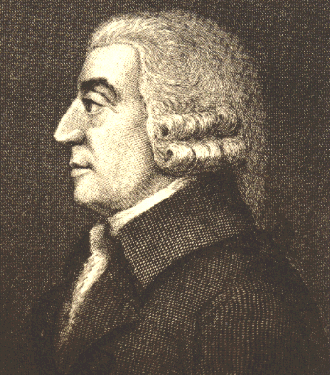 Libertarians (Not only the Libertarian Party members and supporters but also Libertarian leaning Republicans, and many close allies with Libertarians are called Libertarians in this essay) are those who fight against the totalitarianism dominating over America by restoring Classical Liberalism. But, they have not realised that, as explained in the last chapter, the fundamental principle of America fated their nation to become such a paternalist nation. The fundamental problem is that American Classical Liberalism is different from European Classical Liberalism.
Adam Smith is the father of economics as well as one of the remarkable scholars of British Liberalism. So, his philosophy is a good example of the Classical Liberalism, and his Scottish background will help to compare and contrast American idealism with his philosophy. This comparison attempts to show how incompatible American idealism and Smith's liberalism.
Firstly, more than English and American legal system, Scotland has had a closer relationship with Continental European counterpart. So, the influence of Continental Europe on Scotland is still strong, and Scotland adapted both Enlightenment Philosophy and Legal Positivism much faster than England. For example, Scottish regional law is based on Legal Positivism as same as Continental Europe, and the concept of Separation of church from state strongly exists in Scotland unlike the rest of Great Britain.
This is the aspect that Smith's Liberalism became eventually different from Lockean and Jeffersonian liberalism. Adam Smith’s philosophy was highly inspired by Scottish and European enlightenment (The enlightenment) and Legal Positivist philosophy. So, they insisted that only the optimum way is to let all be free to do what they want instead of relying on a particular moral and legal entrepreneur to command all. By contrast, American Libertarianism is based on the concept that the absolutely and universally right morality exists, and this political philosophy regards that all nations ought to follow. So, despite Libertarians’ belief in freedom of choice, their belief in the universal moral principle leads to a moral paternalism.
Adam Smith’s philosophy cannot be compatible with both Wilsonian Liberalism as well as Libertarianism. He would have argued that American idealism including Libertarian put excessive emphasis on paternalism to command humans to follow the natural right as the universal moral principle. He would have pointed out that there is no guarantee to accomplish American idealist paternalism without any sacrifice of either the material prosperity or the big collective involuntary force. Because humans are not God, it is impossible to control their surrounding nature and unseen future. Therefore, by referring to his theory of the Invisible Hand, he explained that there is no absolute moral or legal command which creates a perfect world.
4.3. Ayn Rand’s Dilemma between American legal philosophy and Legal Positivism

Ayn Rand is the most remarkable philosopher who rationally pointed out that the subjective moral universalism was the main cause of the economic and cultural collapse of the modern world from 20th century onward. She tried to reincarnate the Classical Liberalism to free individuals from the moral constrained imposed by various kinds of the modern idealism explained in this essay. Nevertheless, she seemed to have not determined which ethical principle she should have followed, the European Classical Liberalism based on Legal Positivism or the American Natural Right Liberalism based on the moral universalism. Then, even though her work was enlightening as well as artistically beautiful, her theory suffered from the inconsistency in her ethical principle.
Ayn Rand admired America as her ideal nation. She fought against those who replace her ideal capitalist nation the United States of America with a Staticist nation. But, she had not realised that America was fated to become a Staticist nation despite her wish. Meanwhile she always condemned Collectivism, she missed out how the fundamental belief in natural right results in the Collectivism of moral and legal philosophy.
Unlike libertarians, she seemed to have realised that the moral collectivism can easily lead a civilisation to the material collectivism. So, she described herself as a Roman Realist (Another word to describe the Legal Positivist) who is oppose to the Natural Law legalism which is the legal philosophy Natural Right is based on. However, even though she condemned Aquinas's Natural Law and Kantian Deontology (The Human Right), she tended to neglect about Lockean and Jeffersonian Natural Right.
What she called “Welfare Staticism” exactly describes about American idealism. She called Communism and the old 20th century style Socialism, where the property right is redistributed by the central state authority or the communitarian cooperative force, the Collectivism. By contrast, she used the world "Welfare Staticism" to describe the political system which allows individuals' own voluntary will and responsibility to own their property. But, this staticism induces them to engage to become altruistic to support the others.
Meanwhile the traditional (material) collectivism regards highly of the equality in outcomes, the Welfare Staticism insists on the equality in opportunity. Then, in order to accomplish the equality in opportunity, individual citizens and their living environment require a certain high degree of the equality in outcome. Then, this equality of opportunity is seen as one of the fundamental of the Natural Right.
Welfare staticism admits the market mechanism encouraging the individual citizens' property right and their free will to exchange it. It encourages the gradual transition from this world to a more egalitarian one. Then, Welfare Staticists have introduced the two major political tools which are the forcible government intervention and the altruism. Regardless of their methods, in order to convince individual citizens to participate into their policy, these Welfare Staticists often quote altruism, and then defines their controlling state authorities including government and law enforcement units as the guardians of the Natural Right.
The modern Welfare Staticists use the government force taxation and the heavy regulation as means of the redistribution of individuals' wealth and expanding the public goods and services in order to secure the natural rights for all individual citizens. Even though Welfare Staticism accepts the property ownership and some level of income inequality, it claims for minimising the inequality gap and providing the publicly shared goods and services which all individual citizens have an equal access. It imposes the heavy regulations on the activities of individual citizens in order to restrict anyone deviating from Welfare Staticist programme, and their state authority always monitors their flow system. The private individual citizens can be eventually frustrated by the extraction by taxation and the censorship by regulation. Then, in order to reduce their frustration, this politics indoctrinates them to believe its programme is designed to be good for all i.e. altruistic.
This type of the Welfare Staticism did not exist in America because the contemporary Americans detested both their property extortion by tax and the restriction on their actions and free will by either regulations or the hands of the others. However, they still considered the equality in opportunity is the fundamental Natural Right for all individuals. So, Americans used to implicitly enforce all individual Americans to voluntarily participate to minimise the inequality in outcome and regulate their actions and wills. This policy actually requires much higher degree of altruism than the modern Welfare Staticism, and then the moral enforcement upon individuals' mind has been the key necessity to maintain American ideal. Therefore, even though American were materially free to do and think, they were mentally and spiritually commanded by their moral entrepreneurial authority.
Ayn Rand admired America as her ideal nation, and fought against those who replace her ideal capitalist nation with a Staticist nation. But, she had not realised that America was fated to become a Staticist nation. America has already been Welfare Statist nation since its establishment. She explained that the (modern/political) liberals rule our bodies meanwhile conservatives rule our consciousness/soul. Even the freedom of body is given to individuals, their action and wills are highly restricted or even controlled under the name of the Natural Right, the nonhuman sovereign functioning as their moral entrepreneurial authority which can be a rational secular one but will be like the Godless-monotheism which was explained in Ethical Principles explained by Mathematical Logic Pt3.
Libertarians, the modern Jeffersonian political activists, argue that they will only remain the equality in opportunity and deny imposing the equality in outcome. However, when they persist in sticking to their Natural Right ideals as explained in the Part 1, some form of collective intervention forces will be inevitably necessary to correct the errors from their claiming universally valid morality.
Despite Ayn Rand always having condemned Collectivism, she missed out how the fundamental belief in natural right results in the Collectivism of moral and legal philosophy. Then, this is why, instead of categorising Ayn Rand into Libertarian, she is categorised into Hamiltonian on this spectrum.

Although Ayn Rand is not quite equitable to Hamiltonian because she distinguished herself from Pragmatism, she supported both big scale economies and big public sector institutes as long as rational individuals and any objective realities such as the market demand for in order to achieve in their prosperity. Nevertheless, it has been debated to think whether or not Ayn Rand is a mainstream school of American political philosophy. Even though she worshiped her new home nation America, the fundamental characteristics of America does not fit in with her desiring world view.
Regardless of the consequential outcomes induced by Communist policies, the original aim of communism is to unconditionally guarantee the right for all human kinds of individuals to protect their autonomy. Communism supports individuals’ freedom of choice as long as they do not invade others’ right for it and they do not deviate from the universal moral standard implies. This characteristic of Communism is resemblance to the two schools of American idealism, Wilsonian (The mainstream Federalist ideal) and Jeffersonian (Libertarian Rebels).
Both Communism and American idealism pursue in defending their believing universal right and morality. The critical difference between Communism and American is their view on individuals’ property right. Communism claims that individuals’ property right is distributed and monitored by the centralised state authority to each individual according to their rightful need, and then supports redistributing their property by the state’s involuntary force if anyone’s autonomy is threatened. By contrast, American idealism regards that the state should only impose the legislature to protect individuals’ right to keep holding their property, and generally disagree with the frequent usage of the involuntary force of the redistribution.
Libertarians, Jeffersonians and Jacksonians (The realist derivation of Jeffersonians), are against the excess expansion of American economic activity which will cause devaluing any individuals’ property right due to the increasing need for public goods and services in a huge scale. They claim that the redistribution and investing to the public goods and services should be carried out by the voluntary participation by individual citizens. They support the existence of the bourgeoisie, the rich cohort of citizens owing a huge volume of property. But, because these bourgeoisie need to live in such a small scale of economy and community which Libertarians strongly aspire to establish, they will be easily purged when they are seen as uncooperative and they will have less opportunities for their wealth manipulation.
Wilsonians, the mainstream in the current US politics, support the feasible level of the government intervention into the distribution of individuals’ property right even with the involuntary force. As same as Hamiltonians, the pragmatists, Wilsonians aspire to increase the aggregate wealth of the USA in order to gain the economic and political power enough to spend for achieving in establishing their ideal. Even though it is not the same level as Communism, Wilsonians are eager to use the collective force to redistribute individuals’ property by the centralised power of the state authority. Even though Wilsonian modern liberalist ideal is not same as Communism, it is very similar to what Communism originally aspired to achieve in.
When politicians aggressively pursue in the individual right and the individual autonomy, then their policy-outcome will eventually result in either the isolationism based on a small scale economy or the world moral imperialism hypocritically enforcing its universal moral value upon the entire world. In terms of American philosophy of Natural Right, the former is Jeffersonian Libertarian and the latter is Wilsonian political liberalism. In terms of Communism, the former is Marx-Leninism and the latter is Trotskyism as well as the Soviet Communism after the end of WW2.
The modern idealism initially invented by Locke and then innovated by Kant afterward, is based on the staunch belief in Natural Right as the absolute universal morality. This was brought into both Europe and America in different forms. It was transformed to be socialism in Europe while it was transformed to become Jeffersonian (Libertarian) at first and then Wilsonian (Political liberalism) later on. Sum up, even though their characteristics are different from each other, both Communism and American idealism essentially share the same quality of their ethical fundamental principle.
4.2. Libertarian incompatibility with Adam Smith
Adam Smith is the father of economics as well as one of the remarkable scholars of British Liberalism. So, his philosophy is a good example of the Classical Liberalism, and his Scottish background will help to compare and contrast American idealism with his philosophy. This comparison attempts to show how incompatible American idealism and Smith's liberalism.
Firstly, more than English and American legal system, Scotland has had a closer relationship with Continental European counterpart. So, the influence of Continental Europe on Scotland is still strong, and Scotland adapted both Enlightenment Philosophy and Legal Positivism much faster than England. For example, Scottish regional law is based on Legal Positivism as same as Continental Europe, and the concept of Separation of church from state strongly exists in Scotland unlike the rest of Great Britain.
This is the aspect that Smith's Liberalism became eventually different from Lockean and Jeffersonian liberalism. Adam Smith’s philosophy was highly inspired by Scottish and European enlightenment (The enlightenment) and Legal Positivist philosophy. So, they insisted that only the optimum way is to let all be free to do what they want instead of relying on a particular moral and legal entrepreneur to command all. By contrast, American Libertarianism is based on the concept that the absolutely and universally right morality exists, and this political philosophy regards that all nations ought to follow. So, despite Libertarians’ belief in freedom of choice, their belief in the universal moral principle leads to a moral paternalism.
Adam Smith’s philosophy cannot be compatible with both Wilsonian Liberalism as well as Libertarianism. He would have argued that American idealism including Libertarian put excessive emphasis on paternalism to command humans to follow the natural right as the universal moral principle. He would have pointed out that there is no guarantee to accomplish American idealist paternalism without any sacrifice of either the material prosperity or the big collective involuntary force. Because humans are not God, it is impossible to control their surrounding nature and unseen future. Therefore, by referring to his theory of the Invisible Hand, he explained that there is no absolute moral or legal command which creates a perfect world.
4.3. Ayn Rand’s Dilemma between American legal philosophy and Legal Positivism

Ayn Rand is the most remarkable philosopher who rationally pointed out that the subjective moral universalism was the main cause of the economic and cultural collapse of the modern world from 20th century onward. She tried to reincarnate the Classical Liberalism to free individuals from the moral constrained imposed by various kinds of the modern idealism explained in this essay. Nevertheless, she seemed to have not determined which ethical principle she should have followed, the European Classical Liberalism based on Legal Positivism or the American Natural Right Liberalism based on the moral universalism. Then, even though her work was enlightening as well as artistically beautiful, her theory suffered from the inconsistency in her ethical principle.
Ayn Rand admired America as her ideal nation. She fought against those who replace her ideal capitalist nation the United States of America with a Staticist nation. But, she had not realised that America was fated to become a Staticist nation despite her wish. Meanwhile she always condemned Collectivism, she missed out how the fundamental belief in natural right results in the Collectivism of moral and legal philosophy.
Unlike libertarians, she seemed to have realised that the moral collectivism can easily lead a civilisation to the material collectivism. So, she described herself as a Roman Realist (Another word to describe the Legal Positivist) who is oppose to the Natural Law legalism which is the legal philosophy Natural Right is based on. However, even though she condemned Aquinas's Natural Law and Kantian Deontology (The Human Right), she tended to neglect about Lockean and Jeffersonian Natural Right.
What she called “Welfare Staticism” exactly describes about American idealism. She called Communism and the old 20th century style Socialism, where the property right is redistributed by the central state authority or the communitarian cooperative force, the Collectivism. By contrast, she used the world "Welfare Staticism" to describe the political system which allows individuals' own voluntary will and responsibility to own their property. But, this staticism induces them to engage to become altruistic to support the others.
Meanwhile the traditional (material) collectivism regards highly of the equality in outcomes, the Welfare Staticism insists on the equality in opportunity. Then, in order to accomplish the equality in opportunity, individual citizens and their living environment require a certain high degree of the equality in outcome. Then, this equality of opportunity is seen as one of the fundamental of the Natural Right.
Welfare staticism admits the market mechanism encouraging the individual citizens' property right and their free will to exchange it. It encourages the gradual transition from this world to a more egalitarian one. Then, Welfare Staticists have introduced the two major political tools which are the forcible government intervention and the altruism. Regardless of their methods, in order to convince individual citizens to participate into their policy, these Welfare Staticists often quote altruism, and then defines their controlling state authorities including government and law enforcement units as the guardians of the Natural Right.
The modern Welfare Staticists use the government force taxation and the heavy regulation as means of the redistribution of individuals' wealth and expanding the public goods and services in order to secure the natural rights for all individual citizens. Even though Welfare Staticism accepts the property ownership and some level of income inequality, it claims for minimising the inequality gap and providing the publicly shared goods and services which all individual citizens have an equal access. It imposes the heavy regulations on the activities of individual citizens in order to restrict anyone deviating from Welfare Staticist programme, and their state authority always monitors their flow system. The private individual citizens can be eventually frustrated by the extraction by taxation and the censorship by regulation. Then, in order to reduce their frustration, this politics indoctrinates them to believe its programme is designed to be good for all i.e. altruistic.
This type of the Welfare Staticism did not exist in America because the contemporary Americans detested both their property extortion by tax and the restriction on their actions and free will by either regulations or the hands of the others. However, they still considered the equality in opportunity is the fundamental Natural Right for all individuals. So, Americans used to implicitly enforce all individual Americans to voluntarily participate to minimise the inequality in outcome and regulate their actions and wills. This policy actually requires much higher degree of altruism than the modern Welfare Staticism, and then the moral enforcement upon individuals' mind has been the key necessity to maintain American ideal. Therefore, even though American were materially free to do and think, they were mentally and spiritually commanded by their moral entrepreneurial authority.
Ayn Rand admired America as her ideal nation, and fought against those who replace her ideal capitalist nation with a Staticist nation. But, she had not realised that America was fated to become a Staticist nation. America has already been Welfare Statist nation since its establishment. She explained that the (modern/political) liberals rule our bodies meanwhile conservatives rule our consciousness/soul. Even the freedom of body is given to individuals, their action and wills are highly restricted or even controlled under the name of the Natural Right, the nonhuman sovereign functioning as their moral entrepreneurial authority which can be a rational secular one but will be like the Godless-monotheism which was explained in Ethical Principles explained by Mathematical Logic Pt3.
Libertarians, the modern Jeffersonian political activists, argue that they will only remain the equality in opportunity and deny imposing the equality in outcome. However, when they persist in sticking to their Natural Right ideals as explained in the Part 1, some form of collective intervention forces will be inevitably necessary to correct the errors from their claiming universally valid morality.
Despite Ayn Rand always having condemned Collectivism, she missed out how the fundamental belief in natural right results in the Collectivism of moral and legal philosophy. Then, this is why, instead of categorising Ayn Rand into Libertarian, she is categorised into Hamiltonian on this spectrum.

Although Ayn Rand is not quite equitable to Hamiltonian because she distinguished herself from Pragmatism, she supported both big scale economies and big public sector institutes as long as rational individuals and any objective realities such as the market demand for in order to achieve in their prosperity. Nevertheless, it has been debated to think whether or not Ayn Rand is a mainstream school of American political philosophy. Even though she worshiped her new home nation America, the fundamental characteristics of America does not fit in with her desiring world view.
Subscribe to:
Posts (Atom)