Saturday, April 09, 2022

JPY negative interest rate i.e. the inflation tax!


JPY holders are now experiencing the negative real interest rate steadily depreciating our real income, sigh. 

Interest rate r_US > r_Jp. ∴ Money Demand: MD_US > MD_JP
Furthermore, I detest the current Japanese interest rate policy. Usually, the nominal interest rate  is supposed to rise to offset the price inflation rate (ΔP) to keep the real interest rate (r - ΔP: what actually influences the money value held by the savers and the national debt investors) zero at lowest to make it fair and functional. 

The severe problem of Japan is that the current real interest rate for JPY is "negative (-)" which substantially discourages the money demand as well as reduces the real income value (income value depreciated by the price inflation). This is called the inflation tax because the price inflation works as though it were the tax imposed by government allowing the central bank to issue the excess money supply causing the price inflation depreciating the income. Because the inflation rate equally affects all individuals holding JPY, this is indeed a regressive tax (taxing proportionally more to the poorer but less to the rich)!!!!!

The reason why JPY interest rate has neither been raised nor seemed to rise soon is that the Bank of Japan (BoJ) is neglecting the interest rate rise despite this inflation. Actually, the Japanese government reject raising the interest rate because it is more likely to trigger the potential bankruptcy caused by their national debt interest payment overwhelming their budget. ......... thus, JPY holders are now literally experiencing the negative real interest rate steadily depreciating their real income.

Some very rich famous people must have predicted this world economic situation since ages ago. He's accumulated physical gold ingots in his own safe. The current world situation is really dodgy! ... under such a chaotic world situation, I'm thinking of you, my dear friends. Praying for safety of you and your family.


Saturday, March 26, 2022

Is Dictatorship bad?

 - According to Aristotle:

Dictatorship can either the best or the worst political system depending on the quality of this dictator.  If this dictator had a good quality, it would lead to the best.  If this dictator had a bad quality or not good enough, it would fail to the worst.  Democracy is the safest bet because it will neither be the worst nor at least worse than it is expected because the majority have always the right and the opportunity to reflect their opinion over their politics.  Because there are not so many remarkable figures talented enough to be called "good" all the time.  Furthermore, the geographic and demographic nature of this political region matters to select its political characteristics: The geographically and demographically big nations tend to require a more centralised system such as dictatorship for its administrative efficiency; By contrast, the smaller nations tend to be happy with a more democratic system. Only the successful example maybe the ancient Macedonian empire lead by Alexander the great who had actually been personally tutored by Aristotle himself.  


- According to Machiavelli: 

Any political system regardless of dictatorship or democracy tends to claim for one charismatic figure leading the rest.  Anyone who can achieve to obtain such a position through the various conflicts in a politics shall be the ruler as long as this person can be accountable for the result of their actions.  People are often prone to obeying a charismatic figure showing their ways to stabilise their society because people cling to the already established ideas rather than making their own efforts to innovate themselves.  Furthermore, during a chaotic period, majority people do not have their own time and energy to self-govern themselves so that they are weak against powerful bandits pillaging their communities.  Then, people may call for a stronger and more charismatic force protecting their community and attracting their attention.  Nevertheless, a ruler must keep their charisma and understand the custom preserved in a long period which people are familiar with to effectively rule them.  In addition, a ruler must be careful against any opponent who is plotting to defeat to replace the position with theirs.  In order to maintain the political power, not only the force but also the charm for attracting the subordinates are necessary. Thus, the power game will never end so it is not easy for a ruler to stay being a ruler.  


- According to Montesquieu:

The most powerful, functional, and preferable political system is democratic-republicanism which opposes to dictatorship.  However, less dictatorial implies more competence of each individual citizens politics requires.  Under a tyranny, the rest majority just simply obey what a tyrant commands so neither law nor civic compliance is relevant.  Under a monarchy or an oligarchy, favouring for the interests of nobles/oligarchs, the powerful minority, is the priority so law and compliance are kept minimum to protecting it.  Under democratic-republicanism, the majority of people enjoy their freedom unless it neither invades the others' nor disturbs their social order and stability.  So, majority citizens there must understand and comply with their social contracts such as laws and ethical standards.  Civic individuals must always study and think themselves to understand and furthermore develop their own political system. Otherwise, they may easily abandon their democratic right away to welcome a more dictatorial politics. 


- According to Hobbes: 

Everyone should be equally treated under a law.  On the other hand, a stable politics tends to requires one absolute sovereign holding an absolute power of its decision making processes in order to stabilise it for avoiding a chaotic situation nobody agrees with anything during the decision making process.  The equal distribution of political power leads to the chaos where everyone clings to their own interest at first by ignoring the rests.  Therefore, regardless of the talent of this absolute sovereign, it needs someone forcibly inducing one solid conclusion to stabilise the politics as long as this sovereign functions by following the law.  The law shall exist as a guideline/best-practice as well as wisdom of stabilising and keeping it to be developed.  The bureaucratic process based on the law stabilises and prevents it from chaos while an absolute sovereign there simply works for its function merely as a stabiliser in case of preventing politics from chaos. 


- According to Bentham:

This formula is quoted from "Fragment on government" by Jeremy Bentham which shows how the sum of utilities (pleasures minus pains) is derived from by means of each different political function, monarchy (rule by one), aristocracy (rule by few), and democracy (rule by majority).  This aristocracy means not only the rule by nobles or oligarchs but also bureaucrats of the modern governments and corporate tycoons ruling the modern socioeconomics.  


There used to be a time when the existence of monarchy was in a high demand. At this time, the community network of the majority individuals was so primitive that it was restricted by obstacle of natural landscapes and communication barriers mainly of language. Then, conflicts between various feudal tribes were common, and people sought a powerful charismatic figure binding people together. Under a threat of frequent conflict, there needed to be someone who has an ultimate power of final decision making processes when the outcome of their discussion was unstable without some enforcement unit stabilising it.

Then, as shown in the algebra, initially introduced by Jeremy Bentham's Fragment on Government, individuals used to demand the strength of monarchy stabilising their living environment while sacrificing utility (pleasures minus pain) drained by monarchy monopolising their resources in their living environment.  


On the other hand, thanks to the development of international trades and information technology, the strength which monarchy provides with individuals is insignificant for maximising the sun of the utility any more. The global trade based on the free market equilibrium has enabled individuals to mutually agree with each other through the spontaneously derived market equilibrium force without any physical single authority enforcing the decision making process. The information technology development has enabled citizens to rationally accept and understand pluralistic norms and values of various unique individuals living in various different regions and cultures, and to even start to share new norms and values in a shared cybernetwork.

The aristocrats nowadays mean corporate elites and government bureaucrats. The form of this modern aristocracy is now interpreted as meritocracy. There tends to be a gap between those who are able to obtain talents and skills highly demanded for sustaining modern technologies and trade affairs and those who are in the shortage of them. As long as this gap exist, individuals hardly forfeit the utility derived from modern aristocrats' wisdom even though majority individuals have to accept the economic and social inequality caused by this distribution which these modern aristocrats own a higher share of control-ability.  


Even Jeremy Bentham and John Stuart Mill, the devote supports of democracy, argued that the tyranny by mass is dangerous as much as the tyranny by one/few. They affirmed that there need to be law and legislation and a rational (legal) authority monitoring the system based on them not to induce such a havoc while maintaining to deserve for the happiness of individual citizens living there. Thus, law becomes a significant factor to balance the restriction by law and legislation monitored by the rational authority and the mass’s desire.

In the developed stable civilisation which succeeds in maintaining the balance regards highly of the rule by law. The well-defined law functions as the explicit guideline for both rational authority and mass to refer in order to accomplish their happy productive balance. By contrast, the civilisation which puts priority only on doing favour for a particular group of citizens, including both aristocracy (Favouring minority elite) and socialism (Favouring majority mass), depreciate the aggregate prosperity of this civilisation.


On the other hand, regardless of the aforementioned functionality of relatively dictatorial political systems, human-beings usually feel happier in a less dictatorial politics i.e. a more democratic counterpart.  My econometric project "Happiness related to Monarchy, One Party, and Democracy" has proven that the Happy Planet Index (HPI) measuring the sum of people's happiness/utility in each country is maximised when their political system is more democratic than dictatorial. 

This quantitative analytic experiment indicates that the honesty of the democracy and the majority's opportunity and right of reflecting their political opinions are simply but crucially important for their happiness overall regardless of any merit advertised by more dictatorial counterparts.  Thus, as long as it is feasible to accomplish under a given condition, the utilities provided by democracy as the honesty of administrating politics as well as representing and utilising the cooperative power of majority seems to overwhelms the rest counterparts.  


- According to Thomas Paine:

It is a common sense that it has simply been the case that the fortunate powerful ones have dominated over the majority others with their force in a long period of our human history.  These rulers having been merely lucky enough to be fortunate and physically powerful have subjugated the majority humans with not only their military forces and superstitious charisma but also their indoctrination and propaganda processes.  We, the human beings, must be awaken from these false consciousness having fooled us to establish the true democracy based on rules for the people by the people of the people!

Thursday, March 24, 2022

Foreign Exchange Rate, Purchasing Power Parity, Real Foreign Exchange Rate, and the desired global economic transformation

The nominal foreign exchange rate of a fiat money tends to converge the purchasing power parity (PPP) of this country or region.  

The PPP is regularly scaled by means of some commonly traded goods across the borders in the world.  

Either the classical economics case or the modern economics case applies to the foreign exchange rate change depending on time, place, and occasion.


- The case base on the Classical Economics

According to the classical economics, the aggregate demand (AD) is fluctuant while the aggregate supply (AS) is rigid in the short run so that the output level of an economy is rigid.  

The classical economics regards highly of repressing the price inflation rate and maintaining the prudent demand management.

In terms of the macroeconomic management, the high AD means the overheat of the economic activities which should be repressed whereas the suppressed AD implies the prudence. 

The price inflation is considered as the excess money supply circulated into the economy which reduces the nominal FX rate relative to the other currencies.

The price of the commonly traded goods therefore becomes more expensive so their PPP goes down. 


- The case base on the Modern Economics

By contrast, the modern economics regards that the output level can be fluctuant at least in the short run because the higher price encourages the suppliers to produce more.

The macroeconomic policy of the modern economics indicates that the price and the output may rise together enough to increase their productivity level competing against the other economies i.e. the PPP.  

Then, the price of the commonly traded goods tends to be negatively correlated to the PPP often derived from multiplying the price level and the output level.

The correlation of the price level and the PPP depends on whether it is caused by the AD (the positive correlation) or the AS (the negative correlation).

This factor induces the nominal FX rate because the traders then always speculate which correlation is dominant over the counterpart. 

Furthermore, the central bank often intervene into the FX market with their money supply control to control their AD and SRAS: The FX rate change tends to negatively affect on the good market but positively affect on the financial market. 

The effect of this intervention to the FX depends which market factor, goods or finance, is more dominant over the counterpart so this causes the FX market all the more speculative.


- Marxist perspective against the global capitalism

Judging from Marxian economics, this whole theory is nonsense because the capitalist system including this FX market function favours the bourgeoisie, the capitalist class, to exploit the proletariat, the rest majority.  

The bourgeoisie take an advantage of owning various means of productions increasing their purchasing power in the trade meanwhile the proletariat do not capital but their own physical labour (including the white collar works using their brain) and time.  

The socioeconomic conflict of these two classes, the bourgeoisie and the proletariat, also applies to the relationship between the already developed countries and the developing countries including the emerging countries and the least developed countries: The former ones own the higher level of capital whilst the latter ones own only few resources such as labour and natural resource.  

In addition, Marxian theory claims that the market mechanism often neglects taking some external factors hardly shown in account books such as the exploited labour value and the ecological footprints such as excess extraction and pollution. 

All in all, the power balance of the foreign exchange market is asymmetrically distributed among countries, which perpetuate the exploitation of the poorer countries by the richer countries.

According to Marxian socio-economics, these goods and services in the world should be collectively distributed across the borders purely by means of their needs so this over-fluctuant speculative FX market is nonsense to take into consideration.

Perhaps, Marxian scepticism can be true after having observed the wealth and educational gap between countries and the ongoing environmental damages in the developing countries. 

However, the collective distribution planning requires an unfeasibly gigantic bureaucracy administrated by a single world government body managing as well ass monopolising the entire world economy.


- The alternative transformation 

As having learned from the last Marxian economic experiment by the USSR, the collectivist economic policy is risky due to its inefficiency of distribution and decision making processes as well as the excess centralisation of the political power. 

The feasible way to take this Marxian claim is to establish some positive intervention mechanism into the current market economy.

For instance, the foreign direct investment programmes with a fixed FX rate contract for a certain contract period should be implemented to aid these relatively less developed countries.

In particular the LDCs, they tend to lack their own physical and human resources available to split to their research and development (R&D) so the foreign aid is crucial to grow enough to participate to the international trade in a fair competition. 

Enriching the LDCs is actually beneficial for the developed countries providing the aids because it means to increase both customers of their products produced by the developed countries and suppliers of products with higher values added for the developed countries. 

The FX mechanism of the market economy should remain as the automatic adjustor corresponding to the spontaneous market changes while introducing some positive intervention encouraging the fair trade and the product variety which will expand the market potential of the entire global economy.


Sunday, March 20, 2022

Astrologically Predicted Financial Collapse on 5th April, 2022 onward


 * This analysis is based on an astrology so please kindly note that these following assumptions are not quite scientific and objective, and the variance of the error is significantly big.  Thanks for your attention.

Mars usually works as a trigger of an explosive event related to the aspect of a sign forming a major aspect when Mars forms a strong aspect such as the conjunction while crossing an ascendant.  On 5th April, 2022, Mars forms a conjunction with Saturn already forming an aspect of the square with Uranus.  Then, consider the following current conditions of the square of Saturn and Uranus. 

- Uranus is crossing an ascendant of Taurus representing property/wealth which is the detrimental position for Uranus representing spontaneity and innovation. 

- Saturn is crossing an ascendant of Aquarius, Uranus's own sign representing the spontaneity and innovation as well as Saturn's night ruling sign representing structure/society and time/patience.   

- Uranus and Saturn forms a hard aspect the square.  The square usually regularly denotes killed and hidden.  

Overall, economy is weakened at this point. When Mars forms the conjunction with Saturn and the square with Uranus while crossing the ascendant of Aquarius, it is predicted to trigger the explosive effect of this hard aspect inferring a depressive economic condition.  

Uranus is also considered as influencing crypto-currencies.  The crypto-currencies are recognised as a double-edged blade for economy; it will stimulate economy with its innovative force whereas it also disturbs economy by challenging the already established stable system.  A famous astrologist has warned that these crypto-currencies will face a huge catastrophic shock in their market. 


On the other hand, the conjunction of Jupiter and Neptune crossing the ascendant of Pisces is non-negligible while talking about economy and international finance.  As mentioned in "Econometrics meets Astrology: Regressing the world GDP on the aspects of Jupiter and Neptune", the aspect of Jupiter and Neptune represents the wealth so that it is proven to be highly correlated to the world GDP denoting the aggregate turnover of the economic activities.  

As Jupiter and Neptune is still forming the conjunction, the world GDP growth should be expected although it is not certain as much as the major soft aspects the triangle and the sextile.  Furthermore, a famous astrologist has explained that some major commodities such as Gold and Silver are represented by Jupiter so that there will be a bubble of the value of Gold and Silver these days. Therefore, those who hold these commodities and already established wealth may enjoy their 

The catch is that they are crossing the ascendant of Pisces which is the own sign of Neptune and the night ruler so both Neptune and Pisces represent extra-terrestrial including spiritual and dream as well as ambiguity.  When Neptune and Pisces exaggerate their strength, there tends to be sanction toward the corruption and the over-exaggeration of material well beings.  

Therefore, some severe correction process of the current world finance may hit the world economy.  Moreover, Neptune and Pisces represent a tidal wave messing up various matters, and Jupiter, representing the multiplying effects for both good and bad, multiplies their phenomenon. Then, many individuals may experiences the confusing tidal wave of their portfolio performances during this time so it might be safer to hedge their wealth with stable assets at this time period. 

Monday, January 31, 2022

Retrospective Astrological Analysis: French Revolution and Edo-Period were while Pluto was crossing the acendant of Aquarius


Let's make a prediction of the coming age of Pluto crossing the ascendant of Aquarius between 24th March, 2023 and 9th March, 2043 in terms of the retrospective perspective. At the last time Pluto was crossing the ascendant of Aquarius, the French revolution broke out in Europe while Tokugawa Dynasty secured its stability with Sakoku (the national Isolation policy) for 3 centuries in Japan. This provides some ostensible image of what the foreseen world outlook will be. 

Furthermore, in the astrological cycle before the previous one of Pluto crossing the ascendant of Aquarius, Martine Luther printed the first edition of Holy Bible in German as the first attempt of publishing it in other than Latin, which induced the Protestant reformation.  This infers that Pluto crossing the ascendant of Aquarius induces a revolution and the instability challenging the status quo, and it expects for the advantages and the disadvantages of this time period also coming soon. 

From 2023, it is obvious that the further technological advancement is anticipated. In particular, the field of data science and the artificial intelligence (AI) will be furthermore remarkable then.  This outcome will be revolutionary enough to trigger the drastic change in individuals' norms and value such as these previously provoked revolutions in the history in the world.  

On the other hand, the economic outlook will not be so positive that many individuals still feel materially desperate despite the technological development. The employment will decrease due to the rising capital intensive industrial model.  As Prof. Yuval Noah Harari , the author of Sapiens: A Brief History of Humankind, has predicted, the human individuals will be divided in the newly emerging social classes called the super class and the useless class.  Therefore, the wealth distribution is less likely to be stimulate as much as it has been. 

By referring to the previous historical events and outlooks, the age when Pluto crossing the ascendant of Pluto was the age of political and economic instability while newly innovative mindsets were developed.  Until Pluto started crossing the ascendant of Pisces, the instability had continued until the new regime overtook the position to finally stabilise the world situation.  The interesting characteristic was that Europe encountered with the French revolution while Japan cut the tie with foreign countries while Pluto crossing the ascendant of Aquarius last time.  The phenomenon expected to take place will be somehow similar, it maybe predicted as. 

Europe nowadays is still haunted with a decade long recession since the last world financial crisis from 2008.  As same as the past, various political factions are existing and antagonising the other counterparts so that the stable decision making process improving the European socio-economic situation is less likely to be implemented.  Because of the wide spread relative poverty problem due to the economic stagnation might trigger some form of revolution or at least a reformation when majority of European people become no longer able to repress their frustration. 

 By contrast, Japan is the country where people hardly take an initiative to challenge the status-quo.  Nowadays, owing to the mislead Japanese governmental policies, Japan is still difficult to overcome from the economic recession and the ever growing social problems for the multiple decades.  As this perpetuation does not seem to be ended, the economic and political status of Japan will be furthermore depreciated.  Then, many skilled foreigners, having come to Japan for their economic reasons, will start leaving Japan from then on.  In addition, Japan will lose the initiative in their world trade deals so that the export-import volume will decrease. Therefore, even though it is not the government's policy, Japan will be in the situation resemblance to the Sakoku policy during Edo-period.  

Another interesting prediction in terms of the spiritual world theories, Gaia-theory/hypothesis infers that Japan will be the next world model after the end of the Anglo-Saxon's regime as the world model.  At the same time, the next world model lead by Japan will be the Yin 陰 as contrary to the Yang 陽 of the last Anglo-Saxon counterpart.   This implies that the world of the materialist prosperity will be replaced by the world of the spiritualism.  

Summing up these points, it can be predicted that the mind of people in the world will start shifting from their material interests to their spiritual and mental interests in their life while they are losing their material prosperity.  The reason why Japan will reign as the world model then will not be because of its material power.  Instead, Japan will be the country experiencing the fastest pace of losing their material prosperity.  In terms of what Gaia theory explains, Japanese people will also be the fastest ones realising their initiative of placing a higher priority on non-material beings than the others while experiencing the harsh material hardship.  

This is pretty much the foreseen situation resemblance to Edo-period where people and their nation Japan developed their unique interesting culture while suffering from the various hardships such as the oppressive feudalism, several famines and natural disasters, and no freedom of travelling to and trading with foreign countries.  The isolation and the material deprivation of Japan are quite reasonably predictable as seen in the current outlooks.  

All in all, the coming two decades will be the age of revolution and socio-economic and political instability.  Moreover, the contrast of the civilisation shift between Europe and Japan will be remarkable and the history may repeat.


Tuesday, January 11, 2022

The GDP is an obsolete measurement: The Happy Planet Index (HPI) is worth considering for scaling the socioeconomic well-being


Majority of people still seem to be unhappy and unsatisfied with their life and surrounding socioeconomic situation despite the highly available technology and the robustly growing aggregate productivity and wealth as well as stock price indices.  The study of economics has often focused on the gross domestic product for scaling the economic well-being.  Furthermore, these economists still consider money (fiat-currency) as the intermediary of the exchange all the time so they assume the excess money supply not corresponding to the market demand triggers a high price inflation.  


These factors must have been true up to just recently.  Nonetheless, the paradigm of the world socioeconomics has certainly significantly shifted from this classical case.  Moreover, the inflation risk due to the expanded money supply can be quite likely to be a superstition which is not worth off to be scared of.  Well, this does not mean to prioritise controlling the employment over controlling the inflation such as the Phillips curve.  It means to suggest not to be excessively scared of the inflation by means of increasing the money supply.  

The proactive monetary policy has traditionally focused on increasing the aggregate supply offsetting the price inflation by the high output for the return.  Nowadays, in such a post-industrialised world, there is no exact industry which promises to offset the negative effect from the inflation by directly injecting the money supply.  In another word, the aggregate supply is already high enough to satisfy individuals and their life; The only concern is its diversification i.e. the re-distribution.  

There is a reason why it is already unnecessary to be afraid of the inflation.  Nowadays, whenever there is an excess demand or an lacking supply takes place, there is always another supplier jumping into the market to fill the output gap. The speed of the information flow for both financial investment and resource managements including logistics and invention is so high that the macroeconomic gap is immediately reduced. 


Then, it comes to the point of applying the money supply.  The most critical point is that these economists still narrow mindedly focus on the GDP.  The GDP is the gross term which can be artificially increased by increasing the several unproductive turnovers so it is not an articulate measure of an economic well being even in the aggregate level. 

More turnovers implies more environmental damages because of the increased logistics consuming fuels and production processes consuming resources.  Therefore, excessively focusing on the GDP may encourage the environmental destruction. This is another reason to discourage excessively focusing on the GDP. 

In addition to these material factors, there is also an ethical concern on excessively focusing on not only the GDP but also any other gains in the financial terms.  When individual economic agents keep competing to maximise their sales volume and financial gain, it comes to the point majority of them working hard face difficulty to survive in such an ultra competitive market.  It eventually induces either a cut-throat competition where everyone loses or a monopoly/oligopoly where only few powerful economic agents monopolise the gain. 

In such a socioeconomic model, individuals are simply exhausted for working hard enough to neglect the other important elements of their life such as family and friend kinships, cultural activities such as arts, sports, and local festivals, and most importantly sparing their time for their physical and mental health. 

It is often wondering why individuals cannot enjoy their life without working so hard. The top 3 countries of the highest GDP are the USA, China, and Japan in which their citizens are expected to work very hard to prop up themselves. Their income gain opportunity maybe high although the price indices i.e. their costs of living are also high.  

In addition, the income inequality (the relative poverty in another word) of the USA and China is significantly high enough to cause various social problems related to the relative poverty. The income inequality, the relative poverty, of Japan has been substantially rising since 1990s so that social problems related to the relative poverty has been rising since then.


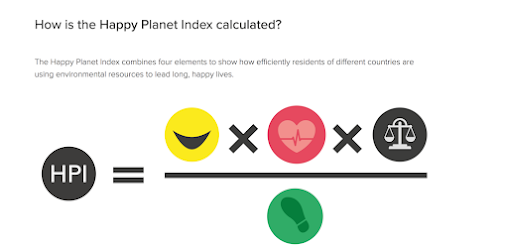
Many people have started wondering if working hard to increase the GDP is really worth-off to consider their well-being in general.  This is why the alternative measure such as the Happy Planet Index (HPI) introduced by New Economic Foundation has become popular as an alternative of the GDP for scaling the socioeconomic well-being. 

This HPI is calculated by the power of three variables, the survey points of happiness, the average life expectancy, and the income equality (the lowness of the relative poverty) divided by one variable, the ecological foot print (the environmental damage).  

The first variable is a simple surveillance asking randomly picked up people in a country for scoring their happiness from the point up to 10.  This can be subjective and often affected by the climate effect (See also my blog article "Happiness related to Monarchy, One Party, and Democracy").  Nonetheless, it is still an important variable directly measuring whether people are happy overall.  

The second variable is a simple and ostensible measure scaling individual people's health and their security in their living society.  An access to a healthy nutritious diet, satisfactory health services, and a clear natural environment free from pollution, a positive prospect with a low anxiety at the present time period, and a safe community preventing its citizens from mortal incidents.

The third variable has been newly introduced recently.  It may be because the social problems related to the relative poverty are non-negligible to take individuals' happiness into consideration. When the income inequality dispersion among individual citizens is significantly big, many citizens become difficult to afford their basic necessities as well as some luxuries because the price goes up due to the monopoly effect by the rich.  Moreover, many individual citizens tend to feel miserable because they feel like being less worth off than the very fortunate rich cohort of individual citizens.  This is why the crime rate as well as the suicide rate tend to go up when the inequality dispersion is widened. 

The forth variable indicates the penalty of exploiting natural environments by such as natural resource extraction and various kinds of pollutions harming natural environment. This claims for a need of the counterweight against economic activities deserving human individuals.  In particular nowadays, socioeconomic indices should take the sustainability of both individuals themselves and their living environment of the mother earth.  

There are many scepticisms against the HPI, and some of them are really articulate and plausible the disadvantages of referring to this index.  Well, nobody has yet ever discovered a perfect index measuring the socioeconomic well-being overall.  In another word, no index is perfect. However, the HPI seems to be at least more useful, precise, and demanded to scale the socioeconomic well-being especially at the current time period when the paradigm has started shifting and this shift is still in progress. 


Having taken these aforementioned factors into consideration, an economic policy of this new paradigm of this world will needs an alternative measurement of the money supply control to the counterpart implemented by the current status-quo.  In order to allow a national/regional economy to prosper, it requires to install a brand new innovative economic policy not shown in a regular text book especially these days of this paradigm shift. 

It will be kind of imitating the economic policy of Korekiyo Takahashi who used an amazing completely innovative policy which was resemblance to Keynesian economic policy although it was way before J.M.Keynes published General Theory of Employment, Interest, and Money.  

At his time period, the monetary policy theory assuming money (fiat-money) is neutral as it is merely an intermediary of exchange.  This classical economic theory therefore regards that money supply is neutral to economic activities i.e. it is meaning less to supply an excess money for those which do not exist at the present time period (Money supply adjusted to the existing economic output).

By contrast, Mr. Takahashi proactively injected the money supply into various ongoing public work projects such as various infrastructure constructions like building ports.  His policy was dedicated to inject the public goods and services not having existed at the time this monetary policy was implemented.  This was entirely a new innovative original economic policy not having been mentioned in any textbook at the contemporary time period!

There is a reason to claim for reincarnating Takahashi-ist monetary policy into the present world.  The private banks tend to be very reluctant to invest to those which may increase the HPI while not directly returning the financial return for their investment immediately. A further rise in the socioeconomic well-being, maybe represented by the HPI, nowadays may require an immense public sector support such as the monetary policy channel by acentral bank.  

Regardless of either a private sector or a public sector a central bank is, a central bank and its function should be considered as public goods and services which are ought to deserve the public well-beings without concerning about the internal profit maximisation.  A central is least likely be bankrupt among all the other banks as long as people keep using and trusting their supplied money (fiat-currency).

For example, it may be the time to re-evaluate the importance of artists and writers being suppressed by the importance of business persons and manufacturers.  Artists and writers themselves are hard jobs to create the immediate cash but some of them will be remarkably successful enough to advertise their local community and nation they are brought up in.  Then, when a policy allows more individuals to spend their life for their own activities of art and writing without their financial anxiety, the probability of bringing up future celebrity artists and writers may rise. 

Not only the previously mentioned quasi-idealist policy but also there is a very emerging realistic matter to deal with to increase the HPI. As a matter of fact, almost all the countries in the world are not sufficiently investing their public expenditure to education and health services which are crucially correlated to the HPI.  The current world economy demands the tertiary education e.g. university as though it were mandatory.  Monetary investment tends to be often diverted from medics and healthcare because they hardly provide the immediate financial returns.  

Adam Smith, the father of economics, even stated that defence, education, and healthcare could not be considered to grow in a free market economy. Smith put emphasis on the necessary public supports for defence, education, and healthcare regardless of their profit maximisation and the free trade while their existence is mandatory for letting the entire economy and society to prosper.  Thus, even though an investment into education and medical services are not directly converted into the internal profit, there must be a way to ensure enough resources are secured for these institutes being in charge of education and healthcare. 

Korekiyo Takahashi must have realised what Adam Smith mentioned there. At the contemporary time period of Japan, the military infrastructure was a priority to invest while many private sectors were reluctant or unavailable to invest in order to secure their trade routes and defend the nation.  In order to enable the national economy prosper, these infrastructure categories, defence, education, and healthcare are crucial to exist even though the private investors were reluctant to invest.  

This is the time to recall Takahashi-ist economic dynamic today.  There are always something not directly related to the economic outlooks while they must exist to back the entire economy as well as all individuals and their society to prosper.  Even though it does not directly contribute to the financial market or the economic outlooks, popular arts and subcultures will attract more foreigners to a region brining up such talented characters.  A well established culture backed up by education, healthcare, and innovative minds may attract many entrepreneurs to obtain their new inspiration to start their business.  

All in all, it is never a nonsense to combine the monetary supply channel of the monetary policy and the cultural and mental well-beings such as those represented by the HPI.  Manifesto Neo-Takahashi-ism is here!