We have believed that the road to serfdom was evaded since the end of the cold war with a victory of capitalism over the socialist-empire, the excess form of socialism which was considered as the serfdom. Nevertheless, we are still in danger of being unintentionally guided to a serfdom. The modern industrial world has increased the material productivity and the political stability under the common interest in pursuing a material prosperity. At the same time, this has also produced the cost for individuals to live in an intensively cohesive structure.
Capitalism mentioned in this short essay refers to the State-Capitalism whose economic and political system is based on a stratified corporate structures backed up by a nation-state government. This capitalism requires the law enforcement (The judicatory body of nation-state) and the centralised economic planning by central-banking and governmental fiscal policy (The legislative body of nation-state). Individuals and their private corporations are free to compete as long as they follow the unified rigid rules imposed by a single autocratic body called nation-state.
These individuals and their corporations are actually not free to act and compete because some of them are privileged more than the others. The nation state's government and judicature set their roles suitable for their peer groups which are loyal to the authority or their nation-state. So, their freedom of action is still restricted by the roles and their competition is based on the authoritarian interests of a nation-state's autocracy and its fellow peer corporate elites.
This state-capitalist political structure is a resemblance to the static monarchist political structure explained in Fragment on Government. Even though a monarchy is merely a constitutional, the status-quo having been maintained so long time has already established the unbreakable hierarchy of power and wealth. These peers of monarchy have already monopolised their power and wealth as much as they are able to prevent their potential competitors away from gaining more power than the already existing status-quo even under a free market competition.
They are protected by the old-fashioned law and legislation which indirectly enable monarchy and its peers to keep holding their power and control over the entire nation and its citizens. Bentham then claimed for replacing the law and the legislation unfairly privileging these peers with the new alternatives in order to liberate individuals from this control-ship.
Many socialists refer to capitalism as an antithesis of socialism. The word capitalism was invented by socialists in order to refer to the policy based on the free market mechanism and private property ownership which socialists oppose to. Capitalism has started to be mentioned as one political ideology since many anti-socialist individuals supporting a freer market system started using this terminology capitalism as their believing antithesis of socialism. But, this seems to be doubtful because there are many characteristics in common between these two political ideologies. Both are the modernist political ideologies requiring a systematic autocratic nation-state and the zealous moral universalism putting an excess emphasis on altruism and cohesion.
Both capitalism and socialism frequently put emphasis on excess-conformity and staunchly regulate individuals and their freedom of action, life, and thought by condemning egoism as vice. Socialism forcibly integrates individuals into its autocratic cohesion meanwhile capitalism simply spontaneously excludes individuals, who are disloyal and/or useless for their interests, from the means of acquiring material well-being and status honour. Both are the homogenous political ideologies discriminating and ostracising who are too unique and eccentric.
Whenever individuals are employed by a corporation to spend their time and efforts for it, they must have realised that many of corporations do not base their business management on the rational market mechanism. The management of these corporations is influenced by the irrational preferences of both the high class members, the minority but powerful executive committees, and the peer-groups of the majority employees. The executives often tend to put priority on their personal favour and their biased view on unique individuals over individuals' competence and merit. The majority workers form their peer group to purge the other individuals hardly integrated into their peer group due to their jealousy and discrimination.
Because of this employment scheme biased by these irrational causes, the market equilibrium of demand and supply of the human-capital is hardly accomplish-able, and the mobility of human capital is far more rigid than the market structure explained by the free market principle, the classical economic theory of capitalism. There is then the political influence on the corporate structure. The modern corporate structure is unnecessarily big and complexly stratified as same as the bureaucracy of a nation state, and this does not look like how the private sector structural model is supposed to be by the free market principle.
The existence and the prosperity of these corporations are secured by the law enforcement and regulations designed and imposed by the single nation-state's authority, and these corporations aid the nation state authority by doing its favour. Unlike a pure form of socialism, how both various private corporations are incorporated into one unified nation-state bureaucracy. But, this capitalist structure is identical to the state-socialist counterpart seen in the USSR. Lenin had actually embraced the growth of state capitalism in The State and Revolution as the modern capitalism becomes more bureaucratic and incorporate into the nation-state's bureaucracy.
The solution to overcome from the rigidly structured capitalism is certainly not a political revolution because a political revolution simply replaces one stratified politics with another stratified counterpart such as socialism. Moreover, remaining the status-quo just perpetuates the authoritarianism of politics repressing individuals' liberty. As long as individuals rely on any form of stratified political structure, these individuals are manipulated to live like cattle or cogwheels propping up the oppressors of individuals' liberty.
The rebellious mind of individuals is the key of the solution. No violence is required for this rebellion: Individuals just need to keep their strong self-esteem and being honest about their pure ego and natural desires. For the time being, the current excessively stratified modern world politics is hardly relinquished at once. So, the gradual step of liberating individuals is the feasible pathway. We, individuals, should use them instead of being used as they can still bargain with government and corporations for our own interest. Individuals will simply need to be enlightened to maintain their self-esteem by preventing themselves from being used by either government or corporations.
Saturday, February 20, 2016


Sunday, February 14, 2016
ABL Political Compass (Legislative and Judicial axes) to the Unknown-Ideal

When people talk about anarchism (Zero control) and the low control level, many of them tend to be confused with a chaotic or primitive state. A chaotic and/or primitive state often implies the low or no control. But, anarchism does not always imply either chaotic or primitive. There are several forms of control-ship as well as there are several forms of no/low control-ship.
However, there is a significant difference of an economic political structure between controlled and less/non-controlled. The characteristics of the economic political control is created within a relatively short time period meanwhile the characteristic of non/less controlled economic political structure is created through various influences of cultural and technological new inspirations unless it is a collapse of civilisation going back to chaos/primitive. The control is artificial meanwhile the counterpart is spontaneous. The spontaneity cannot be artificially created all the sudden: Individuals and their living civilisation need to experience various cultural and technological influences enough to obtain the wisdom to live without an artificial economic political control.
The controlled structure can be sustained as long as a few powerful individuals in charge of the control are wise enough. By contrast, the structure with no/less control requires majority of individuals to be enlightened and already wise enough to be self-autonomous. The root motivation of individuals enabling to establish no/less controlled state can be religion and other forms of strong ideologies. However, this project also adds another form of no/less controlled state which is free from not only the physical (economic) control but also the moral (political) control, and this is the unknown ideal which I, the author of this blog Art&Blue-Liberalism (ABL), is aspiring to discover.
The following charts explains how the new political compass based on the political map of various already-existing forms of civilisation and the unknown ideal together:

There are two axes, the legislative side of politics mainly in charge of regulating economic policies and the judicial side of politics mainly in charge of regulating moral policies.
There is only one the most economically and morally controlled state. It assumes that the objectives of all rational individuals in this world is to achieve in material as well as spiritual prosperity. So, regardless of ideology basing the control-ship, the main-objective is prosperity and the degree of control is adjusted to achieving it.
The spectrum of the old political compass is based on the straight forward high-low control. By contrast, both the ends of this new compass are low control and the centrist indicates the highest control.
* Legislative: Economics side *

This project regards that the pure command economy, such as Marx-Leninism, is equivalent to the primitive economy, and the high economic control implies the positive planning of economic policy such Keynesian economy. So, it does not measure by means of the size of public sector: it measures by means of the active role of government and big corporations directly intervening into the business cycle and the overall economic climate.
Furthermore, it indicates the clear difference between two low control levels: The one where majority of individuals are less aware of market mechanism and the other is majority of individuals are aware of market mechanism without an instruction provided by rational authorities.
* Judicial: Moral side *

An intense autocratic government always requires its citizens' worship to it as though it were only one God. Even an authoritarian government with theological ideology, they often use religion and morality as their political instrument. The pure religious community represses the excess control of government, and individuals follow moral disciplines without any paternalistic intervention by a political autocracy.
The third characteristic of this spectrum is the freedom from both government or any moral entrepreneurs' moral intervention. Many Continental European states are close to this category. The extreme side of it is the anarchism existing in political theories.
The teaching of Islam contains a full knowledge about the market mechanism, and citizens of various Islamic nations achieve in a reasonable level of economy. Their government often intervene into economy to stabilise their business cycles, and the big corporations and the Islamic banks are highly encouraged to voluntarily help the economic adjustment.
Jewish community is not restricted by a nation state, and their holy nation Israel was established relatively new compared to Jewish people's own long history of existence. They are only controlled by the moral entrepreneurship which is free from any artificially created autocratic form of politics. Majority of Jewish are aware of market mechanism, and self-autonomous enough to cope with any havoc challenging them.
Asian nations tend to prefer a high control for both economy and morality. Their culture to follow rational authorities enables them to stimulate rapid economic growth and political stability. The weak point is their low self-autonomic level which hardly promotes a self-autonomous state.
The moral entrepreneurship in Latin America is intense even nowadays. The degree of economic intervention varies across different Latin-American nations. They are less secular than majority Asians but less religious than Isramic citizens.
In the Western nations (except Latin-Americans), there is a big divide between the Continental Legal Positivist states and the Anglo-American Common-Law states. The former is a rational secularist nation which promotes morally neutral policy with an effective economic intervention. The latter remains a strong moral entrepreneurship but a laissez-faire economic policy. The latter puts emphasis on the self-responsibility of all individuals for both fortune and misfortune, and the flexibility promoted by this emphasis has strengthened their strong financial management. The former put emphasis on the safety net helping individuals accidentally trapped into misfortune, but demands on individuals' tax contribution and strict legal codes which disrupt the flexible flow of the financial market.
Scotland is one of the former states even though she is a part of the United Kingdom of Great Britain and Northern Ireland. Jeremy Bentham aspired to establish a perfect legal-positivist state and ardently challenged against the traditional commonlaw of his own mother nation. Bentham 's ideal state is to promote the maximum secular freedom of individuals protected by the reasonable level of positive government intervention and the fair judicature based on the logically and explicitly coded legal codes. Murdock empire is not a nation but its media influence is often superior to any national propaganda. The media empire of Murdock is highly secular meanwhile it still remains its business ethics based on the common law states requiring all individuals to be responsible for both their fortune and misfortune.
The unknown ideal is something combining the secular-rationalism of the legal positivist states and the self-autonomy and the strong financial management of the Anglo-Saxon and Jewish culture. In order to accomplish the unknown ideal such as Max Stirner and Ayn Rand had aspired for, the combination of the flexible flow of the financial market promoted by both Anglo-American Common law and Jewish culture and the morally neutral rationalism promoted by both the Continental Legal Positivist Europe and Asian nations seems to be demanded. The practical method to achieve is not created yet, but there is already an idea leading to keep looking for the solution.
Monday, February 08, 2016

Monday, December 28, 2015
An experimental (philosophical) political compass.

The vertical axis indicates the ethical point of view. This is measured by what kind of means of their political achievement they select. The top side of this scale represents the view that there needs to be an objective principle of what is right and wrong. So, those who are on the top side of this spectrum suggest that all individuals are judged and treated under the agreements made by an agreeable justice such as law and contract. By contrast, the bottom side of this spectrum represents the view that those who are in the power create the rule for all.
The horizontal axis indicates the world view of these philosophy. The left side of this scale represents the view that there will be an alternative world which has not yet existed in the current natural world. So, those who are on the left side of the spectrum have a strong devotion to aspire creating their dreaming ideal world. By contrast, the right side scale represents the view that there is an inevitable nature of both human individuals and their world which cannot be eliminated. Those who are on the right side of the spectrum regard highly of the already established order of human politics.
Sunday, November 08, 2015
ABL Political Compass (Legislative and Judicial axes) to the Unknown-Ideal
When people talk about anarchism (Zero control) and the low control level, many of them tend to be confused with a chaotic or primitive state. A chaotic and/or primitive state often implies the low or no control. But, anarchism does not always imply either chaotic or primitive. There are several forms of control-ship as well as there are several forms of no/low control-ship.
However, there is a significant difference of an economic political structure between controlled and less/non-controlled. The characteristics of the economic political control is created within a relatively short time period meanwhile the characteristic of non/less controlled economic political structure is created through various influences of cultural and technological new inspirations unless it is a collapse of civilisation going back to chaos/primitive. The control is artificial meanwhile the counterpart is spontaneous. The spontaneity cannot be artificially created all the sudden: Individuals and their living civilisation need to experience various cultural and technological influences enough to obtain the wisdom to live without an artificial economic political control.
The controlled structure can be sustained as long as a few powerful individuals in charge of the control are wise enough. By contrast, the structure with no/less control requires majority of individuals to be enlightened and already wise enough to be self-autonomous. The root motivation of individuals enabling to establish no/less controlled state can be religion and other forms of strong ideologies. However, this project also adds another form of no/less controlled state which is free from not only the physical (economic) control but also the moral (political) control, and this is the unknown ideal which I, the author of this blog Art&Blue-Liberalism (ABL), is aspiring to discover.
The following charts explains how the new political compass based on the political map of various already-existing forms of civilisation and the unknown ideal together:
There are two axes, the legislative side of politics mainly in charge of regulating economic policies and the judicial side of politics mainly in charge of regulating moral policies.
There is only one the most economically and morally controlled state. It assumes that the objectives of all rational individuals in this world is to achieve in material as well as spiritual prosperity. So, regardless of ideology basing the control-ship, the main-objective is prosperity and the degree of control is adjusted to achieving it.
The spectrum of the old political compass is based on the straight forward high-low control. By contrast, both the ends of this new compass are low control and the centrist indicates the highest control.
* Legislative: Economics side *
This project regards that the pure command economy, such as Marx-Leninism, is equivalent to the primitive economy, and the high economic control implies the positive planning of economic policy such Keynesian economy. So, it does not measure by means of the size of public sector: it measures by means of the active role of government and big corporations directly intervening into the business cycle and the overall economic climate.
Furthermore, it indicates the clear difference between two low control levels: The one where majority of individuals are less aware of market mechanism and the other is majority of individuals are aware of market mechanism without an instruction provided by rational authorities.
* Judicial: Moral side *
An intense autocratic government always requires its citizens' worship to it as though it were only one God. Even an authoritarian government with theological ideology, they often use religion and morality as their political instrument. The pure religious community represses the excess control of government, and individuals follow moral disciplines without any paternalistic intervention by a political autocracy.
The third characteristic of this spectrum is the freedom from both government or any moral entrepreneurs' moral intervention. Many Continental European states are close to this category. The extreme side of it is the anarchism existing in political theories.
The teaching of Islam contains a full knowledge about the market mechanism, and citizens of various Islamic nations achieve in a reasonable level of economy. Their government often intervene into economy to stabilise their business cycles, and the big corporations and the Islamic banks are highly encouraged to voluntarily help the economic adjustment.
Jewish community is not restricted by a nation state, and their holy nation Israel was established relatively new compared to Jewish people's own long history of existence. They are only controlled by the moral entrepreneurship which is free from any artificially created autocratic form of politics. Majority of Jewish are aware of market mechanism, and self-autonomous enough to cope with any havoc challenging them.
Asian nations tend to prefer a high control for both economy and morality. Their culture to follow rational authorities enables them to stimulate rapid economic growth and political stability. The weak point is their low self-autonomic level which hardly promotes a self-autonomous state.
The moral entrepreneurship in Latin America is intense even nowadays. The degree of economic intervention varies across different Latin-American nations. They are less secular than majority Asians but less religious than Isramic citizens.
In the Western nations (except Latin-Americans), there is a big divide between the Continental Legal Positivist states and the Anglo-American Common-Law states. The former is a rational secularist nation which promotes morally neutral policy with an effective economic intervention. The latter remains a strong moral entrepreneurship but a laissez-faire economic policy. The latter puts emphasis on the self-responsibility of all individuals for both fortune and misfortune, and the flexibility promoted by this emphasis has strengthened their strong financial management. The former put emphasis on the safety net helping individuals accidentally trapped into misfortune, but demands on individuals' tax contribution and strict legal codes which disrupt the flexible flow of the financial market.
Scotland is one of the former states even though she is a part of the United Kingdom of Great Britain and Northern Ireland. Jeremy Bentham aspired to establish a perfect legal-positivist state and ardently challenged against the traditional commonlaw of his own mother nation. Bentham 's ideal state is to promote the maximum secular freedom of individuals protected by the reasonable level of positive government intervention and the fair judicature based on the logically and explicitly coded legal codes. Murdock empire is not a nation but its media influence is often superior to any national propaganda. The media empire of Murdock is highly secular meanwhile it still remains its business ethics based on the common law states requiring all individuals to be responsible for both their fortune and misfortune.
The unknown ideal is something combining the secular-rationalism of the legal positivist states and the self-autonomy and the strong financial management of the Anglo-Saxon and Jewish culture. In order to accomplish the unknown ideal such as Max Stirner and Ayn Rand had aspired for, the combination of the flexible flow of the financial market promoted by both Anglo-American Common law and Jewish culture and the morally neutral rationalism promoted by both the Continental Legal Positivist Europe and Asian nations seems to be demanded. The practical method to achieve is not created yet, but there is already an idea leading to keep looking for the solution.
Wednesday, September 02, 2015
Dilemma between Democracy and Technolocracy
1. Dilemma
Recently, there has been a debate about technocracy since the beginning of this ongoing world economic crises. Many political economists claim that introducing technocracy as the substitute of democracy because of its efficiency to decide and apply effective policies to tackle with the emergency problems. This idea is not new, and it has been expressed by Plato, one of the core-founders of the Western philosophy, since more than thousand years ago. Plato argued that the chosen elites called the guardians or the philosopher-kings ought to be in charge of handling all major political decisions and their practices by preventing all the noise from the relatively ignorant rests of citizens.
By contrast, there is a counter-argument against the centralised politics of technocracy which permits only a certain cohort of individuals to monopolise the political power. They claim that the previously mentioned reason of introducing technocracy based on its centralised politics is hypocritical because none can be perfect to be in charge of intervening to both economy, politics, and possibly individuals' daily life. John Dewey, an American pragmatist political philosopher as well as a devoted advocate of democracy, has claimed that it has never been known what policy is reasonably functioning as it is initially planed. So, politics needs to be wide-opened to test and accept various opinions and attempts without restriction by the ivory tower autocracy. Therefore, a decentralised direct-democratic form can be ideal to increase the benefit of politics.
This centralisation of power is about not only government and its public sectors but also the private corporate structures. As a matter of fact, the size of corporation has been expanding more and more since the industrial revolution, and the scale of the expansion is way faster and wider than government and public sectors. Majority of the modern corporations are based on technocracy so it might sound nonsense to debate about pros and cons about technocracy. This essay's focus is on the market structure and measuring whether the market is based on massive number of small enterprises or the market is centralised into one or few technocratic massive corporation(s). When the market competition is intense among outnumbering small enterprises and/or democratic cooperatives play an active role in the market, it is seen as significantly decentralised. By contrast, when institutional integration of private industries is intense and/or a state/government public sector plays an active role, it is seen as significantly centralised.
In this essay, the centralisation does not simply imply the collectivisation of economy because it does not take account of irrational planning of economy by socialists. The centralisation here implies that the stronger role of a central banking system, government interventions, and thriving nation-wide scale and transnational corporations caused by the expanding scale of economic activity. Therefore, the intensity of market competition does not vary across different levels of this centralisation measure: The scale of economic activity varies across this centralisation measure.
The following explains the analysis to estimate the benefit from technocracy (The centralisation) and (direct) democracy (The decentralisation), and the optimum point where the net benefit from the equilibrium point of the certain degree of technocracy and the certain degree of democracy.
2. Economic productivity

Adam Smith, the father of economics, thought highly of the division of labour. When one smith can manufacture 100 pins a day, 10 smiths with the same skill can join together to produce more than 10,000 pins when the labour is divided to each smith. The scale of this institutional integration of labour force to produce a particular product is called the economic scale. The economic scale expands when the higher production capacity becomes more available and demanded.
Smith put emphasis on the market competition which should be encouraged to increase the motivation of individuals and their firms to produce more efficiently and effectively. These individuals are motivated by a higher reward i.e. their higher profit than others when they can produce better than the others. He also claimed for not only the competition of production but also the competition of ideas among individuals. Then, free open trades in a wider area provide them with more opportunity to compete and gain more productive ideas.
David Ricardo claimed for the specialisation of industries in a wider scale than Adam Smith. He argued that each different country should be specialised in producing what they are good at producing so that the aggregate productivity. In an international trade, the productivity can be maximised due to the division of labour available to be concentrated on producing higher quantity. This idea has provided an opportunity for countries with a relatively lower aggregate productivity to join the international trade.
The size of private sector industries has swelled by taking an advantage of the trade route expansion and the division of labour applied to their production methods as a new management tool. Firms have enlarged their production and management scale, and their business have branched out over the nation-wide and even the world. Then, they have started employing more labourers and their management structure has become more complex and structured. Then, their organisational structure has become more centralised under an authority of one opinion lead with a technocratically selected elites, called the executives, in order to maintain the decision making process consistent and efficient. The executives are usually selected by their merit and responsibility for their company management so that it is a technocracy. When their business management scale expands and centralised, the number of technocratically selected executive per head of the entire population of not only the company members but also all the civilians living in this economic region becomes significantly smaller. So, the entire community structure is considered to be more centralised.
Alexander Hamilton, one of American founding fathers and the first minister of finance in the independent United States of America (USA), insisted on the need of the sufficient degree of the intervention of government authority to economy. He supported the open free market trade among individuals and countries. But, he argued that, unlike the United Kingdom (UK) where the government and the royal intervention and regulation were already intense, the newly born USA needs more regulation and intervention were required. He mentioned that the shared public infrastructure and the public safety network are required to enable individuals and their firms to freely as well as fairly compete and cooperate together.
For instance, Hamilton put high emphasis on need of the central bank and the unified currency supplied by it. Establishing the consistent and legitimate intermediary of exchange is essential for the wide open active free trade. The currency ought to have its credibility enough to encourage saving to increase the aggregate wealth and stimulate the investment flow, and also motivate labourers to feel happy to exchange it with their labour. Furthermore, the unified public sector authority is required for establish a strong defence force and the consistent and fair legal system conducted by the rational authority. These two institutes function for protecting the public safety where individuals are enabled to peacefully trade, thrive, and live happily in their daily life.
Rational authorities, who are in charge of planning the defence strategy and the law enforcement, and interpreting the legal codes, are generally technocratically appointed by means of their qualification measuring their merit such as ability, competence, and knowledge so they are not generally directly elected by the popularity of the general public. Even under the majority modern democracy, these technocratic rational authorities are responsible for administrating these defence and legal process. The candidates directly elected by means of their personal favour of the general public can influence the decisions and the actions of these rational authorities to restrict the excessive centralisation of political decision making. But, the processes in a wide scale modern developed politics require the sufficient skill set gained in a long term training so that it is inevitable that these rational authorities are more likely to be demanded for the core executors of the political administration.
When the economic scale is enlarged and the population of economic agents there increases, the business cycle becomes more dynamic and fluctuating. At the level of the technology available in 19th and 20th century, it became difficult to leave the free market alone to grow itself because of the turmoil of its business cycle fluctuation. As an entire economy of one nation is easily affected by the sudden spontaneous shock, which can be either overheat or downfall, which starts taking place in one part of this national economy. The shock became more contingent than used to be. Therefore, the government's positive intervention reacting against this turmoil started to be required at that time period.
John Maynard Keynes reformed the concept of the market economy. He argued that it is important to keep the basic concept and the nature of the free market economy while he also affirmed that some form of the error correction of this wide fluctuating business cycle to stabilise the economy to enable the market economy overcome from the catastrophic turmoil. The self-proclaimed Keynesian economists support increasing the active role of government. They support increasing the public sector share of economy to the certain extent and the frequent discrete fiscal policy intervention by using the flexible tax rate and the national debt issuing. Milton Friedman and his followers called Monetarists support the monetary policy conducted by the central bank without relying on the government role.

The reason why this kind of the positive intervention toward business cycle is often required is that one shock in one area of a national economy is so high contingent in the modern developed economic structure. When some area economically stagnates, the national economy should deal with stimulating this stagnating area by splitting the resource from better-off areas and/or with the national-wide level stimulus package stimulating the hole national economy together. By contrast, the economy of an overheated area should be tightened by the monetary, fiscal, and supply-side policy. Regulations of labour and capital mobility also plays a big role in controlling the business cycle to either restrict or open their flow to adjust the business cycle. All in all, the rational authorities who are selected by their knowledge and merit of conducting economy, not by the popularity of the majority mass, are desired to be in the government position in order to manage this economic policy. Thus, the community structure is more centralised when the scale of economy at the current level of technology and ideas available.
When the entire economy is still immature and struggles to achieve in a stable growth and suffer from a considerable deprivation without any positive planning, one centralised opinion leader-like institution may need to emerge. In order to achieve in the rapid economic growth to overcome from such under-development and the goal is clear and achievable as long as the resource and the motivation are available, only limited number of authorised individuals of one ideologically unified institutional body ought to conduct the entire economy and politics. A selected cohort of intelligent individuals should directly command economy and private citizens to allocate their resources optimally for the development purpose. The conflict of opinions should be prevented because democracy, promoting freedom of choice and opinions, can be conditionally hindering especially under such an unstable immature state.
This is called the Development-Dictatorship which maintains the decision-making process efficient and unified until this nation is materially developed. When economy is developed at the certain level enough to require more flexibility encouraging freedom of thought and new innovations, any political dictatorship stagnates or even depreciates the growth. However, when economy is critically deprived by means of the material development, the priority is copying and adapting the already existing ideas and the resource concentration. Therefore, in this case scenario, the Development-Dictatorship is conditionally often functional for increasing the aggregate productivity.
Nowadays, it has come to the new era of the new economic paradigm. The world economy has become rapidly globalised so that regions in this world has become economically and politically interconnected with each other. Then, the national governments to struggle with stabilising their business cycle themselves. The transnational monetary institution has become necessary to intervene into the world economy by conducting each state economy because burdening responsibility on each nation state has become beyond the capacity of one nation state. The World War 2 (WW2) taught the lesson about the consequence of burdening full-responsibility on one nation state for its economic depression induces a world wide catastrophe. Then, the more centralised public institutes like the World Bank and the International Monetary Fund (IMF) have emerged as the intermediary of negotiation, policy-making, and transnational direct investment programmes. The authority and the role of these transnational public institutes are still relatively insignificant at the current situation. Nonetheless, as the speed of the globalisation has much faster since the end of the Cold War, and its speed acceleration has been more remarkably high since the last information technological innovation. Therefore, the role of the transnational institutes will become more active, and economic agents of this world might expect for the higher responsibility of them for the world-wide level economic intervention.
There has also been a radical attempt in a shifting paradigm from the age of nation states to the new age. Some member states of the European Union (EU) have adapted their shared common monetary policy and its currency called Euro, and the European Monetary Union (EMU) member states form the Eurozone. They attempted to reduce the menu cost incurred due to the fluctuation of the currency exchange when the international trade between two or more states have increased dramatically.
The currently ongoing economic crisis in the Eurozone occurs due to the systemic shock shown in the picture below:

As each Eurozone member state no longer has its own monetary policy controlling the interest rate and the money supply volume, they struggle in the positive intervention adjusting to stabilise the business cycles. Many economists claim that something like the US federal government conducting the fiscal policy to harmonise the business cycles of states in the USA should be establish to solve the ongoing crisis caused by the dis-harmonisation. Otherwise, it requires to whether bringing back to the system before the EMU was established or ostracise one or few remarkably troublesome members disturbing the harmony. Sum up, the stable solution will be either not only monetary but also fiscally integrating the Eurozone under a more centralised system or decentralise it to minimise the EMU scale enough to be stabilised without a fiscal unification.
There is my econometric analysis assessing the business cycle harmony among the Eurozone states.
The European Monetary Union is inevitable, but has to be fundamentally revised
Published on 23/07/2011 09:18 British Summer Time

The result indicates that all the members except for Ireland are harmonised (The business cycle shock is contingent to each other and the inter-border trade frequency among them is high) enough to cause any of their productivity decline after leaving the EMU except for Ireland. Greek cycle is strongly harmonised with the majority of the Eurozone members, and the significant difference of Greek economy from them is that Greek cycle tends to be exaggerated. This means that Greek economy may become overheated when the entire Eurozone is in boom meanwhile Greek economy falls into the severe economic depression when the entire Eurozone economy experiences the economic recession.
Overall, it seems to be able to affirm that the centralisation of institutes is an inevitable process to increase the aggregate productivity, and majority of the mainstream economists nowadays tends to agree with it. The productivity, representing the material well-being, is essential for individuals to become happy because they need material-resource to survive, live well, work in a productive and creative industry, and enjoy leisure. Nevertheless, this is questionable to regard that increasing the productivity is only the essence of being happy for individuals.
3. Happiness
From the ancient era, the objectivity of philosophy is to discover ways and ideas for individuals to become happy. In Ancient-Greece, all the remarkable philosophers after Socrates agree that the ultimate goal of philosophy is happiness even though they disagree with each other regarding to the process and the tool to induce this goal. Originally, all academic disciplines used to be more synthetic and based on philosophy before the modern era so that their objective of learning and developing used to be unified as pursuit of happiness. The spiritual aspect of individuals is never negligible. When they are used to the reasonable level of material sufficiency in their life, they may take their material well-being for granted, and be more likely to seek their own philosophical reason, which is not provided by the others, and their spiritual means of living. Then, the freedom of their own expression seems to be essential to achieve in happiness.
The centralisation stratifies individuals and their living community, and distinguish them between those who are authorised to conduct and the rest who obey more than the formers. This is suspected to increase the frustration of individuals who are discouraged from being free from the central authority to keep an autonomy. The excess focus on the centralisation for the productivity development purpose, and this might lead to the unrest caused by the frustration of the general public or the annoy-syndrome caused by the loss of meaning of life for majority individuals.
Jeremy Bentham, the father of Utilitarianism as well as a strong advocate of direct-democracy in the modern era, could be the pioneer having quantified the level of individuals' happiness. He generalised happiness to be equal to pleasure minus pain, which he called utility. It could be oversimplified as happiness can be more complex than being expressed by only pleasure and pain. Nevertheless, his assumptions has provided a strong insight to quantify and measure the variables influencing happiness.
* The following part is based on my econometric analysis about the happiness/utility correlated to both the climate and the political effects:
Bentham attempted to explain how the sum of utility is affected by the political structure with the following algebra.

He broke down the modern political structure into these main three elements, monarchy as the rule by one, aristocracy (It was referred as the synonym of oligarchy) as the rule by a few, and democracy as the rule by majority. Each element has its own advantage to provide individuals with their utility such as that monarchy is powerful with the charismatic authority, aristocracy enables elites to use their wisdom in politics, and democracy permits majority individuals to represent their wills in politics. He also affirmed that the element of democracy offers the greatest sum of utility due to its availability of allowing the greatest number of individuals to participate in politics to represent themselves.
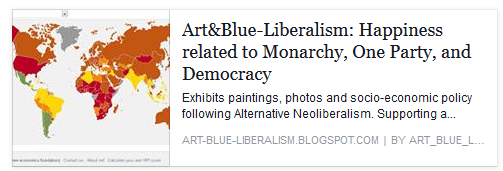
At the contemporary time period when Bentham was alive, there was little objective ways to measure the sum of individuals' happiness in each nation in the world. By contrast, due to the development of the information technology, we have become able to collect some peer assessed numerical indices of various social scientific data sets. This happiness index is also collected by objective view points and survey methods under an academic peer assessment. Thus, it is interesting to assess Benthamite calculus owing to this world happiness index.
The econometric analysis based on the Happy Planet Index (HPI) regressed on the climate effect, represented by the altitude of countries and its square, the binary variables, monarchy, aristocracy/oligarchy, and democracy, and their interaction effects, and the algebraic equation below is used.

The coefficients and their significance is as follows:

The coefficients of the variables showing the climate effect are 0.02256 for the coefficient of the absolute value of Latitude and -0.0004 for the squared variable of the latitude. Then, the formula shapes an upward parabola shown in the picture below.

Therefore, the place where the latitude is either +31 or -31 maximises the happiness of people living.
All the three binary variables denoting the single effect have a significant and positive coefficient. Both the interaction of Monarchy and Aristocracy and the interaction of Aristocracy and Democracy have a significant and negative coefficient. The coefficient of the interaction of all three variables is non-significant, so that the half of the coefficient value is used. The HPI derived from each different political structure is as follows:

This is a bar graph showing the policy effect on the H.P.I.:

These trends can be roughly visualised in a picture graph like this:

A nation with the direct democracy (Monarchy = 0, Aristocracy = 0, Democracy = 1 ) produces the highest HIP. But, Switzerland is the only nation with such a system in the world. So, it is not sure if it is still significant number of the sample to prove its superiority.
By only means of political structure, this seems to be plausible to conclude that a more decentralised political system provides individuals with the higher sum of happiness than the centralised counterparts. As shown in the previous chapter as well as the algebra introduced in this chapter, the centralised political structures have their unavoidable advantages such as the charismatic power of stabilising individuals and their community and the wisdom rationally conducting a positive planning of economy and judicature organised by the elite rational authorities. Nevertheless, this econometric analysis of happiness indicates that the centralisation seems to induce the frustration caused by the repression of majority's representation in politics. This analysis claims that individuals seek the satisfaction from directly representing their needs and desires in politics, and its availability of the representation is beneficial to increasing individuals' happiness overall.
John Dewey also argued that democracy (if possible, more direct for is more desirable) is pragmatically the best political system for both the material and the psychological/spiritual aspects. The reason why American democracy has been successful is that her decentralised political structure does not limit the opportunity of representing new innovative ideas to only few individuals. The decentralised system has enabled various obscure but talented individuals to represent their opinions and inventions into practice. Perhaps, the upward curve denoting the aggregate productivity curve, positively correlated to the rational centralisation, can be more flexible than it is assumed in the previous chapter. So, in the longer run than it is assumed in the previous chapter, the upward aggregate productivity curve may shift rightward as more technological innovations will become available in a decentralised politics.

On the other hand, the concern is that the excess decentralisation can be not optimum as the centralisation seems to be still partially beneficial. Therefore, the optimum equilibrium point which maximises the benefit of both the centralisation and the decentralisation. The next chapter explains about the equilibrium point.
4. The equilibrium

This project assumes that there is an equilibrium point which indicates the optimum point maximising both the aggregate productivity and the greatest sum of happiness together. The excess pursuit of the aggregate productivity increases the political cost which is the frustration caused by the individuals' unhappiness due to the excess control over their life by governments and big corporations. The excess pursuit of the individuals' happiness stagnates the aggregate productivity which supplies the material needs and the public safety. There is a balance matching both demand within the limited supply of resources and the level of enlightenment which encourages their individuals' self-autonomy.
However, the equilibrium only indicates the situation which is inevitable due to the resource limitation and the popular supports. So, this equilibrium point guarantees neither the stable growth and the happiness for all: This only indicates what individuals and/or their authority figures have decided and settled in. For example, the EU citizens and politicians are currently still suffering from the dilemma between the further centralisation needed for stabilising economy and their wishing further peaceful European integration and limiting centralisation for avoiding the monopolisation of political power and opportunity of representing opinions. For the current EU situation, her equilibrium point may merely indicates the possible but undesirable state. The equilibrium point for the EU may need to shift to overcome from this ongoing dilemma. They may expect for the further technological improvement or their change in political preference.
The place of this equilibrium must be different across each different country and culture depending on their market potential enabling their productivity rise and the preference over decentralisation or centralisation. The followings are the case studies of the equilibrium point.
* Case studies
Russia

Russia suffers from a lack of the market potential increasing the productivity rate. The low population density and the hard weather condition hinder the rapid productivity growth. The enlightenment to democracy and individualism hardly prosper despite the remarkable Russian wide spread literature and philosophers promoting. Each individual Russian individual has the ability and the spiritual hardiness to be self-autonomous and self-sufficient due to Russian hard weather breading their hardiness. By contrast, the division of labour is hardly accomplished due to the low level of aggregation of productivity owing to their inefficiency of transportation for distribution and capital development.
Furthermore, Russian citizens are well-cautious of defending themselves from their surrounding troublesome neighbouring nations. Due to the low population density and the low individual productivity level of individual Russian regions are very fragile against the invaders' attack. Russian low population density requires a strong assistance from the strong central authoritarian government conducting to aggregate and conduct the aggregate power of Russian regions spread across the wide Russian land mass.
All in all, Russia requires an intense centralisation to compensate her innate inefficient production capability. For the time being, Russian may need a collective productivity method gather her resources all over Russia and encourage individuals and their regions to collaborate by re-distributing both natural resources and individuals' resources to optimise Russian aggregate productivity level.
Nevertheless, when Russia obtains an opportunity to improve the efficiency of the transportation of distribution and the urbanisation process, Russia has a high potential to rapidly encourage individuals' emancipation from the authoritarian centralisation while increasing their aggregate productivity level. Majority of Russians are creative enough to have produced remarkable literature, arts, and scientists. Then. the positive exogenous shock of the aggregate productivity level combined with the free-entrepreneurship backed up by the more democratic/decentralised political structure will stimulate more innovative Russian individuals to contribute to the benefit of the entire Russia.
Africa

Africa suffers from both the inefficient environment of improving the aggregate productivity owing to the harsh tropical weather and the constant strikes of various epidemic disease threatening the population. In addition, African people's preference for their traditional tribunal community over the modern urbanisation process remains their productivity level low. In this case, the aggregate productivity level is critically low enough to discourage African people enjoying their happiness in their daily life. Even with a relatively decentralised political structure, their physical barriers of propping up their healthy life. Therefore, before enjoying their psychological/spiritual happiness in the decentralised political structure, they simply tend to physically suffer and pass away before enjoying it.
Regarding to the correlation between the decentralisation and the aggregate happiness, their preference for the decentralisation is not based on the enlightenment of self-autonomy seen in the Western nation: It is based on the very traditional sense of their good-old communitarian mind. The reason why the level of their centralisation does not rise is simply because of their disadvantage of constructing their modern centralised political structure. This is caused by their natural environment and their traditionalist characteristics, and they hardly achieve in the centralisation correlated to the aggregate productivity growth taking place in both the Western and Asian nations.

Africa is essentially in a severe environment of developing both their aggregate productivity and their happiness gained from the decentralisation. This situation seems to be extremely difficult to expect Africa to endogenously develop themselves to improve both their aggregate productivity level and their aggregate happiness level. Moreover, the exogenous shock suddenly improving their living standard also seems to hardly occur in the near future. Therefore, the supports from outside Africa, such as the foreign direct investments, the instruction by the global intelligence units, and various international charity organisations, seem to be the key to improve their living standard. The graph demonstrating the rightward shift of the aggregate productivity curve represents these physical supports from outsides Africa.
East-Asia

The East Asia is where the Confucian cultural influence of respecting orders and authorities and diligent and hard-working spirit is strong. This enables the East Asian nations to encourage individuals to stabilise their economy and politics enough to encourage rapid economic growth. Their diligence to commit themselves to learn and to work hard together by following the market mechanism and the legal codes. They naturally have a strong sense of meritocracy which encourages an efficient distribution of resources to the most effective individuals and organisations. Due to their ethnic characteristics of the autocratic culture, the negative impact of the centralisation is less significant than the other nations in the different culture. This characteristics promote the centralisation increasing the aggregate productivity by sacrificing little happiness. Therefore, the East-Asia has enjoyed the high material prosperity since the ancient time period, and their wisdom still prevails in the modern days.

Nevertheless, this unique characteristics of the East Asia with a high preference for the centralisation involve the disadvantage. As shown in the diagramme, when the positive shock of the aggregate productivity curve such as a new technological innovation and the sudden improvement of trades takes place, the positive impact is low or slower to appear than the other cases. As explained by the previous chapter, the decentralisation promotes individuals' self-autonomy and creative thinking. The centralised structure is effective to utilise the already existing ideas and technologies efficiently by optimising them in the division of labour and the political stability. By contrast, the centralised structure can be difficult to encourage individuals to think uniquely, differently, and innovatively to invent something not having existed. The decentralised structure allow more individuals to promote and represent their own opinions regularly so that the new innovation and inventions can be spontaneously discovered much easier than the centralised structure.
Latin-America

The Happy Planet Index (HPI) invented by the New Economic Foundation indicates that Latin-Americans generally achieve in a high HPI score than the others regardless of their economic and political environment. It is supposed that the climate efforts and their ethnic characteristics naturally promote their happiness. So, the dummy variable for the aggregate happiness is added on to the graph, which pushes the aggregate happiness of Latin-Americans higher than the others.
Unknown-Ideal

This attempts to explain one case scenario when it becomes possible to decentralise the economic political structure while sustaining a high aggregate productivity level introduced in one of the blog entries Pathway to the new economics and political theory.
After the end of the nation states, there will be an alternative economic political structure prop up and administrate the public sectors. The classical example of the cooperative has been seen as inefficient as well as ineffective in a wide scale economy and politics so that it seems to sacrifice the benefit from the productivity although it seems to promote a high benefit from the happiness.
However, as written in Pathway to the new economics and political theory, the development of the information technology and the demand for this alternative in the currently ongoing inevitable globalisation. The developed information technology may support the administration for determining who is responsible to pay for the coverage and how the coverage should be collected. As activities of individuals for both their business and private life are active enough to break through the constraint of national borders, it has become more difficult to determine which nation-state is responsible to collect tax from and provide benefits to a particular individuals as well as to judge which individuals is responsible for contributing to a particular nation-state.
There is an idea of establishing a transnational government tracking down individuals' activities and responsibility for the coverage of using public goods and services. But, this extreme economic political centralisation will substantially reduce individuals' happiness in a world scale. Therefore, the alternative option such as reincarnating the cooperative governance introduced in the classical economic theory might be worth-off to take into the consideration. Even though it is still not yet invented and successfully adapted, there might be an opportunity to physically put this plan into practice in the future. Any innovation, invention, and brave-attempts are encouraged and created when there is a strong desire of individuals for it. Without an idea induces individuals' aspiration and opportunity to discover the new resources, technology, and economic political system.
With the best wish of accomplishing the further enlightenment exploring the higher aggregate happiness on the bottom right side of this diagramme of this essay.
.
Subscribe to:
Posts (Atom)