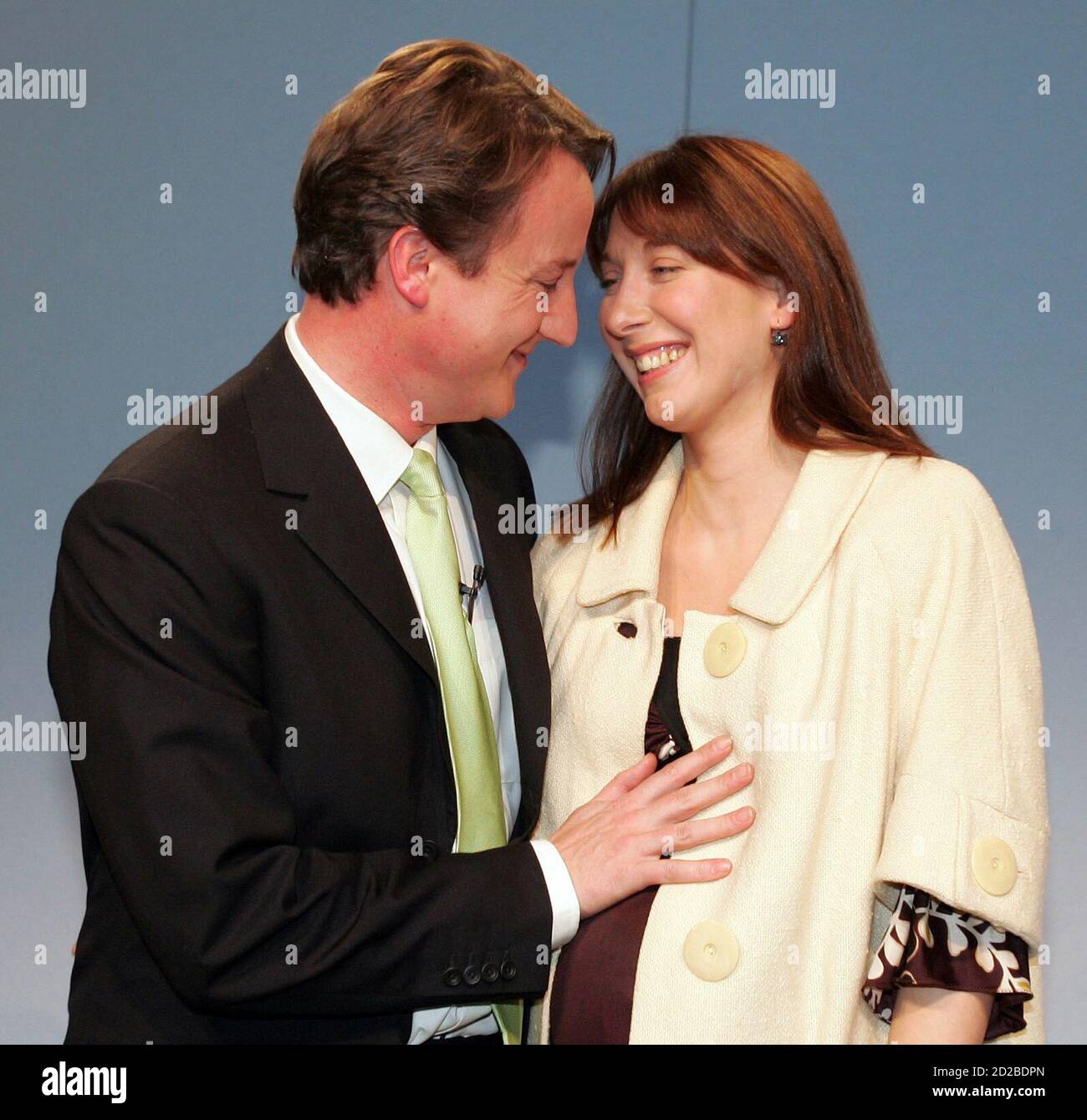
Mr. Devid Cameron with his modern Conservativision
and the reaction from opposing old Conservatives and the Labour 07/December/2005 (Imported from the web archive of Yahoo Geocities)
1. "There is such a thing like society; it is just not same thing as the state"
--- David Cameron the new Tory leader
Today (07/December/2005) finally Mr. David Cameron was elected as a new
Tory leader with 67.7% of votes from members of the Conservative party
having competing with Mr David Davis. The right hand side photo shows
David and Samantha (his wife) Cameron are celebrating such a glorious
triumph with a baby borne in Mrs Cameron. Although they have been in
quite exhausting life situation such as campaigning for the leadership,
taking care of two years old daughter and a disabled son and moving
their house this couple never seem like damned. Mrs Cameron will now in
the circumstances she must become faithful, patient, and tough to bear
the previously mentioned tasks in her daily life as her husband David is
now the leader of the British Conservatives that means he can hardly
comes back his home to spend with Mrs Cameron and their children.
Nevertheless they continue to show their cheerfulness overwhelming
duties in both public and private life. Today must have been the
thankful day for this honourable couple. All of us know this is their
turning point also called a new start line of life for this couple and
all individuals, not only those whom in the UK, those living in society
in a current world. David Cameron has succeeded to attract various
individuals (even those who are the anti-Tories!), with his youthful
energy and the passion to reconstruct the Tory party for the modern
society to gain the support from many individuals from any social
stratum. His policy seems to have strong charisma, there is no double
to say that as much as Mrs Thatcher has had, after this Conservative
party had suffered from the lack of the charismatic leader who can
compete with long reigning pair Tony Blair the prime minister and Gordon
Brown the iron exchequer from the Labour the everlasting opposition for
the Conservatives. Finally the Conservatives seem to have chosen
Cameron as a strong weapon to defeat these two loom large obstacles from
the Labour. Since Michel Howard retired his Tory party leadership the
leader election has lasted so long as this has been a quite
controversial and notable competition inside the Conservatives.
Generally the Tory leader election takes time as this time spent several
months, however the majority of us must have predicted Mr. Cameron wins
this competition as he is blessed by his enormous charisma from various
sorts of individuals. However this is only one step for Mr. Cameron to
the throne of the UK prime minister. All of us know the charisma from
the New Labour the pair Mr Blair and Mr Brown are always Tories’ strain;
and we also should know his opponents are also in his party.
2. "There are yesterday’s men with yesterday’s measures"
--- Harold Wilson the former Labour prime minister
Many of us may still remain the 1980s when we are still in the fearful
tension of the cold war, the conflict between authority based planned
and censored economic and market based laissez-faire economic syndromes,
the most notable Tory leader after the WW2, Margaret Thatcher the most
charismatic and successful prime minister from the British conservatives
in the post war period amended the misled idealised British economy by
the former Labour party with her classical economic style monetarism,
the laissez faire based political structural alternation, and the
conservative social policy to replace the traditional stabilised social
structure.

“There is not such as thing like society; there are only individuals and their family":
this is quite famous phrase Mrs Thatcher said under her regime which
refers to her socio-economic policy described in the previous paragraph.
This Thatcherism has been quite successful to induce the strong
monetary based financial industries into the UK and reduced the
government budget which had been feeding the expanding unemployed
population with no profitable state benefit, sustaining the
state-regulated industries such as huge manufacturing and mining
industries and rail track, and so over-pressuring the taxpayers to cover these
costs. However this policy has had the notorious adverse effect on both
economic and social structure. The over-exaggerated classical economic
operation has underestimated the possibility the business cycle can be
destabilised by the imbalanced economic power relationship between whom
does influence into the economic structure and whom does not, between
those can survive and those cannot after the structural alternation, and
between the insular UK and other 1st world countries such as
cooperative EU countries, the USA and Japan.
From the Thatcherite era The British conservative party has been already
well-known as Neo-liberalist party (also called New Right-wing or New
conservatism) which regards highly of free market economic operation
which regards the government should have little responsibility in the
economic operation to put priority on the individual liberty in order to
induce the effective competition between private businesses. The
right-side of Neo-Liberalism, which means, in economic term, far
Right-wing, is represented by the classical economist who denotes the
business cycle (the cycle of growth and recession) runs stable without
any fiscal intervention and only the government’s responsibility is to
sustain the non-profit maximising organisations, health, education, and
defence and the strong monetary supply.

Although it has not been sure if Mr. Cameron retakes the conservatives'
traditional classical economic concept or uses an alternative economic
strategy, he has suggested the conservatives would inevitably better to
alter their policy as whole in order to attract various individuals from
any social stratum. He has contradicted Ms. Thatcher's concept of
social imagination as he manifested "
There is such a thing like society; this is just not same as state." This phrase indicates that the government should be responsible to the individual life and cannot ignore social problems
that have been regarded by the conservatives as the facts the government
should not intervene into, rely on individual responsibility, and
replace with traditional life style contradicting the modern life style.
However it has been observed that this manifest does not mean to
induce the dynamic alternation of the conservatives' constitution unlike
the British Labour has altered from the old Labour one to the New
Labour one since Tony Blair came into the power. Mr. Cameron remains
one of the Conservative's strength "the business priority" so he may
intend to adapt more liberal policies in order to encourage more labour
force from the abroad to engage in British industries and encourage
individuals in society more progressive to adapt to modernised concepts
to develop British industries and enjoy better standard of living.
These Mr. Cameron's manifests have been indicated by "Financial Times"
the British economist news paper.
"Mr Cameron's more qualified support for business conserns is one of a number of changes in tone and emphasis, alongside a less hardline stance on immigration, collectively intended to reposition the Conservatives as a "modern, progressive, Liberal" party" --- Financial Times 19 December 2005
|
Even though the Conservatives have sticked in far more authoritarian
policy than the previously mentioned one Mr. Cameron empathise on such
as defending pure classical economic policy, remaining small government
which is less likely concern community and society, claiming for
traditional nuclear family life style, limit on the number of
immigration and so on. Mr. Cameron has enlightened the Conservatives
cannot survive without alternation of the unpopular previous
authoritarian values which do not attract people in current society by
means of the changing life style and individuals' social imagination in
the current world. Individuals have seemed more sensitive on adopting
international perspectives in their life, unpopularising traditional
nu-clear family, more opened sex value, over-exaggerated Thatcherism,
and increasing the value of the global standard business corporations
which require meritocracy regardless of national identity.
Among the previous mentioned Mr. Cameron's modern conservative policy,
he conversely encourages antagonism from old conservatives who detest
his modernised conservative policy and defend pure Thatcherism.
Therefore it has been argued nodoubtedy this will be the conflict among
British Conservative party between Cameron's modernisers and old
conservatives.
3. "This is same as old conservatives"
--- Gordon Brown the labour government exchequer
|
Nonetheless, Gordon Brown the Labour government exchequer nicknamed as
"Iron Exchequer" from Scotland is less likely to concern about the new
conservative leader. Mr. Brown persists this election may not alter the
British conservative policy as Tory still remains as same Tory. This
aspect implies Mr. Brown, Mr. Blair the current UK prime minister from
the Labour and other Labour members as the British Labour still keep
their support although the number of votes for the Labour has declined
in the last Westminster parliament election in spite of the immense
number of votes in the previous 2 elections having taken place.
Although the constitution alternation having disappointed some of former
Labour supporters and the dispatch of British troops to Iraq to support
the USA regardless of the international role have depopularised New
Labours, the New Labour still reign as the government party for 15
years.
| 
|
The proud as a popular long reign government is rooted by the stable
economic growth after 1990s. Abandoning inefficient nationalisation of
industries the New Labour economic plan adopts the market economy as the
pragmatic economic operation which encourages competition between
individual industries and saves the public service costs to attract the
middle class citizens having increased from the post war era. This
constitution alternation has succeeded to attract former Tory supporters
after the Labour has struggled with long Tory regime and experienced
breakaway of some members who established the Social-Democrat Party.
Even though majority of socialist individuals most notably Marxists i.e.
left-wing economic supporters have disappointed the New Labours because
of the Tory alike policy. However some socialist individuals, mainly
Social-Democrat alike ones i.e. center-leftwing, remain as New Labour
rutins because "this is still the Labour!"
Mr. Brown's unique economic policy has been considered especially by
Labour supporters as the cause the UK economy has become stable. Mr.
Brown's economic policy is the distinctive Keynesian kind economic
policy (*Keynesian: the group of economists believing the business cycle
needs controlled e.g. government intervention by fiscal policy)
innovated by Mr Brown so called "Golden Rule". The "golden Rule" uses a
unique fiscal policy that takes the recourse of government subsidies
from, instead of income tax, borrowing from bank so then while it
prevents lowering standard of living, it can restrict over consumption
causing to hyper-inflation and also increase the profit of banks.
However, Mr. Brown has bid up the indirect taxation on particular
commodities such as inelastic resources such as oil, some elastic
commodities, and habit formings (alcohol, cigarette, etc) for both the
resource of government expenditure and the Keynesian rule i.e.
controlling business. According to the Keynesian rule cycle he
advocates this rule intends to control the amount of these burden taxes
depending how business cycle runs at current time.

Nevertheless, Mr Brown's Keynesian rule has been suspected to bid
burdened taxation especially corporation tax further than controlling
business cycle by non New Labour economist thinktanks. It has been
claimed he intends to increase the public expenditure in order to
sustain the level of public service the Labour aims to achieve. Tory
Economist thinktanks claim Golden Rule does not seem to apply to lower
the gradient of rising taxation even though the business cycle comes to a
peek of the boom. This study denotes Mr. Brown tends to assume his
mechanical fiscal policy and his centralised economic plan do not
precisely apply to calm down the fluctuation of the business cycle.
Majority of non New Labour economists thus assume Mr. Brown as a
"simulator" who underestimates misleading affects inducing further
fluctuation on business cycle. This simulative Mr. Brown's fiscal and
centralised policy interlinks to the following topic about
"continuing/compromising in expanding the North-sea oil firm".
4. The North sea oil firm & European Union
- Choice whether Continuing/Compromising in expanding -
The heating point Mr. Brown's fiscal policy has been suspected it is not
perfectly healthy for the market economy is that his corperation tax
bidden up on a near day to gain further resourse for the government
expenditure on public services. Although Mr. Brown has stressed this is
also beneficial to calm down the boom of growing UK economy i.e. the
Keynesian economic operation, the UK may miss the opportunity to explore
the further capacity of the oil firm in the North sea. As the
extra-burdened corperaiton tax has discouraged the investment from
transnational corperations such as "Shell" and "Esso" in the
"blend-spun" in the oil firm although it has been presumed there is more
capacity to drill further down the spin. To cover the cost it
inevitably needs the support from the big multinational corperation,
however this business chance might be ignored if Mr. Brown persists in
his fiscal operation. Therefore Tory economic think-tanks claim to
reduce the coperation tax on the profit of these investors.
- Strategy for "the UK in European Union" -
The British conservative party is the quite notable party which has
persisted in anti European Union stance although there are various
levels of the sceptism.
| 
|
Some Tories claim the UK should be completely independend from the EU in
order to accomplish their economic independence and take the control
over theri own immigration control. Other majority of Tories affirm the
UK should be intergrated into EU more by means of sharing defence
territory with other EU countries and establishing branches of UK owned
business corperation in relatively less economically progressing nations
inside EU in terms of the relative advantage in a trade; however the UK
monetary must remain Sterling (£) as currency due to the concern from
the future hyper-inflation of Euro (). As a matter of fact, the
European Central Bank (ECB) has been suspected it has lost the capacity
to control the inflation. Most notably, Gemany, where the ECB is
situated because of its historical reliablity (Germany has experienced
harsh hyper-inflation for several times so is sensitive against the
hyper-inflation) is currently in the crisis of inflation for a few years
inspite of its famous reliable monetary policy. Also Italy, where
Milan one of the world biggest financial institution is situated, has
suffered from the same crisis as Germany because of the influence from
over estimated credibility of Euro the universal currency in the EU.
The well-known disadvantage of such universal currency is concerned with
the possiblity to induce hyper-inflation. The rapit publishment of
currency stimulates rapid rise in the demand for this currency. The
immense scale of currency transaction require extremely sophisticated
monetary control and well predicted future plan for the capital
expansion relying on this currency transfer. Even though the ECB and
Milan have had famous history as the sophisticated financial
intermediary, controlling underling inflation of Euro may become the
bizzare challenge for them or even the under-estimated disaster to
destroy the reliability. In consequence of flowing Euro, there seems to
be little advantages if the UK adopts Euro instead of Sterling(£)
unlike some mediterranean and Central&Eastern; European countries
which do not have much control in inflation.
5. Conclusion: "Modern, Progressive, Liberal" party
--- David Cameron in Financial Times 19 December 2005
Having looked at these relative issues to the competition between Mr.
Cameron and his disciples and his oppositions who are both inside and
outside Tory, Mr. Cameron seems like a rising star of British
conservatives whereas critiques against Mr. Cameron may oppress his
confidence as the new reader. Despite the fact Mr. Cameron indicates
main manifestos which Tory (since the Thatcherite era) have indicated
most importantly such as business priority, tax-cut, and Euro-sceptic
policy, Mr. Cameron has been recognised his manifests sound less likely
to be Tory as anti-modernisers in Tory are highly sceptic against Mr.
Cameron's modern conservativision. In fact, Mr. Cameron has been
contradicted as too young to become a Tory leader who must be
responsible to defeat the New Labour's strong charisma. However Mr.
Cameron inevitably oughts to seek consensus with all Tory members as he
cannot perform like a president in federation system, who has the
independent control over individual parties, due to the parliamentary
cabinet system so then Tory members are more likely to expect just for
Mr. Cameron's charsma and youthful passion rather than his own modern
conservativision. Nevertheless, Mr. Cameron's modern conservativision
seems enough attractive to expect to raise the support for the
conservative party. This modern conservativision is indeed attractive
to all individuals living in current society and plausible element to
reform the party to become a modernised and progressive governmental
party. In terms of liberal economists' perspectives his modern
conservativision has been recognised as healthy for market economic
operation as it may encourage pure meritocracy, anti-statism, individual
liberty, more liberal social policy, etc those are beneficial to
improve market economy and international trades and communications to
consider the UK as a "party of the world".