2.1. From Natural Right to Kantian Deontology:
The previous chapter explained that the idea of Natural Right is the base ethical principle for all various political ideology groups in America. There is no one mainstream opinion leader of politics, and various political ideology groups compete each other to gain the popularity. However, there is one shared fundamental principle which all these different political ideology groups share, and this principle exists as a nonhuman sovereign of America. This is called Natural Right, which means the naturally given right, which regards that there is a naturally given impregnable right provided equally to all human-beings, and all individual citizens and their nation must use their best effort to protect and furthermore promote.
American theists believe that the provider of this Natural Right is God. Natural Right theory is heavily influenced by Christianity because John Locke, the father of Natural Right, was a devout Christian. The original founding principle of America was Protestantism because majority of European immigrants moved to America during the establishment period were Protestants. The founding fathers of America were devout Christians, and aspired to enable be Christianity more influential in their new home country America than their previous home country in Europe.
When several years after American independence had passed, the change in American people's mind started taking place. During the 20th century, the new modern political ideology emerged in Europe, and this spread the strong scepticism about religion, history, culture, and the pre-existing perception of this world in Europe, and then the rest of the world afterward. The mastermind of this movement was Immanuel Kant, and his followers encouraged this movement. America was not an exception from its influence, and in a different form from the others, the influence was way stronger than the rest of the world.
The speed of spreading its influence was slower in America than the rest of the world due to Americans' strong resistance against this European born politics which seemed to decay the traditional American Liberal Democracy based on the Natural Right ethics originated from Christianity. Nevertheless, because Kantian ethics was evolved from Lockean Natural Right theory, Kantian Deontology was familiar to American political culture. As same as American traditional Natural Right theory, Kantian theory puts emphasis on the universally right morality, an absolute truth, and the challenge against the reality, and these characteristics of Kantian philosophy corresponded to American personality. More than Europe, because the natural right ethics is more influential in America, Americans are more likely to constantly put emphasis on the universally right morality, aspire after an absolute truth which they believe in, and express their world view by means of their idealism. Then, Americans adapted Kantian philosophy to America as a different form from the European counterparts.
After some time passed, agnostics and atheists started appearing in America. But, even though the characteristics of someone changes, the fundamental quality of the innate personality of all the people tends to remain unchanged. As America, the nation, was born as a Christian and Liberal Democratic nation who has a strong invincible universal ethical principle, American agnostics and atheists tend to look for the agnosticism and the atheism whose fundamental characteristics is similar to both Christianity and the traditional Natural Right. Kantian characteristics of God-less monotheism has attracted many American individuals who were disappointed by Christianity for some reason, and then Kantian Deontology has become an alternative belief for these Americans which is different from Christianity but whose characteristics is similar to Christianity.
Kant was a German, but his ethics as well as the legal philosophy influenced by Kantian ethics seemed to be more influential in America. In European and any modern secular nations, the objective of creating legal codes of law and imposing the law enforcement is the economic and political stability. Then, in these nations, morality is considered to be relative to various different cultures and situations in these nations so that morality tends to be considered not as a primary matter in law. Therefore, their social justice tends to refer to the objectively (Kantian theorists call "hypothetically" instead) determined measures and values such as property values, utility (pleasure minus pain), and any form of physical or psychological sanctions predicted to induce a desired consequence i.e. the stability. By contrast, American social justice regards highly of the abstract but absolute universal moral code equally important as or sometimes more than any legal legal codes of law which Kantian theorists may call hypothetical (Not categorical). All in all, Kantian ethics and legal philosophy deeply corresponds to American mentality and was adapted to one of the big political ideology groups of America (The other groups tend to be deeply sceptical about Kantian philosophy due to its compatibility with their characteristics and political aim).
2.2. Rise of Wilsonian
Woodrow Wilson shaped a new form of American politics, and his political philosophy, called Wilsonian, has become the most dominant American political ideology in 20th century onward. Moreover, Wilsonian is a compatible American ideology with the modern idealism created by Kant and Hegel even though Wilson himself was not categorised as either Kantian or Hegelian. The combination of Wilson's political philosophy and the ethics of Kant and Hegel became to be known as the international Human Right activism.
Wilson himself had not declared to enthusiastically support Kantian philosophy, and his admiring political philosopher was Edmond Burke whose philosophical principle is totally different from the counterpart of Kant and those influenced by Kant like Hegel. However, Wilson's original political philosophy somehow shares a very distinctive similarity with Kantian deontology, and Wilson's political principle had turned up to be similar to Kant's ethical principle. Kant's ethics attempts to create an ethical principle because it is totally unique from any existing philosophical principles. Wilson’s Burkean philosophy encourages thinking beyond any existing philosophical principles. All in all, both Kant and Wilson aspire to invent the new methodology of imagining and accomplishing in their transcendental ideal world which completely deviates from the philosophical axiom and the wisdom of life which had ever been invented. The characteristic of their idea was very different from each other, but the quality of both was identical to each other.
Since Wilsonian became popular in American politics, America has started aggressively intervening into various foreign affairs of the international politics as the opinion leader of the International Human Right activism. American international interventionism used to be merely motivated by the materialistic interests. Nonetheless, when Wilsonian politics was introduced, America started intervening to the international politics by means of her moral interests on the top of the materialistic interests. Wilsonian attempts to combine the power of the federal government, which Hamiltonian puts emphasis on, and the consistent attitude toward the pursuit in the political ideal which Jeffersonian insists on.
Wilson himself condemned Jeffersonian politics and admired Hamiltonian, but his enthusiasm of pursuing in American Liberal Democratic ideal was very similar to how Jefferson did. Wilsonian also insisted on the strong federal government for not only the economic and domestic political stability but also maintaining the strong unified moral standard and protecting and promoting American Liberal Democracy and its base principle Natural Right. It is similar to Jeffersonian in terms of its moral obligation. Both Jeffersonian and Wilsonian expect America and her citizens to be well-enlightened with American Liberal Democracy and her ideal.
Nevertheless, Wilsonian accuses Jeffersonian scepticism of a strong paternalistic federal government. Wilsonian regards that the federal government is responsible to be operated as a guardian of American Liberal Democracy, and the union of states under this ideal. Meanwhile Jeffersonian believes that securing and prospering Liberal Democracy in one country is already a big challenge, Wilsonian states that the international corporation of spreading Liberal Democratic ideal is essential to establish stability and prosperity in the liberal democratic world as well as maturing the own liberal democratic nation.
* These 4 political ideology groups are referred from “Special Providence: American Foreign Policy and How It Changed the World” by Walter Russell Meade, 2002. But, these descriptions combines Meade's analysis of politics and history of the international relations and mine mainly based on economic policy.
As Wilson was a big admire of Alexander Hamilton, the way of Wilson and his follower Wilsonian to structure American political system is very similar to Hamiltonian way. Wilsonian insists on the stable unified monetary system under the common currency usage and the central bank's supervision. The traditional Wilsonian claims for regulations imposed on the private sector intensive market economy unless it interrupts the healthy economic growth. Wilsonian assists American international trade expansion and big businesses unless these things threaten American national interest.
The big difference between Hamiltonian and Wilsonian is budgeting the public finance. Hamiltonian is far more sensitive about balancing the budget than Wilsonian. Hamiltonian purpose of the government expenditure is to secure the necessary infrastructure basing both economic growth and domestic political stability, and the peaceful international trade roots. By contrast, Wilsonian government expenditure plan is aimed to achieve its political and moral objective in both the domestic politics and the international relations on the top of what Hamiltonian insists on. Hamiltonian objective of government expenditure plans are materialistic and regard the moral issue can never be the primary purpose. So, meanwhile Hamiltonian objective is more visible and a shorter perspective, Wilsonian government expenditure plan is motivated by the moral achievement. The Wilsonian plan is quite difficult to estimate when the objective will be fulfilled and how much cost will be incurred upon this plan. In addition, Wilsonian moral objective may sacrifice the material objectives such as an economic stability and cause a strong antagonism from the other political ideological groups from both America and abroad when this plan takes significantly long enough.
On the other hand, despite the critiques of Wilsonian imprudent fiscal management based on its zealous moral commitment, there were several occasions which demanded a stubborn persistence encouraged by Wilsonian kind of an intensively strong moral commitment in order to keep America united for American future prosperity and her strong initiative in the foreign diplomacy. Wilson was the remarkable figure who established a distinct political ideological group retaining his political ideology. But, before Woodrow Wilson was born, there were already some political leaders and political thinkers who had a similar political ideology to Wilsonian. There have been various political events in American history which required the stubborn persistence even to cause the fiscal imprudence and the antagonism from enemies as well as allies. The most notable one of them is the American Civil War, and Abraham Lincoln could be seen as the most remarkable Wilsonian who had already existed before Wilson was born. In fact, the best role model of Wilson was Lincoln, and so Wilson looked upon Lincoln and imitated many Lincoln's policies and customs. Therefore, it can be quite legitimate to categorise Lincoln as one of Wilsonian politicians.
* The description about these American political ideologies refers to “Woodrow Wilson: A Biography (Vintage)” by John Milton Cooper, Jr., 1 Jun 2011
2.3. Discussion on American Civil War: Prequel of the Fate: Lincoln’s Fundamentalism over Consequence
The American Civil War from 1861 to 1865 was the most remarkable political event in the entire American history. The way American behaved in this war describes the fundamental characteristics of America. Also, this time was recognised as the first time when America reinforced her federal government power to impose their law enforcement by means of the moral reasoning and the political idealism on the citizen of this nation.
It is still a very controversial topic to define what the exact causes of this civil war. Despite that many historians and political scientists concluded that this was caused by the slavery issue and the South's secession from the union, there seemed to be so many various causes, and the Confederacy (The South) had many legitimate reasons to fight against the Union (The North). The Southerners nowadays call this war the "The Aggression from the North" instead of the American Civil War. To be fair, both the Union side and the Confederacy side certainly had their own politically and morally legitimate causes and reasons to fight against the other. Regardless of the cause of this war and the reason of both sides, this chapter of this essay focuses on the consequence of this war and the contemporary attitude of the Union government lead by Abraham Lincoln.
The war was prolonged longer and the war damage was more severe than estimated. The resistance of the Confederacy was overwhelming and persistent enough to prolong the war more than the Union government expected due to the Confederate able commanders, soldiers' morale, and geographic advantage.
The scale of this war was incomparable with any war having existed in the past. The newly invented technology of weapons was destructive enough to dramatically increase the death toll per its usage. The logistic for the supply in this war incurred the huge cost because it required to build locomotives and railroads as fast as possible. The Confederacy requested for the assistance of Europe, their important trade partner, to secure the sea trade routes after the Union imposed the naval blockage on the Southern sea to sabotage the Confederacy's trade with Europe. Then, the Confederacy and Europe started increasing the speed of building transport and war ships. However, the Union productivity was significantly higher than the Confederate counterpart so that the Union overwhelmed the Confederacy in this competition. All in all, the industrial productivity level was a critical key aspect to defeat the opponent so that both the Confederacy, assisted by Europe, and the Union competed for increasing their industrial power as faster than the opponent as possible.
The high price inflation hit the entire America due to this tremendously resource consuming war. The demand of production was always consistently higher than the supply capacity. So, the transaction speed of goods and services were high, and the government's demand of goods and services produced was very high so that the currency was always in short during the war. Therefore, when the war broke out, Lincoln administration started printing the new currency notes called Greenbacks in order to finance this expensive war. This caused the quantity of currency issued to be significantly higher than the increase in the aggregate supply of productions. This was the trigger of the high price inflation which harmed American people's life and the post war economic recovery. The income gain of people was always lower than the price rise of goods and services. Furthermore, the perpetuated inflation after the war harmed businesses due to the rising operation costs.
Due to these critical material disadvantages, any Hamiltonian would claim to stop the war when it was predicted to burden a sizable cost on economy which would haunt badly in the future. But, at the beginning of the war, Hamiltonian in the Union side would agree with the war in order to keep the national economic well-beings secured under the stable union of states. Hamiltonian in the Confederacy side would support the secession to put priority on the trade with Europe over remaining in the Union. The Union started enforcing the South to suddenly alternate their industrial features and follow what provided more advantages to the North then the South. In addition, the Union started interrupting the international trade between the Southern states and Europe, and then Hamiltonian in the Southern side supported the Confederacy to maintain the socio-economic stability and the international relationship with Europe. Nevertheless, when they started recognising that the Union naval force was invincible enough to keep blocking the trade route and the Union productivity level was far superior to the Confederacy combined with their European Confederacy supporters, Hamiltonian realised that it was far more costly to support the Confederacy, and more profitable to support the Union.
Not only these previously mentioned physical living standard but also this war severely depreciated the mental and spiritual living standard as well. Majority of historians and political scientists recognise this war as the first modern total war in the human history because the aggregate material productivity of one nation significantly affected the national military strength in this war. Therefore, a military force started using the mass destruction such as a scorched earth policy to reduce the aggregate production level of the opponent. Then, this war is seen as the typical example how more ordinary citizens have started to be involved in a war than ever, and the strength of national economy and the foreign diplomatic relation have become the key to win a war since then. Therefore, this war killed not only many soldiers but also many civilians, and also severely affected their life style so that a strong ressentiment attached to this war remained in both sides.
George McClellan, one of the Union generals and the nominee opposing Lincoln in the 1964 US presidential election, supported the ceasefire of this war due to the tremendously high cost and the unexpected tragedy of American people. McClellan himself was a devout supporter of the Union cause as well as abolition of slavery and defending Natural Right for all Americans. His philosophical commitment in these cause was stronger than majority of Americans. Nonetheless, he realised that the war damage was underestimated and the cost of it would keep haunting after the war ended as long as the war was prolonged further longer. Therefore, after dealing to the Confederacy enough to exhaust the Southern majority citizens and weaken the Southern economy, he recommended America to wait until the Confederate economic and political power naturally collapsed due to its lack of ability to compete with the Northern economy. As a matter of fact, his plan was materially efficient and peaceful, and sounded far more plausible than Lincoln's perspective by means of economic and social aspects.
By contrast, Lincoln persisted to continue this war until the Confederacy's defeat became clearly certain and the Confederate government officially surrendered to the Union even by using some ruthless brutal forces. For example, on the top of the previously mentioned huge economic loss and people's unbearable sufferings, the Union decided one notirous scorch earth policy called "Sherman's march to the sea". This march destroyed the entire towns and villages on their passage in order to cut the Confederate supply base and transportation network. In America, Lincoln's aggressive manifest, which is often seen as even brutal, was favoured by majority, and the majority Union politicians were not hesitate to completely agree with him. Moreover, even though McCellan's passion for the Union cause was never weak nor diluted, McCellan started to be condemned as being too soft on the traitors, and then he was miserably expelled to Europe from America due to his unpopularity among Americans then.
Lincoln affirmed that this war was not based on the material interests so that the meaning of this war was to maintain the impregnable spiritual characteristics of America. This was the ideal of America created of people by people for people. This ideal is the natural right initially explained by John Loch and the American founding fathers, and evolved further by the modern idealists inspired by Immanuel Kant. Lincoln thought that defending the Natural Right ideal was an unremovable factor of American identity, and then authorised the Union federal government to become the guardian of protecting and promoting the Natural Right ethical principle. In order to keep the Natural Right principle surviving, Lincoln believed that there should not be any exempted state from strictly following the universal morality based on this principle. Hamiltonian regards that, as long as America is a wealthy nation, the Union will be maintained because Americans will assume the Union brings their wealth. Lincoln also thought of the material well-being and keeping the Union was the key to achieve it. Nevertheless, he was afraid that any small collapse of this American spiritual identity would induce the domino-effect of this continuous collapse of this identity, which would eventually collapse the material well-being when America would no longer be united.
These stories convinced Lincoln to put priority on defending and promoting the unified fundamental ethical principle for all individuals and their states under the federal paternalism even by sacrificing the fiscal stability and causing some big antagonism. This war conducted by Lincoln certainly characterised the modern America and her future. Wilson reincarnated Lincoln's policy, and theorised Wilson's own thoughts inspired by Lincoln. Afterward, the mainstream democratic party members became converted to the policy of Lincoln and Wilson after observing the remarkable Wilson's Democratic party administration. Since America became powerful in both economy and foreign diplomacy and her action became influential to the entire world, the paternalism manifested by both Lincoln and Wilson was put into practice for not only the united states of America but also the other foreign countries.
Jeffersonian at this time strongly disagreed with Lincoln because Natural Right also puts emphasis on each state's right and sovereignty not violated by the federal authority. By contrast, Lincoln, and Wilson later, criticised Jeffersonian disadvantage of not able to guarantee to secure the system providing all American people with Natural Right when many states decided to compromise the Natural Right ideal. Thus, Lincoln and Wilson claimed that there has to be a strong cohesive force preventing states deviating from American ethical principle. The modern Jeffersonian accepted this claim, but Jeffersonian is still highly against Lincoln's and Wilsonian style big federal authority. Jeffersonian is worried about "The power to do good is also the power to do harm." as Milton Friedman said.
2.4. What Edmund Burke could not predict about America
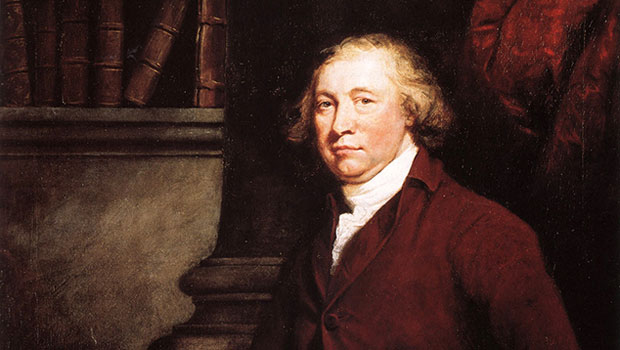
Edmund Burke, one of the famous Classical Liberalist philosophers as well as the supporter of American independence, could not predict such future outcomes like the rise of Wilsonian ideology and this transformation of America. Burke noticed that American independence was emerged in order to provide people in the new land with liberty even though Burke tends to be seen as a devout British monarchist. One of the reasons why Burke supported American independence was that the over-expansion of British empire resulted in the expansion of bureaucracy in both her domestic policy and colonial management. He was worried that this was a big threat for the healthy stable development of Great Britain, and the cause of the collapse of the traditional laid-back British culture. In addition, the contemporary British bureaucratic administration was brutal enough to deteriorate the culture of British new land America. Burke detested brutality especially imposed by authority, and despised the loss of beauty and sublime caused by this brutality. Therefore, Burke stepped up to encourage American independence as the negative sanction against the contemporary British policy.
Nonetheless, despite his enthusiastic support for American independence, America has actually become the nation which Burke would disagree if he were still alive in several decades after the independence. Even though Burke supported American independence, and he despised and protested against French revolution. He distinguished American Revolution from French revolution because each of them was based on the different political reasoning process from each other. American independence did neither attempt to replace the American culture nor imposed a notorious brutality like massacre and an execution of the state figure head. French revolution incurred the tremendous pains such as committing a huge scale massacre of the old status quo.
What the point that Burke criticised at most was that French revolution was motivated by sticking to the fundamental principle. He warned that human-beings' experience, knowledge, and rationality to construct logical inferences are still way too limited to enough to draw and construct their dreaming ideal politics. Therefore, there principle basing their political ideal can never be rigorous as much as mathematical axiom. Moreover, sticking to one principle tends to misguide individuals to ignore obtaining the furthermore sets of knowledge and impression from new experiences when they deviate from their believing principle. He also insist that the traditions having existed in the past which the believers of the fundamental principle reject may have some beneficial characteristics useful in the future. Many traditions have to be evaluated and contradicted in order to expect a productive progress from the past to the present, and to the future. He insisted that human-beings should neither stubbornly stick to the entire traditions nor completely ignore them.
Burke described that the danger brought by French revolution was caused from this fundamentalism of believing in the ethical principle and the complete abandonment of the past traditions. He recognised that American revolution was not detached from carefully reevaluating the traditions which retains beauty and sublime from the past, and then American revolution was motivated by the basic needs rather than the fundamental principle. He argued that American independence was the natural transition of British governance to transform British administration more able to handle with the smaller bureaucratic scale. By contrast, French revolution was motivated by the fundamentalist bureaucrats of their new national legislature based on their believing fundamental principle.
Burke could not predict that American ethical principle called Natural Right became to govern the entire America as a nonhuman sovereign after throwing a human sovereign, a British monarchy away through her life. Burke was sceptical about John Locke's ethics as he had written a lot of criticisms about Locke's ideas. Nonetheless, Burke's understand of the contemporary America was a piece of British colonial territory, cohabiting the other European colonial territories inside American continent, who was struggling with the contemporary overgrown British bureaucratic occupation. He did not imagine American have finally occupied a large land mass of the Northern American continent, chosen to unify themselves under a strong unified principle in order to maintain their big nation, and become a stronger and influential nation than her former suzerain Great Britain.
After America abandoned the colonial master, they started worshiping their political idealism as their alternative sovereign of their new nation. American politics is still never comparable with the French fundamental principle base politics causing a brutality and political and economic inefficiency. However, it has shown that American worship of Natural Right as her ethical principle contains some element motivating an aggressive pursuit in their strongly believing ethical principle such as the political action taken by Lincoln, Wilson, and onward. Burke might have shrugged and revised his own political agenda if he had been alive and observed how Lincoln and Wilson changed America to be.
Saturday, November 23, 2013
Saturday, November 16, 2013
America and her base ideological principles: Pt1
1.1. Rise of a Recklessly Idealistic Nation called America
The birth of a nation called the United States of America (America) was a miracle at the contemporary time period. This was a democratic republican nation whose political administration was lead by democracy where majority of the people were actively participating in the political and diplomatic decision making processes. This was a Liberalist nation whose foreign diplomatic strength was derived from well played strategies in peaceful international trades rather than military power struggles. Nobody could believe that a nation who had no strong unified sovereign power could sustain both her domestic political stability and her defence strength against aggressors.
America looked bizarre and was unthinkable at the contemporary time period. Montesquieu and Rousseau aspired after establishing an ideal world where individuals and their nations keep their peaceful diplomacy without strife by promoting an equitable trade among them. This ideal was certainly desirable, but it was seen as a reckless if it were to put into practice in the real world politics.
Great Britain has partially taken this ideal politics into practice since she expanded her international trade network. The policy of other European countries in their international relation during the modern time period was based on the extortion of wealth from their colonies as well as the other territories in the world by their military might under the command of their sovereignty. By contrast, though it was to the certain extent, Great Britain treated her colonial countries as her trade partners so that she allowed her colonies to accumulate their own wealth. Furthermore, Great Britain took an advantage of her dominance in seas in the world, and she expanded her friendly international trade relationship with the other countries and territories. She combined her military strength with her wisdom in the free international trade. Aristocrats and bourgeoisie in Britain seemed to know that they would certainly be able to extort more from both their colonies and the other trade partners after letting them grow in the free and equitable trades.
Great Britain is also the nation which has developed the modern democracy from a much earlier time period than any European nations. The notion of the equality of all aristocrats and commoners under the law since the Magna Carta was signed, of the republicanism provoked by Cromwellian revolution, and of the parliamentary democracy under the constitutional monarchy established by the glorious revolution are complementary with establishing a modern democratic nation. Both British monarchies and aristocrats (Though there were some reactionary ones who opposed to the democratic development in British politics) tolerated the freedom of speech and choice promoted by the modern democracy because it has actually produced huge profits for not only bourgeoisie, the emerging well off social class, and the commoners but also the monarchy and the aristocrats. The openness offered by the democracy encouraged various new inventions which profited the entire British nation. The competition among politicians and entrepreneurs with their voluntary will, rather than the unilateral autocratic command enforcing them to act involuntarily, was the efficient and effective way to motivate them to work for the monarchy's interest and providing the aristocratic investors with high returns.
The combination of these political notions and the wisdom of liberalism gained from the free trade have grown the modern liberal democracy ideal in practice. Great Britain took advantage of the liberal democracy, and resulted in the situation that one of her colonies increased the political and diplomatic influence. This was America. America has taken over these characteristics of Great Britain as America was once a part of Great Britain. In addition, since America became independent, America has promoted the domestic policy and the foreign diplomacy based on democracy and the international trade, which used to be seen as utterly idealistic, furthermore. America was a nation which was seen as recklessly idealistic as well as unique more than Great Britain.
There were several schools of political ideologies competing in the decision process of inducing their desiring outcomes for both the domestic policy and the diplomacy. Unlike Great Britain, as there was no hereditary monarchy who shares with his/her family, there was no strong single sovereign who had the right to choose the final choice of decision making process. The president could be seen as a sovereign, but the president was constantly replaced, and the political ideology was also frequently switched over again and again because a newly elected president often believed in and supported for a different school of political ideology from the previous one.
Before Great Britain and America emerged, all the nations believed that America's policy was unreal. The realistic view of politics at the contemporary time regarded that a strong military might commanded with one charismatic sovereign was the primary importance to secure and increase the wealth and hold an initiative in foreign diplomacy. Even nowadays, some schools of politics and foreign diplomacy still claim that there always needs to be a solid guardianship by an executive branch with a unified ethical principle. These realists assume that there always needs someone who is effective and virtuous enough to lead the others to stabilise the decision making process and derive the expected outcome. Then, they argue that it is utterly unrealistic to "expect" for spontaneously stabilising outcomes by letting all various individuals do freely. They consider that the autocratic executive branch needs to exist to stabilise the decision making outcomes and instruct citizens to follow a certain form of norm and value which the unified ethical principle suggests citizens to follow. Furthermore, they also insist to collectively plan economy to avoid the unwanted actions and outcomes instead of letting individual agents to freely choose and act. This traditional realism in domestic policy and foreign diplomacy is called the Continental Realism. America has been following to what the school of the Continental Realism describes as unrealistic at the contemporary time. None would believe that such a fragmented idealistic nation could grow so much as becoming the world most strongest nation in the future.
America seemed to be an unstable nation. However, although American politics has been administrated by fragmented groups of political thought, these groups and American people shared the common ethical in politics. Because America is a democratic republic nation without a unified political decision making code, majority of American people think their voice frequently represents American politics and American future and so actively participate into politics. Because there is neither a hereditary monarchy nor any paternalistic autocratic executive branch who would have a final say in politics, it looks like resulting in unstable outcomes where the ongoing havoc continues to takes place.
Nonetheless, even though there are more than one fragmented groups of political thought which American politicians and people belong to, majority of them share the common ethical principle which is called the natural right. When America was founded, both Christian value and the enlightenment philosophy of the natural right, most notably spread by John Locke and Thomas Paine, were introduced to be the base universal ethical principle of American nation. There was no monarchy, or no autocratic executive branch, who guides the nation to follow or refer to their suggesting principle, American nation is endowed with a nonhuman/non-manmade sovereign, and then all American have become equal under it since American establishment.
This nonhuman sovereign is called God by believers, and called either humanity or the categorical imperative by agnostics and atheists. In America, even agnostics and atheists tend to have a faith in a mystic transcendental being. Even though they challenge against the traditional faith in God, their custom of worshiping a nonhuman sovereign above all human-beings has never changed since America was founded. This characteristics of American ethics still forms American politics and influences how America as a whole nation changes over time. This aspect has encouraged Americans to share and aspire in pursing one universal moral principle, the natural right created by either God or any transcendental being.
1.2. Jeffersonian Natural Right V.S. Hamiltonian Opposition
The comparison between Jefferson's political ideology and Hamilton's is the most remarkable and the most traditional topic in American political discourse. Jefferson persisted in pursing the American ideal and the ethical principle basing it meanwhile Hamilton insisted on what are required for the national security and growing the wealth of nation in real. Jefferson argued that America should be concentrated on maturing and protecting the American born liberal democracy at home and put priority on securing this ideal politics at home over intervening to political issues outside America. By contrast, Hamilton was aware of fiscal reality and defending America from potential aggressors, and so he put emphasis on the need of the strong federal government administrating the centrally planned public finance and hold the nation wide military power. Hamilton also insisted on growing America as a wealthy nation, and encouraged to actively involve and intervene to the foreign affairs. Both Jefferson and Hamilton are right by means of talking about what America and her people need. But, their ideologies are never compatible with each other, and these two schools of American political ideology, Jeffersonian and Hamiltonian, has been disputing each other since American establishment.
1.3. Jeffersonian: The American Revolutionary
Since America was founded, the Natural Right ethics has been American underlying ethical principle. John Locke was the most remarkable Natural Right theorist, and his logic and its basing ethical principle is certainly what Jeffersonians have adapted to their political ideology. Another Natural Right theorist Thomas Paine, one of the founding fathers, has never read Locke's thesis but his political ideology and ethical principle is coincidentally identical to Loch's.
The political ideology of Thomas Jefferson, called Jeffersonian, is indeed regarded as the first base ideology of America and represents the initial purpose of American establishment. Jeffersonian supports the impregnable individual rights for freedom of choice, owning and defending their property, and equality in opportunity regardless of any human category. It protests against the government intervention to their choice and extortion of their property, and then supports the government intervention only when the government collective power is required to secure these rights from the violators with a forcible intervention. Jeffersonian insists on a strong each state's right but also on the reasonable level of the federal government power in case when it becomes necessary to give a negative sanction against a state government neglecting of the duty of defending the impregnable individual rights.
Jeffersonian promotes the private sector intensive laissez-faire economy motivated by the voluntary will of individual citizens, and then strongly opposes both the government intervention into economic activities and the existence of huge public sectors financed by the tax which is an involuntary force to extort from citizens. In addition, Jeffersonian also disagrees with the existence of big corporations whose economic power is influential enough to change people's life style and monopolising the purchasing power of property ownership. It expects individual citizens to voluntarily protest against deserving for these big corporations without relying on the government sanction when it becomes necessary. All in all, Jeffersonian pursues in the truly competitive laissez-faire economy, which expects majority of individual citizens to be enlightened themselves with both the rationality to analyse cost and benefit of their choice and the voluntary spirit required for the self-governance.
Jeffersonian supports the international trade because it regards of the openness of American national economy as the virtue of American liberal democracy. America has to provide Americans with the opportunity to sell their products abroad as well as the freedom of choice to buy foreign products. She should also provide talented immigrants with the opportunity to succeed in business or any other productive activities and enjoy the luxury living standard with liberty. Furthermore, in order to thrive as a peaceful liberal democratic nation, America has to advertise herself as a beneficial trade partner whose productivity level meets foreigners' demand and whose purchasing power. Then, America would no longer need to rely merely on her military might, and then be able to hold her initiative in foreign diplomacy by attracting the other nations as the foreign customers of America.
However, it disagrees with the over expansion of it when its reliance becomes too big to violate individuals' natural rights and sovereignty. Jeffersonian national economic model regards highly of the self sufficiency which does not have to rely on importing some foreign products. When people and economy become reliant on a big scale of production and foreign products, the intervention by a government, any big public sector institute, and big multinational private corporations will be inevitable to mediate their trade, and individual people's autonomy will become too small to act on behalf of their own want and will without depending on the interest of these big institutes.
Jeffersonian is indeed a revolutionary political ideology. The establishment of the United States of America is called American Revolution, and Jeffersonians were considered to be the leading faction of American revolution. Jeffersonian politicians and citizens nowadays still aspire to establish America as the true genuine utopian nation of liberal democracy based on the Natural Right principle. This aspect is very similar to the Russian revolution in which Russians aspired to establish a genuine socialist nation enthusiastically following Marxist doctrine. Even though the characteristics of American Revolution is totally opposite from the counterpart of Russian Revolution, the quality of both revolutions is very identical and strong. As same as Bolsheviks advocated their ideal and pursued the universal moral objective, Jeffersonians believe in one universal moral objective which all humans are ought to follow and cling to creating an utopia which they imagine.
1.4. Hamiltonian: Balancing the Liberal Democratic Ideal and the Reality
While Jeffersonian persists in its dream and so attempts to create a nation whose political model is deviating from any nations which have already existed in this world, Hamiltonian warns of the danger that Jeffersonian stubborn attitude toward the ideal may collapse the nation's existence itself due to the unreal financial management, lack of the national defence ability, and a disregard for wealth of nation. He focused more on what were more inevitably required for the prosperity of a nation and her citizens rather than stubbornly persisting in the ideal which might result in shrinking the national wealth and the defence strength.
Of course, as one of American founding fathers, Hamilton also supported American Natural Right principle, and he tried not to violate this principle as much as possible. So, Hamilton was sympathetic to Jefferson and his idealism at a certain extent. This characteristics differentiated Hamilton's realism from the Continental Realism, and created a new form of the realism in political science. Hamilton thought highly of American liberal democracy and the free trade, and his realism was different from the Continental Realism. His realism was considered to be an antithesis of Jeffersonian idealism, but at the same time its realism is totally distinguished from the Continental Realism. So, Hamiltonian realism can be seen as a synthesis between the liberal democratic ideal and the traditional Continental Realism, and then was born as the new political realism which can be called the economic/commercial realism.
The Continental Realism regards that increasing the power of central authority is the primary key to increase economic strength, and supports extorting individuals' property and wealth and controlling individuals' activities to cover the budget of the central authority. By contrast, Hamiltonian realism putting priority on both the power of a central authority and economic strength as both are the primary importance for a nation's initiative in diplomacy. Both Great Britain and America were the first modern nations who found that growing their economic strength is the necessary factor to invest to the public sector administrated by their central authority, and not the other way around like the Continental Realism regards. So, Hamiltonian demands the minimum optimum rate for extracting the public finance from private citizens and institutes. This extraction rate is supposed to be feasible enough to allow individuals and their institutions to enjoy the free competition encouraged by their own voluntary will, which consequently increases the aggregate public finance.
Hamiltonian imitated the political model of Great Britain which regards highly of the liberal democratic domestic policy and the diplomacy based on the free international trade, and adapted it to America's own politics. As same as British model, Hamiltonian regards that there need to be some central authorities mediating political decision making processes and economic activities, and America needs to secure her dominance in sea in order to enable her to expand her trade ties in this world. So, it insisted on having one sovereign leader and a unified federal government supervising all state governments who have the final say in political decision making processes. Furthermore, one strong national military, a navy in particular, securing national defence as well as securing America's dominance in seas expanding and sustaining the peaceful trade routes.
Hamiltonian focuses on the fiscal reality such as balancing budget under the federal government's supervision and the sufficient level of intervention to people's personal activities such as imposing taxation and regulations. When Hamilton was appointed as a secretary of the treasury, he proposed the plan called the Assumption which was aimed to clear the American national debt under the collective fiscal administration conducted by the federal government. Each state had to contribute to the Assumption by paying the tax to the federal government, and the level of each state's accountability to the Assumption was determined by the federal government owing to each state ability and responsibility. The Assumption was imposed to free America from the interest payment to the nations lending money to America and any responsibility burdened on America due to holding debt.
The tight fiscal policy like the Assumption is an essential act to provide Americans with a healthy free market economy where both their income and their activity are not restricted by the debt responsibility. Also, it provides America with the free choose of their trade partner by means of their favour without any pressure from the lending countries. Since the Assumption was put into practice at American establishment period, Hamiltonians have put emphasis on defending the tight fiscal policy which stabilises American domestic policy as well as the international diplomacy. Even though some opponents insist on increasing government expenditure for either an economic stimulus or a military campaign, Hamiltonian opposes an excess expenditure which is not guaranteed to pay off for its cost. Hamiltonian is against the speculative fiscal policy, which contains the high residual cost (E.g. Risk of the estimated variation of the cost and benefit forecast), and supports for the optimum but minimum level of expenditure for the foreign affairs.
Hamilton initially proposed the plan to unify American monetary policy among all states with a shared common currency usage. A national central bank was established to control the overall money supply level and the central interest rate, which are set to stabilise American economic indices such as the business cycle and the price inflation rate. Then, each state was prohibited from issuing its own currency under Hamilton's plan in order to avoid the possible havoc caused by the excess money supply and the interest rate fluctuation. His fellows Hamiltonians also defend his plan so that they claim for the consistent and rigorous monetary policy management under the strict supervision by the selected executive branch of the central bank.
Jeffersonian, even nowadays, is highly sceptical about Hamilton's plan of the tight centralised monetary policy because this plan contains a very high risk of violation of states' right as well as individual citizens' right. Jeffersonian suspects that the central bank may take the advantage of its control over money supply. When the right to issue only one unified currency is owned by one elitist institute, only limited number of authorised elite executives will monopolise their right to print money, and then they may start using their power to supply money to deserve their favourite groups of individuals and corporations regardless of the interest of American majority people. On the top of the monopolisation of the right, Jeffersonian also concerns about the high price inflation caused by the excess money supply which harms majority of American people's life. Nonetheless, because Hamiltonian is a fiscal realist, as long as these executive follow Hamiltonian principle, they are supposed know their primary duty is stabilising economy. The economic stabilisation consequently benefits to not only the majority people but also these executives themselves. If they violated this role to seek their own short term interests, the economic unrest resulted by their violation would depreciate their interests in the long term. Therefore, Hamiltonian claims that the moral hazard of the central bank only takes place when they ignore the rational monetary policy management originally suggested by Hamilton.
While putting emphasis on the necessity of the central authorities, Hamiltonian promotes the private sector intensive free market economy encouraging the competitive economy as well as a big entrepreneurship leading American economy. Hamiltonian admires the existence of the gigantic enterprises and the financial institutions in American liberal democratic economy. Because Hamiltonian economic model focuses on the globe rather than being restricted to inside America, it encourages many American enterprises to become big enough to expand their business abroad. Also, many foreign corporations are welcomed to America to compete with American counterparts. Hamiltonian regards highly of meritocracy which encourages all entrepreneurs and workers to have an equality of opportunity to succeed in the market competition owing to their merit.
Jeffersonian also assists meritocracy as much as Hamiltonian does. But, Hamiltonian view on meritocracy is global scale meanwhile Jeffersonian view is much smaller. Jeffersonian warned of the over stratification of social class caused by Hamiltonian favour for a big business. By contrast, Hamiltonian focuses on the high aggregate productivity growth which consequently deserves for all the citizens living in America. Hamiltonian economic model follows what Adam Smith said about the income gap, "The poorest in a richer nation is better off than the richest in a poor nation due to the high market potential to succeed in the competition, the access to education and high culture, and the free civil liberty".
Nevertheless, when the monopoly power of American enterprises becomes excessively huge and the foreign corporations start invading American economy, then Hamiltonian claims for the government negative sanction toward them in order to balance the power among all economic agents in order to maintain the free competitive economy. Whenever it comes to the government intervention to the market economy, several Hamiltonians dispute with each other. Some Hamiltonians are in favour of big enterprises leading the market as it is a healthy outcome of the meritocracy whereas the other Hamiltonians argue that constantly stimulating the meritocratic competition by avoiding monopoly is a primary objective.
Hamiltonian philosophy is considered to be Pragmatism. It aims at achieving in the philosophical objective of this idealistic nation by using the inevitably required methods of developing and defending this nation. As long as these methods are useful to deserve for the well-being of the survival of this nation as well as they are not extremely deviating from the philosophical objective, they are allowed to ostensibly violate what the natural right principle at a certain degree. Therefore, Hamiltonian policy frequently changes owing to various different principles across different times, places, and occasions so that Hamiltonian politicians policies are often significantly different from each other even though they seek the same goal.
Moreover, Hamiltonian also promotes the specialisation of industries and academic subjects in order to encourage individuals to be efficiently concentrated on putting their effort into what they are working for. Hamiltonian pragmatism has induced many industrialists to merely seek their own material profit and many academics to study merely for the approval by the authority of their belonging academic peer group. Unlike Jeffersonian who demands every citizen to be enlightened with American idealism, Hamiltonian does not pay much attention on the ideological principle of all individual citizens as long as they consequently deserve for the survival and the prosperity of America.
1.5. Jacksonian: A Populist Derivation of Jeffersonian
There was another remarkable figure who formed his own unique form of American political philosophy. This person was a war veteran, and neither was a privileged family background nor had a high intelligence. His name is Andrew Jackson, and his philosophical followers are called Jacksonian. He called himself a Jeffersonian Democrat, but Jefferson called Jackson as a dangerous man. (The Presidents of the United States: Episode 2 - 1789-1825 (History Documentary), 2013) He believed in Jeffersonian way of American revolutionary politics but did not pay attention to the ideology politics like Jefferson had a strong commitment in.
Jackson gained popularity from American people because of his heroic characteristics and his straight forward thoughts of politics which was easy for majority of people to understand. His politics was derived from the interests of ordinary American mass who were frustrated with the widening gap between them and the elite Americans, and also with the increasing power of the federal government authority and the big enterprises' monopoly over their economy. These American mass found that their life style was miserable relative to the elite members of America. Jackson proposed his aggressive popular politics which corresponded to the contemporary American mass's wish and antagonised the rich elite status-quo. Jackson was far radically opposed both the federal government and big businesses, and he even demanded abolition of the national currency. Although, majority of the modern Jacksonians are not radical as much as Jackson himself, they strongly support for a decentralised political economic model and put priority on states’ right over the federal power far more than Jeffersonians.
Most of Jacksonian believers are from the good old country sides who are willing to fight with their muscle and arms for securing their own property right, their family’s well-being, and their romanticism of American tradition. Jacksonian is a down to the earth ideology which puts priority on the slow traditional American country-side life style which detests the diversity. Even though Jacksonian shares a lot of similarity with Jeffersonian, Jacksonian politics is totally distinct from Jeffersonian. Jefferson's politics was understandable for educated and young citizens who create their logical arguments to fight for their rational ideal, but seemed to be often difficult for relatively uneducated mobs and nonacademic elderly citizens to understand. By contrast, Jacksonian ignores applying the complicated methodology of idealism and its rationale so that they tend to follow the straight forward politics.
The follower of Jackson Jacksonians can be categorised as Hobbesian realists who believe that the moral is relative, and the political stability is created and sustained by the physical power balance rather than how impregnable the political ideal of a nation and her citizens is. In Jacksonian politics is attached to neither a strong idealism, which Jeffersonians claim for, nor a solid objective principle which Hamiltonians’ action is based on.
Nonetheless, as an American born political ideology, Jacksonian is still implicitly influenced by Lockean idealism even though Jacksonians may not realise: They always claim their “rights”. Their claim for the rights is not based on an idealist rationale: Their claim is based on their realistic needs in their life. In a way, Jacksonian clings to individual right, freedom of choice, and self-governance based on citizens' voluntarism far more than any other American political ideological group. Moreover, Jackson is more radically isolationist and support more radically for decentralisation of government than Jeffersonian. For example, Meanwhile Jeffersonian supports for a reasonable size of the federal government and an existence of the common currency system, Jacksonian radically protests against both the existence of the federal government itself and sharing the common currency which, Jacksonians suspect, deserves the privileged minority elites monopolise the advantage of its usage.
Jacksonian political ideology is popular among labourers and small and medium entrepreneurs, and majority of the trade unions are Jacksonian leaning. Because American proletariats are not interested in Marxist socialism from the Continental Europe which is based on the centralised proletariat dictatorship, they tend to stick to American own traditional ways of protecting workers' right. Jacksonian is the decentralised proletariat libertarianism which is close to an Anarcho-Syndicalism which existed in Spain during Spanish Civil War. Jacksonian libertarian socialism is the private sector intensive in which all workers defend themselves rather than relying on forming a politicised collective pressure group. As many Americans detest calling themselves socialists, they avoid using the terminology “socialism” and substitute it with American State Nationalism or Civil Libertarianism.
Furthermore, Jacksonian politics assists a decentralised economic model based on self-employed and small and medium size companies. As same as Hamiltonian, Jacksonian focuses on the profit maximisation of entrepreneurs. However, meanwhile both Jeffersonian and Hamiltonian cling to meritocracy, Jacksonian entrepreneurs support more for the equality of outcome. Jacksonian interest in business is maintaining the traditional way of living in small country-sides which is opposite from Hamiltonian dynamic economic model. Rather than a competition, development, and diversity, Jacksonian economy affirms that state should be responsible to subsidise them to survive in order to maintain the traditional shape of their local life style.
Even though Jacksonian is against the welfare organised by the federal bureaucracy, it clings to the state base welfare which deserves the state own interest and maintains the traditional laid back American life. As same as Jeffersonian, Jacksonian insists on the voluntarism, the self-governance, and the small scale economy. The difference is that Jeffersonian seeks a long term idealistic goal meanwhile Jacksonian focuses on the realistic short term goal which is the survival of the ordinary majority American people.
Jacksonian is a fond of militarism as Jacksonian takes over Hobbesian realist foreign diplomatic view which regards that moral is relative, and the physical power balance among individuals and nations is only the key to stabilise the domestic policy of nation and securing the national initiative in the international diplomacy. Jacksonian characteristics is resemblance to the Continental Realism in terms of its power politics. However, unlike the Continental Realism, Jacksonian militarism is based on each state and individual citizens of America because Jacksonian detests the centralised nationwide autocracy which the Continental Realism affirms.
Jacksonian is generally the isolationist, but it demands the international intervention by temporarily allowing the federal government to be strong only when American national interest is threatened. Jeffersonian, which clings to its dovish attitude to any costly interference to the international affairs, was once very unpopular during the Cold War which constantly threatened American national interest. During the Cold War, most of Jeffersonians resisted against any costly military action, and expected all enemies would not attack if America would not show any aggression against them. By contrast, Jacksonian promoted the need of preparing for war and put emphasis on reinforcing American military might during the war crisis. So, Jacksonians gain a huge popularity among isolationist American citizens during the Cold War.
Jeffersonians and Jacksonians often form the civil libertarian alliance together in order to protest against the excessively grown federal government power except when a big war, such as American Civil War and the Cold War, breaks out. Their common opponent used to be only Hamiltonian, but the new political ideological faction, who perpetuated the growth of the federal government power more than Hamiltonian has done, emerged in American politics. This new faction has become the most dominant, politically influential, and controversial in not only inside America but also this entire world since it arose. This political ideology is called Wilsonian, which is regarded as a big rival by Jeffersonian, utterly imprudent by Hamiltonian, and the most hated enemy by Jacksonian.
* The description about these American political ideologies refers to “Special Providence: American Foreign Policy and How It Changed the World” by Walter Russell Meade, 2002
The birth of a nation called the United States of America (America) was a miracle at the contemporary time period. This was a democratic republican nation whose political administration was lead by democracy where majority of the people were actively participating in the political and diplomatic decision making processes. This was a Liberalist nation whose foreign diplomatic strength was derived from well played strategies in peaceful international trades rather than military power struggles. Nobody could believe that a nation who had no strong unified sovereign power could sustain both her domestic political stability and her defence strength against aggressors.
America looked bizarre and was unthinkable at the contemporary time period. Montesquieu and Rousseau aspired after establishing an ideal world where individuals and their nations keep their peaceful diplomacy without strife by promoting an equitable trade among them. This ideal was certainly desirable, but it was seen as a reckless if it were to put into practice in the real world politics.
Great Britain has partially taken this ideal politics into practice since she expanded her international trade network. The policy of other European countries in their international relation during the modern time period was based on the extortion of wealth from their colonies as well as the other territories in the world by their military might under the command of their sovereignty. By contrast, though it was to the certain extent, Great Britain treated her colonial countries as her trade partners so that she allowed her colonies to accumulate their own wealth. Furthermore, Great Britain took an advantage of her dominance in seas in the world, and she expanded her friendly international trade relationship with the other countries and territories. She combined her military strength with her wisdom in the free international trade. Aristocrats and bourgeoisie in Britain seemed to know that they would certainly be able to extort more from both their colonies and the other trade partners after letting them grow in the free and equitable trades.
Great Britain is also the nation which has developed the modern democracy from a much earlier time period than any European nations. The notion of the equality of all aristocrats and commoners under the law since the Magna Carta was signed, of the republicanism provoked by Cromwellian revolution, and of the parliamentary democracy under the constitutional monarchy established by the glorious revolution are complementary with establishing a modern democratic nation. Both British monarchies and aristocrats (Though there were some reactionary ones who opposed to the democratic development in British politics) tolerated the freedom of speech and choice promoted by the modern democracy because it has actually produced huge profits for not only bourgeoisie, the emerging well off social class, and the commoners but also the monarchy and the aristocrats. The openness offered by the democracy encouraged various new inventions which profited the entire British nation. The competition among politicians and entrepreneurs with their voluntary will, rather than the unilateral autocratic command enforcing them to act involuntarily, was the efficient and effective way to motivate them to work for the monarchy's interest and providing the aristocratic investors with high returns.
The combination of these political notions and the wisdom of liberalism gained from the free trade have grown the modern liberal democracy ideal in practice. Great Britain took advantage of the liberal democracy, and resulted in the situation that one of her colonies increased the political and diplomatic influence. This was America. America has taken over these characteristics of Great Britain as America was once a part of Great Britain. In addition, since America became independent, America has promoted the domestic policy and the foreign diplomacy based on democracy and the international trade, which used to be seen as utterly idealistic, furthermore. America was a nation which was seen as recklessly idealistic as well as unique more than Great Britain.
There were several schools of political ideologies competing in the decision process of inducing their desiring outcomes for both the domestic policy and the diplomacy. Unlike Great Britain, as there was no hereditary monarchy who shares with his/her family, there was no strong single sovereign who had the right to choose the final choice of decision making process. The president could be seen as a sovereign, but the president was constantly replaced, and the political ideology was also frequently switched over again and again because a newly elected president often believed in and supported for a different school of political ideology from the previous one.
Before Great Britain and America emerged, all the nations believed that America's policy was unreal. The realistic view of politics at the contemporary time regarded that a strong military might commanded with one charismatic sovereign was the primary importance to secure and increase the wealth and hold an initiative in foreign diplomacy. Even nowadays, some schools of politics and foreign diplomacy still claim that there always needs to be a solid guardianship by an executive branch with a unified ethical principle. These realists assume that there always needs someone who is effective and virtuous enough to lead the others to stabilise the decision making process and derive the expected outcome. Then, they argue that it is utterly unrealistic to "expect" for spontaneously stabilising outcomes by letting all various individuals do freely. They consider that the autocratic executive branch needs to exist to stabilise the decision making outcomes and instruct citizens to follow a certain form of norm and value which the unified ethical principle suggests citizens to follow. Furthermore, they also insist to collectively plan economy to avoid the unwanted actions and outcomes instead of letting individual agents to freely choose and act. This traditional realism in domestic policy and foreign diplomacy is called the Continental Realism. America has been following to what the school of the Continental Realism describes as unrealistic at the contemporary time. None would believe that such a fragmented idealistic nation could grow so much as becoming the world most strongest nation in the future.
America seemed to be an unstable nation. However, although American politics has been administrated by fragmented groups of political thought, these groups and American people shared the common ethical in politics. Because America is a democratic republic nation without a unified political decision making code, majority of American people think their voice frequently represents American politics and American future and so actively participate into politics. Because there is neither a hereditary monarchy nor any paternalistic autocratic executive branch who would have a final say in politics, it looks like resulting in unstable outcomes where the ongoing havoc continues to takes place.
Nonetheless, even though there are more than one fragmented groups of political thought which American politicians and people belong to, majority of them share the common ethical principle which is called the natural right. When America was founded, both Christian value and the enlightenment philosophy of the natural right, most notably spread by John Locke and Thomas Paine, were introduced to be the base universal ethical principle of American nation. There was no monarchy, or no autocratic executive branch, who guides the nation to follow or refer to their suggesting principle, American nation is endowed with a nonhuman/non-manmade sovereign, and then all American have become equal under it since American establishment.
This nonhuman sovereign is called God by believers, and called either humanity or the categorical imperative by agnostics and atheists. In America, even agnostics and atheists tend to have a faith in a mystic transcendental being. Even though they challenge against the traditional faith in God, their custom of worshiping a nonhuman sovereign above all human-beings has never changed since America was founded. This characteristics of American ethics still forms American politics and influences how America as a whole nation changes over time. This aspect has encouraged Americans to share and aspire in pursing one universal moral principle, the natural right created by either God or any transcendental being.
1.2. Jeffersonian Natural Right V.S. Hamiltonian Opposition
The comparison between Jefferson's political ideology and Hamilton's is the most remarkable and the most traditional topic in American political discourse. Jefferson persisted in pursing the American ideal and the ethical principle basing it meanwhile Hamilton insisted on what are required for the national security and growing the wealth of nation in real. Jefferson argued that America should be concentrated on maturing and protecting the American born liberal democracy at home and put priority on securing this ideal politics at home over intervening to political issues outside America. By contrast, Hamilton was aware of fiscal reality and defending America from potential aggressors, and so he put emphasis on the need of the strong federal government administrating the centrally planned public finance and hold the nation wide military power. Hamilton also insisted on growing America as a wealthy nation, and encouraged to actively involve and intervene to the foreign affairs. Both Jefferson and Hamilton are right by means of talking about what America and her people need. But, their ideologies are never compatible with each other, and these two schools of American political ideology, Jeffersonian and Hamiltonian, has been disputing each other since American establishment.
1.3. Jeffersonian: The American Revolutionary
Since America was founded, the Natural Right ethics has been American underlying ethical principle. John Locke was the most remarkable Natural Right theorist, and his logic and its basing ethical principle is certainly what Jeffersonians have adapted to their political ideology. Another Natural Right theorist Thomas Paine, one of the founding fathers, has never read Locke's thesis but his political ideology and ethical principle is coincidentally identical to Loch's.
The political ideology of Thomas Jefferson, called Jeffersonian, is indeed regarded as the first base ideology of America and represents the initial purpose of American establishment. Jeffersonian supports the impregnable individual rights for freedom of choice, owning and defending their property, and equality in opportunity regardless of any human category. It protests against the government intervention to their choice and extortion of their property, and then supports the government intervention only when the government collective power is required to secure these rights from the violators with a forcible intervention. Jeffersonian insists on a strong each state's right but also on the reasonable level of the federal government power in case when it becomes necessary to give a negative sanction against a state government neglecting of the duty of defending the impregnable individual rights.
Jeffersonian promotes the private sector intensive laissez-faire economy motivated by the voluntary will of individual citizens, and then strongly opposes both the government intervention into economic activities and the existence of huge public sectors financed by the tax which is an involuntary force to extort from citizens. In addition, Jeffersonian also disagrees with the existence of big corporations whose economic power is influential enough to change people's life style and monopolising the purchasing power of property ownership. It expects individual citizens to voluntarily protest against deserving for these big corporations without relying on the government sanction when it becomes necessary. All in all, Jeffersonian pursues in the truly competitive laissez-faire economy, which expects majority of individual citizens to be enlightened themselves with both the rationality to analyse cost and benefit of their choice and the voluntary spirit required for the self-governance.
Jeffersonian supports the international trade because it regards of the openness of American national economy as the virtue of American liberal democracy. America has to provide Americans with the opportunity to sell their products abroad as well as the freedom of choice to buy foreign products. She should also provide talented immigrants with the opportunity to succeed in business or any other productive activities and enjoy the luxury living standard with liberty. Furthermore, in order to thrive as a peaceful liberal democratic nation, America has to advertise herself as a beneficial trade partner whose productivity level meets foreigners' demand and whose purchasing power. Then, America would no longer need to rely merely on her military might, and then be able to hold her initiative in foreign diplomacy by attracting the other nations as the foreign customers of America.
However, it disagrees with the over expansion of it when its reliance becomes too big to violate individuals' natural rights and sovereignty. Jeffersonian national economic model regards highly of the self sufficiency which does not have to rely on importing some foreign products. When people and economy become reliant on a big scale of production and foreign products, the intervention by a government, any big public sector institute, and big multinational private corporations will be inevitable to mediate their trade, and individual people's autonomy will become too small to act on behalf of their own want and will without depending on the interest of these big institutes.
Jeffersonian is indeed a revolutionary political ideology. The establishment of the United States of America is called American Revolution, and Jeffersonians were considered to be the leading faction of American revolution. Jeffersonian politicians and citizens nowadays still aspire to establish America as the true genuine utopian nation of liberal democracy based on the Natural Right principle. This aspect is very similar to the Russian revolution in which Russians aspired to establish a genuine socialist nation enthusiastically following Marxist doctrine. Even though the characteristics of American Revolution is totally opposite from the counterpart of Russian Revolution, the quality of both revolutions is very identical and strong. As same as Bolsheviks advocated their ideal and pursued the universal moral objective, Jeffersonians believe in one universal moral objective which all humans are ought to follow and cling to creating an utopia which they imagine.
1.4. Hamiltonian: Balancing the Liberal Democratic Ideal and the Reality
While Jeffersonian persists in its dream and so attempts to create a nation whose political model is deviating from any nations which have already existed in this world, Hamiltonian warns of the danger that Jeffersonian stubborn attitude toward the ideal may collapse the nation's existence itself due to the unreal financial management, lack of the national defence ability, and a disregard for wealth of nation. He focused more on what were more inevitably required for the prosperity of a nation and her citizens rather than stubbornly persisting in the ideal which might result in shrinking the national wealth and the defence strength.
Of course, as one of American founding fathers, Hamilton also supported American Natural Right principle, and he tried not to violate this principle as much as possible. So, Hamilton was sympathetic to Jefferson and his idealism at a certain extent. This characteristics differentiated Hamilton's realism from the Continental Realism, and created a new form of the realism in political science. Hamilton thought highly of American liberal democracy and the free trade, and his realism was different from the Continental Realism. His realism was considered to be an antithesis of Jeffersonian idealism, but at the same time its realism is totally distinguished from the Continental Realism. So, Hamiltonian realism can be seen as a synthesis between the liberal democratic ideal and the traditional Continental Realism, and then was born as the new political realism which can be called the economic/commercial realism.
The Continental Realism regards that increasing the power of central authority is the primary key to increase economic strength, and supports extorting individuals' property and wealth and controlling individuals' activities to cover the budget of the central authority. By contrast, Hamiltonian realism putting priority on both the power of a central authority and economic strength as both are the primary importance for a nation's initiative in diplomacy. Both Great Britain and America were the first modern nations who found that growing their economic strength is the necessary factor to invest to the public sector administrated by their central authority, and not the other way around like the Continental Realism regards. So, Hamiltonian demands the minimum optimum rate for extracting the public finance from private citizens and institutes. This extraction rate is supposed to be feasible enough to allow individuals and their institutions to enjoy the free competition encouraged by their own voluntary will, which consequently increases the aggregate public finance.
Hamiltonian imitated the political model of Great Britain which regards highly of the liberal democratic domestic policy and the diplomacy based on the free international trade, and adapted it to America's own politics. As same as British model, Hamiltonian regards that there need to be some central authorities mediating political decision making processes and economic activities, and America needs to secure her dominance in sea in order to enable her to expand her trade ties in this world. So, it insisted on having one sovereign leader and a unified federal government supervising all state governments who have the final say in political decision making processes. Furthermore, one strong national military, a navy in particular, securing national defence as well as securing America's dominance in seas expanding and sustaining the peaceful trade routes.
Hamiltonian focuses on the fiscal reality such as balancing budget under the federal government's supervision and the sufficient level of intervention to people's personal activities such as imposing taxation and regulations. When Hamilton was appointed as a secretary of the treasury, he proposed the plan called the Assumption which was aimed to clear the American national debt under the collective fiscal administration conducted by the federal government. Each state had to contribute to the Assumption by paying the tax to the federal government, and the level of each state's accountability to the Assumption was determined by the federal government owing to each state ability and responsibility. The Assumption was imposed to free America from the interest payment to the nations lending money to America and any responsibility burdened on America due to holding debt.
The tight fiscal policy like the Assumption is an essential act to provide Americans with a healthy free market economy where both their income and their activity are not restricted by the debt responsibility. Also, it provides America with the free choose of their trade partner by means of their favour without any pressure from the lending countries. Since the Assumption was put into practice at American establishment period, Hamiltonians have put emphasis on defending the tight fiscal policy which stabilises American domestic policy as well as the international diplomacy. Even though some opponents insist on increasing government expenditure for either an economic stimulus or a military campaign, Hamiltonian opposes an excess expenditure which is not guaranteed to pay off for its cost. Hamiltonian is against the speculative fiscal policy, which contains the high residual cost (E.g. Risk of the estimated variation of the cost and benefit forecast), and supports for the optimum but minimum level of expenditure for the foreign affairs.
Hamilton initially proposed the plan to unify American monetary policy among all states with a shared common currency usage. A national central bank was established to control the overall money supply level and the central interest rate, which are set to stabilise American economic indices such as the business cycle and the price inflation rate. Then, each state was prohibited from issuing its own currency under Hamilton's plan in order to avoid the possible havoc caused by the excess money supply and the interest rate fluctuation. His fellows Hamiltonians also defend his plan so that they claim for the consistent and rigorous monetary policy management under the strict supervision by the selected executive branch of the central bank.
Jeffersonian, even nowadays, is highly sceptical about Hamilton's plan of the tight centralised monetary policy because this plan contains a very high risk of violation of states' right as well as individual citizens' right. Jeffersonian suspects that the central bank may take the advantage of its control over money supply. When the right to issue only one unified currency is owned by one elitist institute, only limited number of authorised elite executives will monopolise their right to print money, and then they may start using their power to supply money to deserve their favourite groups of individuals and corporations regardless of the interest of American majority people. On the top of the monopolisation of the right, Jeffersonian also concerns about the high price inflation caused by the excess money supply which harms majority of American people's life. Nonetheless, because Hamiltonian is a fiscal realist, as long as these executive follow Hamiltonian principle, they are supposed know their primary duty is stabilising economy. The economic stabilisation consequently benefits to not only the majority people but also these executives themselves. If they violated this role to seek their own short term interests, the economic unrest resulted by their violation would depreciate their interests in the long term. Therefore, Hamiltonian claims that the moral hazard of the central bank only takes place when they ignore the rational monetary policy management originally suggested by Hamilton.
While putting emphasis on the necessity of the central authorities, Hamiltonian promotes the private sector intensive free market economy encouraging the competitive economy as well as a big entrepreneurship leading American economy. Hamiltonian admires the existence of the gigantic enterprises and the financial institutions in American liberal democratic economy. Because Hamiltonian economic model focuses on the globe rather than being restricted to inside America, it encourages many American enterprises to become big enough to expand their business abroad. Also, many foreign corporations are welcomed to America to compete with American counterparts. Hamiltonian regards highly of meritocracy which encourages all entrepreneurs and workers to have an equality of opportunity to succeed in the market competition owing to their merit.
Jeffersonian also assists meritocracy as much as Hamiltonian does. But, Hamiltonian view on meritocracy is global scale meanwhile Jeffersonian view is much smaller. Jeffersonian warned of the over stratification of social class caused by Hamiltonian favour for a big business. By contrast, Hamiltonian focuses on the high aggregate productivity growth which consequently deserves for all the citizens living in America. Hamiltonian economic model follows what Adam Smith said about the income gap, "The poorest in a richer nation is better off than the richest in a poor nation due to the high market potential to succeed in the competition, the access to education and high culture, and the free civil liberty".
Nevertheless, when the monopoly power of American enterprises becomes excessively huge and the foreign corporations start invading American economy, then Hamiltonian claims for the government negative sanction toward them in order to balance the power among all economic agents in order to maintain the free competitive economy. Whenever it comes to the government intervention to the market economy, several Hamiltonians dispute with each other. Some Hamiltonians are in favour of big enterprises leading the market as it is a healthy outcome of the meritocracy whereas the other Hamiltonians argue that constantly stimulating the meritocratic competition by avoiding monopoly is a primary objective.
Hamiltonian philosophy is considered to be Pragmatism. It aims at achieving in the philosophical objective of this idealistic nation by using the inevitably required methods of developing and defending this nation. As long as these methods are useful to deserve for the well-being of the survival of this nation as well as they are not extremely deviating from the philosophical objective, they are allowed to ostensibly violate what the natural right principle at a certain degree. Therefore, Hamiltonian policy frequently changes owing to various different principles across different times, places, and occasions so that Hamiltonian politicians policies are often significantly different from each other even though they seek the same goal.
Moreover, Hamiltonian also promotes the specialisation of industries and academic subjects in order to encourage individuals to be efficiently concentrated on putting their effort into what they are working for. Hamiltonian pragmatism has induced many industrialists to merely seek their own material profit and many academics to study merely for the approval by the authority of their belonging academic peer group. Unlike Jeffersonian who demands every citizen to be enlightened with American idealism, Hamiltonian does not pay much attention on the ideological principle of all individual citizens as long as they consequently deserve for the survival and the prosperity of America.
1.5. Jacksonian: A Populist Derivation of Jeffersonian
There was another remarkable figure who formed his own unique form of American political philosophy. This person was a war veteran, and neither was a privileged family background nor had a high intelligence. His name is Andrew Jackson, and his philosophical followers are called Jacksonian. He called himself a Jeffersonian Democrat, but Jefferson called Jackson as a dangerous man. (The Presidents of the United States: Episode 2 - 1789-1825 (History Documentary), 2013) He believed in Jeffersonian way of American revolutionary politics but did not pay attention to the ideology politics like Jefferson had a strong commitment in.
Jackson gained popularity from American people because of his heroic characteristics and his straight forward thoughts of politics which was easy for majority of people to understand. His politics was derived from the interests of ordinary American mass who were frustrated with the widening gap between them and the elite Americans, and also with the increasing power of the federal government authority and the big enterprises' monopoly over their economy. These American mass found that their life style was miserable relative to the elite members of America. Jackson proposed his aggressive popular politics which corresponded to the contemporary American mass's wish and antagonised the rich elite status-quo. Jackson was far radically opposed both the federal government and big businesses, and he even demanded abolition of the national currency. Although, majority of the modern Jacksonians are not radical as much as Jackson himself, they strongly support for a decentralised political economic model and put priority on states’ right over the federal power far more than Jeffersonians.
Most of Jacksonian believers are from the good old country sides who are willing to fight with their muscle and arms for securing their own property right, their family’s well-being, and their romanticism of American tradition. Jacksonian is a down to the earth ideology which puts priority on the slow traditional American country-side life style which detests the diversity. Even though Jacksonian shares a lot of similarity with Jeffersonian, Jacksonian politics is totally distinct from Jeffersonian. Jefferson's politics was understandable for educated and young citizens who create their logical arguments to fight for their rational ideal, but seemed to be often difficult for relatively uneducated mobs and nonacademic elderly citizens to understand. By contrast, Jacksonian ignores applying the complicated methodology of idealism and its rationale so that they tend to follow the straight forward politics.
The follower of Jackson Jacksonians can be categorised as Hobbesian realists who believe that the moral is relative, and the political stability is created and sustained by the physical power balance rather than how impregnable the political ideal of a nation and her citizens is. In Jacksonian politics is attached to neither a strong idealism, which Jeffersonians claim for, nor a solid objective principle which Hamiltonians’ action is based on.
Nonetheless, as an American born political ideology, Jacksonian is still implicitly influenced by Lockean idealism even though Jacksonians may not realise: They always claim their “rights”. Their claim for the rights is not based on an idealist rationale: Their claim is based on their realistic needs in their life. In a way, Jacksonian clings to individual right, freedom of choice, and self-governance based on citizens' voluntarism far more than any other American political ideological group. Moreover, Jackson is more radically isolationist and support more radically for decentralisation of government than Jeffersonian. For example, Meanwhile Jeffersonian supports for a reasonable size of the federal government and an existence of the common currency system, Jacksonian radically protests against both the existence of the federal government itself and sharing the common currency which, Jacksonians suspect, deserves the privileged minority elites monopolise the advantage of its usage.
Jacksonian political ideology is popular among labourers and small and medium entrepreneurs, and majority of the trade unions are Jacksonian leaning. Because American proletariats are not interested in Marxist socialism from the Continental Europe which is based on the centralised proletariat dictatorship, they tend to stick to American own traditional ways of protecting workers' right. Jacksonian is the decentralised proletariat libertarianism which is close to an Anarcho-Syndicalism which existed in Spain during Spanish Civil War. Jacksonian libertarian socialism is the private sector intensive in which all workers defend themselves rather than relying on forming a politicised collective pressure group. As many Americans detest calling themselves socialists, they avoid using the terminology “socialism” and substitute it with American State Nationalism or Civil Libertarianism.
Furthermore, Jacksonian politics assists a decentralised economic model based on self-employed and small and medium size companies. As same as Hamiltonian, Jacksonian focuses on the profit maximisation of entrepreneurs. However, meanwhile both Jeffersonian and Hamiltonian cling to meritocracy, Jacksonian entrepreneurs support more for the equality of outcome. Jacksonian interest in business is maintaining the traditional way of living in small country-sides which is opposite from Hamiltonian dynamic economic model. Rather than a competition, development, and diversity, Jacksonian economy affirms that state should be responsible to subsidise them to survive in order to maintain the traditional shape of their local life style.
Even though Jacksonian is against the welfare organised by the federal bureaucracy, it clings to the state base welfare which deserves the state own interest and maintains the traditional laid back American life. As same as Jeffersonian, Jacksonian insists on the voluntarism, the self-governance, and the small scale economy. The difference is that Jeffersonian seeks a long term idealistic goal meanwhile Jacksonian focuses on the realistic short term goal which is the survival of the ordinary majority American people.
Jacksonian is a fond of militarism as Jacksonian takes over Hobbesian realist foreign diplomatic view which regards that moral is relative, and the physical power balance among individuals and nations is only the key to stabilise the domestic policy of nation and securing the national initiative in the international diplomacy. Jacksonian characteristics is resemblance to the Continental Realism in terms of its power politics. However, unlike the Continental Realism, Jacksonian militarism is based on each state and individual citizens of America because Jacksonian detests the centralised nationwide autocracy which the Continental Realism affirms.
Jacksonian is generally the isolationist, but it demands the international intervention by temporarily allowing the federal government to be strong only when American national interest is threatened. Jeffersonian, which clings to its dovish attitude to any costly interference to the international affairs, was once very unpopular during the Cold War which constantly threatened American national interest. During the Cold War, most of Jeffersonians resisted against any costly military action, and expected all enemies would not attack if America would not show any aggression against them. By contrast, Jacksonian promoted the need of preparing for war and put emphasis on reinforcing American military might during the war crisis. So, Jacksonians gain a huge popularity among isolationist American citizens during the Cold War.
Jeffersonians and Jacksonians often form the civil libertarian alliance together in order to protest against the excessively grown federal government power except when a big war, such as American Civil War and the Cold War, breaks out. Their common opponent used to be only Hamiltonian, but the new political ideological faction, who perpetuated the growth of the federal government power more than Hamiltonian has done, emerged in American politics. This new faction has become the most dominant, politically influential, and controversial in not only inside America but also this entire world since it arose. This political ideology is called Wilsonian, which is regarded as a big rival by Jeffersonian, utterly imprudent by Hamiltonian, and the most hated enemy by Jacksonian.
* The description about these American political ideologies refers to “Special Providence: American Foreign Policy and How It Changed the World” by Walter Russell Meade, 2002
Saturday, October 19, 2013
Ethical Principles explained by Mathematical Logic Pt4
4. The counter-revolution
4.1 The aftermath of the modern idealism:
.... The age of the absolute morality came into the 20th century, and still influences this world in this 21st century. The idealism dominating in this era has motivated human-beings to aspire in creating their ideal world which is beyond what they could imagine within their knowledge and experience as well as the resource limitation which this earth contains. The imagination of this modern idealism is something which the idealism of Plato was not able to inspire human-beings to think and believe in. Aristotle would have been shocked by the bizarre imagination of the modern idealism which the idealism of his teacher Plato had even never gone beyond to. The new methodology of drawing the new idealist principle completely deviates from the philosophical axiom and the wisdom of life which were invented by these two great ancient philosophers. The achievement of the human race motivated by the modern idealism was astronomical enough to encourage the technology to be developed and the scientific endevour to be expanded as seen in our currently living world. John Locke said a big ideal dream is an effective engine for us to encourage us to devote ourselves to put an enormous effort of innovating a new technology and establishing an advanced world structure into practice. But, John Locke would not imagine that human-beings started claiming that their dream "will/must come" in the near future, and their project is in their hand as though they have already transformed themselves to become God.
Nevertheless, this modern idealism also has brought various kinds of havoc and unrest which human-beings could ever been able to predict to happen. In the world politics, the modern idealism inspired by Kant and Hegel caused this world to create the devout human right movement as well as the fanatic ethnocentrism and the socialist empire. Even though some political philosophers would disagree, these three big political movements are rooted from the same transcendental idealism imagined by Kantian deontology. The core members of Nazis actually fundamentally believed that their ethnocentric policy was an absolute necessity after having thought and evaluated their own thought again and again, and then they came to draw the conclusion to declare that their planned policy corresponds to what the absolute morality suggests for the future of the human race. As explained in the previous chapter, the idea of socialism was inspired by the human right theory. These socialists believe that we will finally achieve in establishing the utopia where all human-beings can become equally rich materially and spiritually, and no longer have to worry about the conflict for obtaining the natural resource in this planet. Plato's idealism regarded that the inequality of possession and the mind level is inevitable even in the fairly administrated political system, and this new idealism born in the modern era would have astonished Plato for being way too much idealistic more than Plato was. Pragmatism and Logical-Positivism, the philosophical theories inspired by Kantian metaphysics, have made any academic subject to be over-specialised, and then started demanding all human-beings to seek their verification of their reasoning processes by the authorised validity established by the peer assessment by these academic and political authorities. Also, these two theories regard what we judge things as is relative to how it is measure by a particular measurement chosen to be used. So, it has become nonsense to have our own unique reasoning process and stick to our own belief in something we would like to keep pursuing in our entire life span. We have never know how the world wide political movement based on the ethics based on the belief in the absolute morality will turns up to affect the life of human-beings. But, there are already some alerts of the dangers which the right idealism inspired by Kantian deontology will bring over to this world. ... As they say "Atlas shrugged" when the expectation of human-beings is heavily burdened on the earth which Atlas sustains.
4.2 Rise of the counter-revolution: Re-evaluating the antiquity and the new progress
There is a strong counter-revolutionary act against the natural right theory which was initially created by John Locke and modified and advanced by Immanuel Kant. Of course, we may have our own ideal as our objective goal we would like to keep pursing and aspire in achieving it. But, this ideal should be considered to be an achievable, and must be something balancing humans' want and need and the resource limit this world can afford. There are several schools of ethics challenging against both the traditional natural right theory and those ethical principles influenced by Immanuel Kant who was influenced by the natural right.
Both of the ethical principles introduced in the previous chapters regard that human-beings can reincarnate something we have imagined as long as the process follows the right rigorous principle like a mathematical axiom. By contrast, there is a strong scepticism about their belief in the ethical principle existing like mathematical axiom. The ethical principle should not be rigorous as much as mathematical axiom, and we should be free from the unified moral entrepreneurship. Because the amount of knowledge, experience, and strength of sensation which human-beings are endowed with are too small to be capable enough to collectively cooperate to establish the ideal world, to create the one unified moral code, and predict the availability of resources and technologies in the future.
Not all mathematical theorems are based on what the axiom implies. For example, the Pythagorean theorem was discovered by Pythagoras's own observation of actual objects in the real world, and was not referred to the mathematical axiom to create his own theorem. Statistics deals with the data collected from survey and experiment with people and actual objects. Statistics is less axiomatic as it rather deals with how the real world actually is. Both the infinity and the complex number are valid to exist in the world of mathematics by means of the axiom. But they are rarely used in statistics. All in all, these stories show that the universal fundamental principle is not applicable to all the situation for both mathematics so that it should not be for ethics either.
4.3. Choice
Because ethical theories cannot prove their validity based on the self-deduction process like mathematics and natural science, the validity of the morally right actions which the moral code of these theories suggest to take cannot be proven. So, only what we can do is allowing all different individuals to freely choose their action and decision making process according to their need and want required and the things available for them to take to use at the current moment, and then burden the responsibility for what they have chosen on them. Their responsibility should be to pay the various internal costs incurred by their action and compensate for the external costs and the pain caused to the others.
The moral judgement should be based on how the consequence derived from their action deserving themselves at most and the exchange with the others which maximises the mutual benefit of both the parties turns up to be. When the consequence turns up to be beneficial to them, their choice deriving this consequence should be continued. When the consequence turns up to be undesirable, they should amend their decision making process and reforming the outcomes to be more desirable.
All individuals in this world have got their own various different cultural codes and their own unique individual situation. These different individuals are easily offended by subjectively judging their own belief and reason to live by following their own will. So, in order to live with mutual respect among individual human-beings, we should neither judge the morality of their action with our prejudice nor impose one universal ethical principle even though it is claimed to be secular and neutral. The optimum solution is to let them live with their life style unless they invade ours.
Human-beings should feel positive about their choice based on their rationality to predict the outcomes. But, it is also important to realise and accept that their choice is also affected by many surrounding situations which these individual human-beings cannot control. These situations externally affect their choice in spite of their need and/or want, and then inevitably divert their choice from their own initial will. The modern idealists introduced in the previous two chapters have ignored about this fact. So, this is one of the reason why both aspiring to establish the ideal world and imposing the universal moral principle cannot be perfectly fulfilled. Then, it is not a productive way of living to regret about our choice; We should repent and improve it instead. Furthermore, it may cause human-beings to always feel like miserable when they live by always expecting the future to be better than the past and the present. It can be more mentally healthy to appreciate their past as well as their present to be enjoyable.
4.4 Reality and Consciousness:
We human-beings are enabled by the facility called the the consciousness (Someone translates as spirit) to observe and sense actual objects existing in real, and then memorise our experience in them. Locke admitted that we rely on the consciousness to understand about the world we live in. But, he suggested to consider the imaginable unreal factors which the consciousness enables only to imagine but does not guarantee to enable to produce in real. Kant, and those who have been influenced by him, seemed to suggested to be highly sceptical about the consciousness because anything the consciousness enables to experience, feel, infer, know, and reason can be biased (irrational and/or superstitious), or simply deviate from the categorical imperative (Morally valid) (i.e. it can be hypothetical). By contrast, both the principle in the antiquity and this principle newly explained in this chapter claim that the consciousness of us, human-beings, must be the fundamental principle of understanding the world we live.
Consciousness (Someone translates as spirit) and Conceptualisation. For instance, rather than we are told to think a board with a wide, plane, and shallow shape, which stand on the ground with 4 legs as a table for the interest of others, we conceptualise this kind of things as a table for our own convenience. Many sorts of conceputalisation can be hypothetical, which Kant defined as ethically nonsense. But, hypothesis itself is a very important tool of our life. It can be right or wrong. But, we have never known until we observe the consequence.
Moreover, when we rely on the fundamental principle outside our consciousness, we are more likely to reduce our honest feeling about beauty and sublime. When this happens, we may start saying "Oh, that's nice, and I'll never forget about it", people started saying "Why?" Do we actually need to think why about such a feeling? Those who are influenced by Kant always say "But, that's not true", and treating anything challenging the mainstream perspective as deviants. This is very dangerous to undermine the honest feeling about beauty and sublime coming from the consciousness. When we start sticking to the unknown abstract universal fundamental principle instead of the direct feeling coming from consciousness, it will be the cause of the havoc and the unrest mentioned in the first part of this chapter to occur.
4.5. The alternative logic:
The alternative ethical principle explained by mathematical logic is as shown by the venn diagramme above. This is essentially same as the one shown in the chapter 1, and this one explains about it with more details.
In the formula of this mathematical logic, any A (A1 and A2) denotes what exists, or what we can observe and sense, in the reality, i.e. ∀A = ℝ\0, and A denotes non-existence i.e. A=0 (zero). As explained in the previous two chapters, both Locke and Kant claimed that there are more than A=ℝ\0 A=0, and there is the ideal which we have to aspire to make it possible outside what we can observe in the reality.
Unlike John Locke's world view, this principle separates the imaginable world from the substantial world. This regards that the imaginable world is created of the knowledge gained from the substantial world and the records of the imaginary world such as books, pictures, and music.
These sets of knowledge are denoted as Ai where i∋(1,2,...,r). Then the combination of knowledge can be denoted as the interaction of A1 and A2 i.e A1 ∩ A2, and the union of A1 and A2 i.e. A1 ∪ A2. Then, these combination may create A1 ∪ ( A1 ∩ A2 ) and ( A1 ∩ A2 ) ∪ A2, and then it may create the furthermore sophisticated idea of A1 ∩ A2 to create an alternative new idea of A e.g. A'.
In order to make this newly designed idea, obtained from this logical inference process, possible in the substantial world, then this process has to be put into practice by scientifically experimenting, constructing as an architecture or an artifact, implementing as policy in practice, drawing/painting on a campus board, or playing with musical instruments.
In this process, there are several possibilities that the imagined thoughts cannot be put into practice, or there can be an unexpected incidence to obtain the new knowledge during the attempt of this practical experiment.
A1 and A2 cannot be compatible i.e. A1 ∩ A2 cannot exist in the substantial world.
A2 may simply imply A1 i.e. A1 ∩ A2 = A2 itself.
Suppose there is a case that A1 and A2 can be combined i.e. ∃ A1 ∪ A2, but it is not known how the part A1 ∩ A2 looks like. When both A1 and A2 are experimented to be combined i.e. showing A1 ∪ A2 in the substantial world, then A1 ∩ A2 might accidentally come up as a distinctive form of the substance.
When A1 ∪ A2 was wanted to be created, and the imagination showed that something like A1 ∩ A2 was required to create A1 ∪ A2, but nobody had not yet found what A1 ∩ A2 exactly was. Then, the inventor started looking for a substance which would work as A1 ∩ A2 the bond of A1 ∪ A2. Then, when the inventor finds out a substance which works as the bond A1 ∩ A2, then A1 ∪ A2 will become to be the real in the substantial world.
Therefore, the infinity, the phenomenon that any real number powered by zero becomes 1, and the complex number exists in the mathematical world, one of the imaginable world, but have not been proven in the substantial world.
The fundamental moral principle which Kant and those who are influenced by him will restrict the new discoveries shown above.
Even though the consequence desired to be induced is denoted as A', but the process to discover A' from A1 and A2 such as A1 ∩ A2 and A1 ∪ A2 can be against the categorical imperative i.e. morally invalid.
The action of A1 ∪ A2 which induces A1 ∩ A2 can fulfill what the categorical imperative suggests i.e. the moral duty. But, the consequence which is naturally and unintentionally induced from combining A1 and A2 may eventually leads to some undesirable consequence. For example, suppose A' is an undesirable consequence, and a part of A1 ∩ A2. Even though A1 ∪ A2 fulfills the categorical imperative, the result from creating A1 ∩ A2 from this action may induce the outcome A' which is the element of A1 ∩ A2.
4.6 The counter-Revolutionary Ethical Principle and Legal Positivism
Legal Positivism is different from Logical Positivism. Both philosophies follow positive/objective statements. E.g. When the combination of A1 and A2 holds, then A’ “does exist” / “will exist”. The difference between them is that their principle of their logic.
As explained in the last Chapter (Ch3), the logical positivism regards that there is an absolute universal principle which verifies the validity of our actions and thoughts, and it often refers to some natural scientific factor like the brain cell function as the root cause of the motivation of actions and thoughts. Also, the logical positivism claims that believing our own cause, and described that having our own unique cause, belief, reason, and ideology are pathetic because it describes senses as merely biological functions and/or illusions.
By contrast, Legal Positivism provides more freedom of choices and will in its logics by detaching its logics from the absolute universal moral principle. This ethics regards of its principle is what individuals select as an objective measurement to determine their actions and future plans, and this may vary across different time periods, places, and occasions. The objective principle can be maximising the utility of them (their greatest sum of pleasures minus their lowest sum of pains), their own cultural norm and value, and their sense of beauty and sublime. They are free to choose their own principle owing to their want and their surrounding situation as long as they are ready to bear their responsibility to face the consequence induced by their action. The feasibility of choosing their action and future plan will be determined by competition, negotiation, and trade. So, it allows ethics to be more flexible while it still remains its discretional logics like shown in the Venn diagram shown above.
On the other hand, the statements Locke, Kant and those who are influenced by them frequently use are very normative E.g. A’ must/ought to be achieved so that A1 and A2 should be combined. (Then, categorising Locke, Kant and those who are influenced by them as the Normativists here) In addition, these Normativists would accuse the way Legal Positivists define their principle because it is hypothetical i.e. morally invalid. But, the valid universal principle which they would admit to verify seems to require a sizably long term to achieve in where it may face various unexpected obstacles externally affecting humans’ mind on the process of achieving it.
If the process to induce A’ is not found, then they may need to spend tremendously long time, huge amount of resources, and enormous efforts to convince the others. If combining A1 and A2 is sure to induce A’, then, if the combination of A1 and A2 does not fulfil what their moral principle, they suffer from the severe dilemma of choosing their action and plan. Furthermore, even though the combination of A1 and A2 fulfils the moral principle and is predicted to induce A’, because A’ is something rarefied as much as these Nomativists aspire to accomplish in, there is a proportionally high possibility that the process of heading toward A’ diverts from the initial goal of A’ due to its sizably costly process and/or some unexpected obstacles.
The legal positivism suggests the process of pursing the objectives has to be prudential enough to maintain the aim to be clear and achievable, avoid diversion from the objective, and refrain from wasting time, resource, and efforts of clinging to the ideal morality of the actions and the plans unlike the abstract costly rarefied universal moral principle. In a liberal democratic civilisation, the flexibility of the Legal Positivist ethical principle prevails to deserve citizens there because they are open to negotiate to whether preserve or modify their law by means of their favour. The objective of citizens has to be providing them with liberty and life security, and the law is simply a tool to achieve in this objective purpose.
Nevertheless, when the law becomes rigid in the long term as the Normativists want rather than the tool flexibly changing over time, place and occasion, citizens may have to sacrifice a substantially high degree of freedom in exchange for accomplishing what the universal moral principle demands for. Then, the law will turn to become the bodiless authority which preaches over citizens to conduct how their life style to be and command their economy to be morally right rather than traded freely with a prudential fiscal policy. Therefore, even in a liberal democratic civilisation, the rigid universal morality seems to reincarnate an autocracy in the system.
Even a vile oppressive dictatorship, if this regime wishes for its long stable regime, needs to preserve the consistent legal codes which secure the stability of the order. Also, it is extremely costly to keep pointing sword or gun at the masses back i.e. fearing them with violence to enforce them to obey all the time. So, this regime needs to provide their obedient masses with pleasures and the life security in exchange for their obedience. Then, both the oppressive legal code and the rule of the trade between the dictator and the obedient masses should be clear, easy to understand, prudential, and achievable. When the measurement of their trade agreement is hypothetical as the legal positivism suggests i.e. detaching legality from morality in this case, there tends to be a limit on fulfilling the desire of both powerful and powerless parties. The powerful members’ hypothetical desire faces its limit of increasing when the marginal utility gained from its privilege is maximised. This oppressive regime needs to secure the utility of powerless members at least to let them survive and to maintain their obedience.
When a vile oppressive dictatorship adapts the moral universalist principle like the Normativists introduced in this essay, the dictator will use the good moral objective as her/his false promise to manipulate the obedient masses. The desires detached from morality such as handling corruption exchange for seeking pleasure and creating unfair rules deserving only a particular cohort of her/his peers, have a limit to satisfy their desire, and visible for the masses to observe even enough to become able to question their authority if the exploitation becomes excessively harsh. By contrast, when a morality is attached on this regime, because the oppressive dictator is the leader of this political system, when the masses think of their belonging political system as divine (moral-oriented), they may start obeying their oppressive leader not only as a leader of their divine state but also as a guardian of its divinity itself under a misapprehension. Then, the dictator takes an action or plan for the future can be taken under the name of morality, and then the excess power usage will be hidden under the curtain of morality.
The legal positivism tends to be considered as the base logic of the civil law (The Roman Law). Because the Civil Law is the “code-base” law, the law makers apply their positivist logics to constructing the consistent law codes of the Civil Law, and then their statements written in the law have to be positive; not normative.
The philosophy of Legal Positivism was also developed by British philosophers such as Hobbes, Bentham, and Austin in 18th and 19th century in order to create the new principle of the moral and legislation in Great Britain. In the contemporary Britain, these progressive philosophers attempted to create the new political movement to detach British legal system from the dominance of morality and traditionalism. The moral code was too abstract and superstitious to calculate the level of rewards and punishment which is equitable to what individuals have provided themselves and the others with. They expected the judgments to become able to focus more on the future rather than sticking to referring to the past cases. Therefore, they invented the new progressive legal philosophy which adapted the hypothetical but objective measurements of judgements to the legal system. This reform has enabled the justice to provide individuals with the equitable exchanges of trades and legal sanctions. Also, their invention of various forms of the algebra in this system has enabled individuals to calculate their cost and benefit in the time serious which forecasts their expected future outcomes i.e. the consequence of their actions and thoughts.
Saturday, July 20, 2013
Ethical Principles explained by Mathematical Logic Pt3
3. Deontology = Human Right, Socialism, and Nihilism
In late 18th century, the most influential but extremely controversial ethical principle was invented by a very eccentric philosopher called Immanuel Kant. He had learnt from the ethical principle of John Loch which claimed that the ethical imagination is dynamic and goes beyond the reality of our currently living world. Then he developed and expanded the ethical principle further deeper and more complex.
He tried to detach ethics from natural science, economics (Social Science), and any popular philosophies (Kant called all ethics theories having existed before his "the pure philosophy" which merely exist to deserve what people and/or an powerful moral entrepreneur seek to fulfil their desire) in order to establish one legitimate philosophy called the "Pure Ethics" which truly contributes our humans' well-being. Kant claimed that there shall be something equivalent to the mathematical axiom for ethics which can objectively determines the validity of logical inferences in ethical theories and the righteousness of humans' action in our daily life. In order to judge whether these inferences and our actions are ethically valid or invalid, ethics needs an axiom which can self contradict these inferences.
Kant attempted to create this fundamental principle which judges the validity of our knowledge, action, and logical inference, and then our world really is. He called it the Categorical Imperative which insists that there is always something we must or at least ought to do regardless of what our experience tells, what logic implies, how we are pleased and pained, what the others want, and how the reality shows and treats us. He affirmed that the Categorical Imperative shall exist as the ethical fundamental principle which leads each of us and our world to be the truly virtuous. Furthermore, this principle is an objective measurement which aids us to discover and draw the image various unknown truth of our world and the cosmos. Then, according to this newly invented ethical principle, our own knowledge can be biased, the cause of our actions is merely hypothetical, i.e. not categorical, which means ethically nonsense, logic is a useless tool, and the reality of our world we are currently living can be merely an illusion or against how the world should really be.
First of all, Kant was sceptical about knowledge itself. The knowledge gained from experiences can be easily based by each human-being's own subjective interpretation of the experience. The only objective knowledge of any experience is the immediate memory at a moment. Nonetheless, this memory soon becomes modified by our own subjective prejudice after a few second passes.
The feeling of fear induces human-beings to believe in a superstition whose existence cannot be objectively proven by the fundamentals of physical/natural existences such as vertical axis, horizontal axis, altitude, and time. Kant strongly denied the existence of God in the physical world because God cannot exist in the formula based on these fundamentals of the natural world. John Locke put emphasis on the possibility of existence because the notion of distance and power is infinite so that God cannot be simply discovered in the natural world. By contrast, Kant completely separated the imaginable figure cannot be possible if it is deviated from the axiom. The infinity exists in the mathematical formula but not in the natural world.
Wisdom and history tend to be taught by those who have the power to indoctrinate the others with by means of their own favour. Before this understanding became popular, majority of people believed that the formation of governance and the history of nations were naturally created, and they were naturally born to participate in the function of these social structures differently owing to their innate ability, blood relation, and ambition. Nevertheless, since knowing the knowledge about history can be biased, these histories of social structure can be also hypothetically constructed by means of an interest of the few powerful minorities such as monarchies, moral entrepreneurs such as religions, and lack of knowing the true duty we all human-beings must or at least ought to accomplish.
Natural Sciences are utterly subjective even though majority of natural scientists claim it to be objective. These natural scientists persist that their discovery and their invention are derived from their scientific experiment. However, in the most of cases, the fact is that their scientific experiment is derived from their discovery, and their invention tends to be created from an accident. These scientists also deny the existence of some new discovery when it does not fit in with what their theory claims it to be. They often failed to invent a new practical thing or theory whenever they attempt to innovate a new technology by following their supporting scientific theories. What are introduced as their new inventions are only a few of those which are accidentally found to be able to use practically. Although, these scientists may say their perseverant efforts and their scientific knowledge induce them to achieve in discovery and technological innovation, they often encounter with their success when some accident, which can be called the miracle, happens. In addition, their knowledge is what they interpreted the phenomena of this natural world by means of their favour and fashion.
Kant was highly sceptical about logics itself which is used to infer something not known from either our experience or knowledge. The reason is that the formulas of logical inference are not based on something like a mathematical axiom which enables logic to objectively self-contradict itself. Therefore, there is nothing which can verify logic's validity, and then the reasoning derived from a logical inference is merely a hypothetical which is an ethically nonsense.
Kant explained that mathematics has been an only objective academic science because the axiom enables it to self contradict and verify its validity itself. The reason why mathematics is objective is that the axiom is a rigorous but very subjectively determined rule. This is the rule which mathematicians decide to use in order to create a truly objective science. Therefore, their strong intensive subjective will induces them to create an objective science like mathematics.
Kant aspired to establish the pure ethics as another objective science as mathematics. This fundamental principle of the pure ethics has to be intensively subjective as much as the axiom. As mathematicians agree to create a rigorous but intensively subjective rule to maintain mathematics as objective with their subjective will, he attempted to create a rigorous but intensively subjective fundamental principle. According to Kant's anticipation, this fundamental principle of the pure ethics should be able to objectively self-contradict our actions in our life and our knowledge about this world, and then verify their validity themselves by following this fundamental principle. He insisted that only the legitimate validity of the reasoning based on logical inference can be the fundamental principle of the pure ethics.
As expressed in the Venn diagram above, the validity of the existence of A (A=ℝ\0), no A (denoted A=0),
(E.g. the infinity ( ∞ )), and
(E.g. The complex number) depends merely on verification by the axiom denoted as " α " here. So, the validity of these existences can be only verified when α, the axiom, verifies. This principle regards that the reality, which we can see, imagine, and feel, in this world, is not necessarily always valid to be the truth as explained in the previous paragraphs. So, the reality (Our knowledge about) is not relevant to our reasoning for living. This implies that some impossibility or unimaginable things might be possible when the fundamental principle verify the validity of their possibility even though both observation and logic deny their possibility. An illusion might be truth and become an alternative reality meanwhile an reality we know can be an illusion and fake. This theory is called as the Human-Right theory (Also called "Political-Liberalism" by John Rawls), and Kant is called as the father of Human-Right. As same as Natural-Right, Human-Right regards that all human-beings have the naturally endowed rights which should prevail for all humans under any circumstances. The difference between these theories of right is that Natural-Right regards providing people with right is conditional whereas Human-Right regards it must be unconditional. Regardless of the limitation of resource and technology available, there is an action we must do even though whatever the expected consequence turns up to be. Because this theory regards that any estimate based on either experience or logical inference is hypothetical which implies ethically nonsense according to this theory. It commands human-beings to follow what they must or at least ought to do whatever their given condition is in order to lead all human-beings together to accomplish in providing all of them with what the categorical imperative, the fundamental principle of this ethics theory, suggests.
Natural-Right suggests to offer an equality of opportunity and equal distribution of the basic necessities to the all. By contrast, this theory insists on providing some degree of equality in outcome distributed among all people. It regards that, in order to truly accomplish the equality of opportunity, it requires not only ensuring the equal distribution of basic necessities but also the collective responsibility among all people to conduct all people to be the good human-beings. It puts emphasis on ensuring the least fortunate member of the community of humans to avoid being impoverished and being wicked. Therefore, fortunate members of the entire human community must be obliged to contribute some proportion of their income and properties to the others, and there has to be a sufficiently big proportion of publicly shared properties among all people in this community.
Furthermore, this theory claims that the community of human-beings must have an universal moral duty to conduct all human-beings to be the morally right track of their life. Kant was also sceptical about the freedom of choice. He argued that the true freedom for human-beings shall be the freedom of living, and the freedom of choice restricts the true freedom. Because this theory regards that human-beings have to make their choice which the categorical imperative suggests to choose, and they may make a mistake of choosing the right pass, there always needs to be restriction on the hypothetical freedom in order to guide them to the true freedom. This moral error correction process should not forced to be done by a violence of moral entrepreneur; It has to be encouraged by the reason based on the fundamental principle of the pure ethics which is called the categorical imperative. An order by violence is against the categorical imperative because it allows human-beings to be cruel and vicious when any violent action is permitted.
This theory regards highly of the cultural and ethnic pluralism which admits that all of human-beings can keep their own unique life style following each different custom of their own culture. However, it insist on imposing an universal moral law on all humans and their communities in order to establish a harmony among all different kinds of humans and their different life styles. It suggests that this universal moral law has to be a moderator/guardian of their community so that it must be fair (By means of this theory implies) and neither religiously influenced nor based on one particular cultural standard. This universal law has to be secular because it has to be religiously and culturally intermediate. All in all, this pluralism is permitted to exist under one unified universal guardianship by the a secularist law enforcement agent. Meanwhile Kant denied the existence of God and condemned religious teachings, he seemed to have established one God-less monotheism and the moral teaching which is a resemblance to Christian moral teaching. This characteristics has attracted many individuals who were disappointed by Christianity for some reason, and provided them with an alternative belief which is different from Christianity but whose characteristics is similar to Christianity.
Kant only hoped that human-beings can only achieve in aspiring to keep acting according to what the categorical imperative implies to. Nevertheless, he did not expect that they can always follow what the categorical imperative suggests them because human-beings are not perfectly rational, and their surrounding environment often spontaneously affects the situation to be difficult for accomplishing in their rational action.
Georg Wilhelm Friedrich Hegel modified Kantian theory to be a furthermore idealistic and a progressivist ideology. Meanwhile Kant did not expect humans and their world to be perfectly rationally oriented by perfectly following what the categorical imperative suggests, Hegel assumed that humans can gradually become able to accomplish in establishing what the categorical imperative suggests. Hegel applied his believing Luther Christianity, the Nordic Liberal Christian, to his own ethical theories hinted from Kantian philosophy. Unlike Kant's atheist view, Hegel indicated that the fundamental principle which Kant taught was actually the way God expects humans to be. So, he explained that, as the development of humans themselves and their world progresses, they gradually become evolved to what God expect them to be, and their world becomes more likely to be the heaven i.e. the utopia. Karl Marx interpreted Hegelian philosophy and historical view, and he invented his own political philosophy claiming that socialism is the necessary step to the utopia.
There is another big stream of Kant's influence which is totally different from Hegelian perspective but based on Kant's principle. These philosophies are different from Kantian perspectives but they are heavily influenced by Kantian philosophical principle.
Pragmatism took over the perspective which regards that there should be an axiom verifying the validity of both knowledge from experiences and answers induced from logical inferences, and justifying the righteousness of any decision making. However, it focuses on a much shorter perspective than Kant's and Hegel's philosophy. Kant and Hegel believed that there shall be a universal principle which prevails at any times, in any place, and on any occasion. By contrast, Pragmatism only regards that there are various different principles across different times, places, and occasions. It attempted to create a practical philosophy which combines both the idealistic philosophical rationale and the natural scientific analysis which Kant described as hypothetical. For example, Mount Everest is considered to be high and big by means of earth geological view whilst it is considered to be short and small by means of astrological view. So, how things are measured varies across a different fundamental applied to any measurement. Pragmatism approves a hypothetical decision making process as long as a fundamental principle basing this decision making process verifies it. Pragmatist ethical principle has encouraged a specialisation of academic subjects since it became influential. Before its influence, academics studied various different subjects and dissolved sets of the knowledge into their own philosophical theory which was used for reasoning their own cause and belief in their life. Nevertheless, since both Kantian philosophy, and then Pragmatism, started influencing over the world, the reasoning process of our own cause and belief in our life has started being seen as nonsense, and majority of academics have no longer pursued their own cause nor created their own unique philosophy. Since then, majority of academics have specialised in studying one particular subject by following the principle given from their chosen academic. The fundamental principle for each subject is determined by an academic peer group, and it has become taboo to deviate from this already created principle verified by this peer-assessment.
There is a philosophical theory, called Logical-Positivism, which deeply regards highly of natural science and a hypothetical decision making process. It is yet under a strong influence from Kant who was sceptical about natural science and condemned a hypothetical decision making process. The common perspective between Kantian philosophy and Logical-Positivism is the perspective regarding that there is an absolute universal principle which verifies the validity of experience, knowledge, and logical inference, and determines the righteousness of any justification and decision making process. Logical-Positivism also copied the idea of denying not only the existence of God but also believing our own cause, and described that having our own unique cause, belief, reason, and ideology as pathetic. This philosophy describes senses as merely biological functions and/or illusions. So, owing to this philosophical perspective, knowledge from experiences and inference, feeling, and sense of reasoning and belief have to be examined by a scientific experiment and theory in order to verify their validity.
This caused individuals to become apathetic to hold their own cause and reason, and then nihilism has spread as epidemic since then. I rather follow Aristotle's perspective which regards that we constantly suffer from ignorance, and then we have never known the absolute truth or principle. Kant and all those influenced by him started arguing that ignorance is sin, and there shall be a measurement which leads us to know the absolute truth. The converse effect of these previously mentioned philosophical theories of pursuing the absolute truth has created Nihilism which regards both the truth and the reality are nonsense because these people are simply taught to think there is only one absolute reality = truth. But, they become too tired of pursing it, and then become apathetic about pursing it even though they still remain the existence of an abstract image of the absolute truth in their mind. Furthermore, they are also already too castrated to have a pride to create and emphasise on their own interpretation of the reality. Then, they have eventually run away to the illusion.
All in all, those who are influenced by Kant always say "But, that's not true", and treating anything challenging the mainstream perspective as deviants.
Subscribe to:
Posts (Atom)


