Friday, December 26, 2014

Political Chart of Ideologies and Nations based on The Rational Spectrum: Redefining the Political Spectrum


The category of social left has been fundamentally revised. On this revised version of the Rational Spectrum, the social left is authoritarian promoting not only secularism (Separation of religion from state) but also intensive anti-aggression i.e. passiveness. This group excessively thinks highly of "harmony" and avoids wars with others even by discouraging individuals' autonomy and emotional passion.

Stalin put an excessive priority on his national interest and engaged in various international wars. His racial discrimination was intense especially against Asian ethnic groups in the USSR and her surrounding middle Asian satellite nations. Under the communist party he formed a basis of, Russian gender policy was chauvinist, and hardly followed the original Marxist gender policy. His economic policy was rather a corporatist one instead of a communist/socialist counterpart: He and his liking peer groups monopolised wealth with their collectivist force, and he neglected providing public welfare.

By contrast, Mao Zedong actively promoted multiculturalism integrating all races, and radically transformed China into a more gender equal nation. However, it does not mean he was tolerant; Actually, he was ruthless against those who disagree with his idea of the "harmony". So, he was disharmonious against those who are not joining his dreaming harmony. He provided various radical public welfare programmes even by sacrificing China's aggregate economic strength. Even he inevitably needed to sacrifice his well-beings although he did not intentionally attempted to because of his radical collective economic policy following his believing socialist principle.

Meanwhile Stalin was harsh against those who are against Russian race and his corporate interests in his actively participating domestic and international wars, Mao Zedong was harsh against the reactionary rebels in his ruling nation China. Meanwhile Stalin was more tolerant toward traditional Russian cultures, Mao Zedong was abysmally destroying all the basis of Chinese traditional cultures.

After revising this part of this spectrum, now it is much clearer to define where the Brave New World is. Unlike Fascism, the Brave New World excessively regards highly of "harmony" and avoids wars with others even by discouraging individuals' autonomy and emotional passion. In this extreme case scenario shown in this fictional world, all individuals are fundamentally equal enough to lose their individuality and sovereignty. Its maxim is "War is bad for business".


Also, it is more able to indicate where Japan after WW2 has been since 1945. Japan has adapted a radical pacifist constitution which technically prohibits Japan owing military (The Self-Defence force is not technically categorised as a military force even though it is actually the world second most advanced modern military force). So, even her neighbour nations are threatening by force, it is restrained from counter-attacking.

Since its establishment, Japan has been known as an extremely secular nation where citizens have no consistently believing religion or other faith and they hardly have their own principle to pursue in their life. However, it does not imply that Japan is a rational liberal nation: It is actually opposite. Majority of Japanese are highly subservient to their authority, and they are somehow superstitious even though they have no religious faith.

Except a certain time period of the modern era when Japan adapted a chauvinistic Prussian militaristic politics, Japan has been known as a matriarchy nation since her establishment. So, Japanese females actually hold a high degree of freedom and sovereignty meanwhile many Japanese men are struggling to obtain less demanding female partners than majority of Japanese females.

Japanese economy is not intensively monopolistic unlike the other Asian nations. Japanese market structure is more Westernised so that it is fairly balanced interventionist. But, its interventionism is not considered as the Left-wing and so it is more the Right-wing. Even though Japan provides small&medium enterprises with the government expenditure, the government expenditure for big scale industries is high. Therefore, their government intervention is relatively more favouring for corporatist causes than socialist counterparts.

Japan also suffers from the negative impact of the big government such as excessive privileges of public bureaucrats and corporate elites and excess regulations disrupting free market competition and individuals' freedom of expression. Even tough it is not at the intolerant level as much as all socialist=communist models and some European models,


* Europe:


* The modern US politics:


Sunday, November 30, 2014

Autocratic Law Enforcement is not only about restriction but also about permission: Libertarians of the Natural Right side v.s. the Positivist/Utilitarian side

1. The Law Enforcement and the Culture Code

- The self-proclaimed liberals claim that anarchy permits the chaos and the reasonless massacres caused by unrestricted control of lethal weapons.

- As Montesquieu described, the law code is firmly influenced by the culture code of the region where the law is created.

- The government as the guardian of the Natural Right, an abstracted universal principle, may not only restrict but also permit what majority individuals and talented minority individuals disagree to do so.

- The universality of the Natural Right which many anti-Positivist Libertarians believe in needs to be questioned.


2. Both the Natural Law Libertarian, most notably Nozickians, and the modern self-proclaimed liberals are misguided

- The culture code and the individuals' will are more relative to time, place, and occasion than the Natural Right Libertarian, most notably Nozickian ones, assume.

- In an anarchism, people may decide to agree with each other restrict, rather than permit, them to hold lethal weapons freely in order to rationally decide and choose to derive their expected liberal consequence.


3. Not all human individuals are rational: Attack to Nozick style Libertarianism

- There is no such a thing like a naturally endowed universal right for all individuals: All rights are artificially created and the word "natural" is merely an antithesis of artificial.

- The right shall be given to those who are responsible and reliable to own.

- The law permitting all human-individuals to hold the equal right tends to hinder the others and the whole system.

- Thus, the consequence induced by providing all human-individuals with the universal liberal right is more likely to be illiberal.


4. Common Characteristics of Socialism and The Natural Right (Nozickian) Libertarianism

- Both reject the inequality, of both opportunity and outcome, and any regrettable situations such as inevitably occurring accidents and undesired and/or irrational choices which they have unintentionally or spontaneously chosen

- Both stick to their own abstract principle which they hypocritically claim it is the universal absolute principle.

- The government as the guardian of the Natural Right, an abstracted universal principle, may divert from what the market equilibrium

Wednesday, November 05, 2014

God and Liberalism

- God

This substantial world is mainly composed of the four base criteria, wedge/longitude, length/latitude, height/altitude, and time. The mind of enlightened human individuals is independent from the world of physical substances. Therefore, these four criteria of the substantial world do not base their mind.

Everything is originated from something, and the one originating is the base criterion of it. As enlightened human individuals are free from the pressures from the outside of their own will, they are independent of any. There shall be the origin having induced them to be independent of any. The criterion, the liberator of these enlightened ones, shall be called God. God exist as the criterion of their mind forming their free will.

If the mind were only the biological phenomenon caused by the brain function, why these enlightened individuals would be such innovative and sometimes rebellious against their surrounding nature and oppression from both various natural environment and tyrannical oppression by the others? Often, they suffer from unnecessary harms, and they sometimes sacrifice their life, even though they are healthy and able to survive well in a longer term, for something divine.

The independent mind from the barrier of the substantial world enables individuals to rationally understand the spontaneous exogenous factors inevitably affecting their life regardless of their own ability and will. The independent mind detaches individuals from unconsciously taking their surrounding situation for granted, and then enables them to understand them objectively. Therefore, instead of either attempting to irrationally control these factors or expecting some superstition to endogenously change these factors.

There factors can be called as the objective realities such as the natural resource limitation, mathematical and scientific factors, and the market mechanism. Individuals are then enabled to analyse these objective realities in order to learn how to be adapted to various situations created by these objective realities. These individuals are no longer forced by either nature or tyranny; they live themselves by following their free will based on their independent mind.

Some human individuals have been pursuing something can be explained as either an extra terrestrial perfect being or a criterion of enlighten individuals' mind which is unable to be reduced furthermore. They have never known what it exactly is while they have realised it shall certainly exist. They have called it as God or something God derive. Their main loyal aim is to discover their ultimate method and goal to liberate themselves. They have chosen to believe in God to detach their mind from the substantial world to objectively rationally observe and analyse themselves and their living world. Then, they have realised they exist "As I think, I am!".


- Liberalism

The interaction effect of all individuals' wills is called as God's invisible hand in the market mechanism. These individuals think themselves to act instead of being forced or taught by anything. As previously mentioned, the fundamental criterion basing their thought shall be God. So, their freedom of thoughts encouraging them to optimise their resource gain is based on God's will.

When individuals' free will is emancipated to enable them to act and think freely by following their rational independent mind, the distribution system and the sum of their utility are eventually miximised when they produce the merit which God expect us to derive. By contrast, those who follow other than God are suffering from their misery caused by maldistribution and lack of spiritual satisfaction.

Liberal individuals are those who materially and spiritually gain a lot, and a Liberal world is where many individuals accomplish it. Those who accomplish are those who are enlightened with their free independent mind and wise enough to know the invisible hand of the market distribution.


There are many modern self-proclaimed liberals who misunderstand these concepts. These liberals believe that their action principles and wills can be completely deviated from the substantial world mechanism. The criterion of individuals' mind differs from the criteria of the substantial world. However, the limitation of their available actions and the consequences derived by their actions are still influenced by the limited resource of the substantial world because their physical body is still a part of this substantial world.

Furthermore, there are interactions of the others acting and thinking in another way around. When their wills differ from each other, they are in conflict unless they agree with each other with an equitable contract with each other. There is no need of law & order and understanding of the market mechanism i.e. the invisible hand unless there is no resource limitation. By contrast, there is certainly a resource limitation, and they are indeed required to exist.

Many of these self-proclaimed liberals also defy the existence of God. They assume that all human individuals are unconditionally the essentially rational beings, and the criterion of their rationales is created by human individuals' own will instead of endowed by an extra terrestrial, God, as they defy the existence of any extra terrestrial. Nevertheless, since more human individuals started denying the existence of God as the criterion of their mind in the modern era, more humans have lived servilely without seeking any noble reason to live.

Although these self-proclaimed liberals claim that the detachment from divinity will lead them to create an alternative transcendental rationale of their mind, the observed reality seems to be far away from their expectation. Regardless of various debates about the necessity of religion, it seems to be highly suspicious to expect human-beings themselves are able to create their alternative universal principle which is expected to function as though it were a substitute of God.


These self-proclaimed liberals argue that religions are irrational, the classical Liberalism (The legitimate Liberalism) is incomplete, and their claiming rational secularism is the best alternative option. But, the age of their claiming rational secularism is only a few decades meanwhile various world religions have existed for thousands years. These religions have developed various rationales within their norms and values which were were merely suitable to the contemporary time period just after a while this religion was established. Therefore, many of them revise and amend their norms and values gradually without deleting their irreplaceable fundamental principle, which is often called as the unmovable mover or the divine law, gradually to be adapted to this constantly changing world.

There is no norm and value naturally impregnable and rigid in the world: All norms and values are artificially created so that should be flexibly transformed, altered, newly created, and deleted. This change may occur either he nature, the antinomy of artificial concepts, or technology, the mixed factor of nature and artificial, evolves. Therefore, their norms and values might not perfectly fit in with what the current world requires to enable individuals to be happy all the time. Nonetheless, their wisdom having been assessed and evaluated through errors and trials is priceless and something should not be underestimated to consider about liberating individuals and establishing a liberal world.


Thursday, October 30, 2014

Political Compass Revised The Comparison between the Old and the New, Left and Right wing --- Part 3

... previous

... previous


6. New Right-wing
The New Right-wing represents Neoliberalism, Utilitarianism, Objectivism, and the developmental dictatorship. This is the political ideology which many human individuals love to hate, and the previously introduced New Left-wingers regard of as their arch-enemy. Unlike the other political ideology groups on the other sides of spectrum, the New Right-wing does not offer any sweet-sounding dream song.

The other political ideology groups on the other sides of spectrum may provide them with some instant satisfaction for promoting their superstition and their rights to act and acquire something. However, these ideologies are less likely to induce the prosperous consequence they would want to induce. These individuals only believe that their believing policy induces the prosperous outcome meanwhile they are not practically guaranteed at all.


The New Right-wing supports the justice determined by the equitable reward and punishment rather than the principle. The incentive to reward for something profitable and comfortable and to punish for something deteriorating the living standard and violating fairness is effective in order to keep the stable and productive distribution and the stable and progressive order. In addition, the principle base of law and contracts should be simple but flexible and practical rather than an ideal abstract one.

As same as the Old Left-wingers, they think highly of the responsibility of acquiring right and liberty and the inevitable conditions imposed by the objective realities so that they insist on the equitable reward and punishment instead of protecting the unconditional right based on the abstract principle. Their difference from the Old Left-wingers is whether they regard of liberty as an impregnable natural right or a useful tool to derive a desirable consequence.

The New Right-wingers regard of the social class as an inevitable factor under. But, unlike the Old Right-wing, the class stratification shall not be based on the zealous worship of superstition and the rigid social norm and value. This stratification process needs to be formed under what the objective realities such as the natural resource limitation, mathematical and scientific factors, and the market mechanism, of the world instruct as.

There is no need of law & order and any structured institutes such as family, company, government, and nation unless there is no resource limitation. Furthermore, there is no norm and value naturally impregnable and rigid in the world: All norms and values are artificially created so that should be flexibly transformed, altered, newly created, and deleted. This change may occur either he nature, the antinomy of artificial concepts, or technology, the mixed factor of nature and artificial, evolves.

Instead if either a human sovereign, such as monarchy and dictator, or an unproductive illogical superstition, individuals ought to be directed by these objectives and treated differently owing to the exogenous objective realities which are based on either the interaction effects of various individuals and the nature or the technological evolution not fully controllable by each one human individual’s effort. Then, individuals can optimise their resource distribution, the incentive to encourage them contributing to increase the greatest sum of the aggregate utility, and cohabit together under an agreeable contract with each other.

The level of both the law enforcement authority and the government intervention into economy depends upon different material and spiritual development of each civilisation and individuals themselves living there. When majority of individuals are rational enough to understand the previously mentioned objective realities and the mechanism to be adapted to, any authority over distribution system and contract creation and management is less likely to be demanded. By contrast, when either majority of individuals are ignorant and immature enough to be unable to understand he previously mentioned objective realities and the mechanism to be adapted to, then some rational paternalistic guardian selected by means of the feasibility to adapting to the objective realities to guide the majority.


Wednesday, October 22, 2014

The IS-LM Model is wrong!

* Preface *

Many students of economics may have studied about the IS-LM model, and then tackled with various homework assignments requiring to solve the excessively complex formulas and understand the theoretical reasoning behind them. These macroeconomic teachers always expect students to consume their precious time and energy to solve a ton of equations and memorise the theory to explain what these algebras denote. The mathematical formulas applied to this model are mostly linear and straightforwardly simple but all equations are interconnected to all the others. As long as they are familiar with economics in general, it should not be a big problem to understand the theoretical bases. But, these teachers require these students to interlink all the necessary theories which textbooks show to all equations. In addition, when the interpretation of these students differ from what the textbooks and the teachers expect, their mark tends to be lowered. Therefore, studying the IS-LM model is very exhausting.

Nevertheless, despite their efforts and well-understanding, there is a big scepticism about the IS-LM model. There are still many debates about whether or not this model successfully explain the real world economy. Of course, there is always a residual gap between what the prediction model estimates and what the real world phenomenon is in real. This is why the IS-LM model is a problem because of its complex tangle of a bunch of the equations. Especially in social science, when many mathematical equations are used and interlinked together, the total sum of the residuals tends to be significantly magnified, and the bias and the inconsistency of the model also tend to take place much often. Furthermore, these estimate mathematical models are not statistically tested as their formulas are merely based on the literature of economic theories. Therefore, it is really a natural fact that the IS-LM model often fails to fit into what really happens in real.

Even in the pure literature based economic theories and the logical economic theories also counter to the IS-LM model. This report introduces some significant counter-arguments against the IS-LM model as follows.


1. The Ricardian Equivalence


This theory implies that providing economic agents with extra income by the stimulus package does not successfully induce them to spend enough to stimulate their economy. When they prefer consuming/invest less and saving more at the present time to the extra consumption&investment, the extra income available by the tax cut and/or the government expenditure rather causes the negative impact on economy than the positive impact. The cost incurred by the tax cut and/or the government expenditure at the present time period has to be paid back in the future. As the economic stimulus becomes unsuccessful due to their preference of spending less than expected, the tax revenue in the future time period is lowered meanwhile the cost remains.

Those who disagree with the Ricardian Equilibrium argue that there are many economic agents with the low income insufficient to satisfy their needs and wants during the recessionary period so that they happily spend their extra income provided by the stimulus package to stimulate economy.

However, their extra income spent for consumption/investment is eventually transferred to owners of the means of production who produce the consumptions and own the assets invested. These owners will rather want to shift their income earnt from their capital investment to their assets in this downward market to either saving in their bank account or investing more active foreign markets.

When an economy become at the point that even these owners of the means of production become deprived enough to cling to the extra income provided by the stimulus package, the national government is less likely to be able to issue their bonds to incur the debt as the bond credibility is substantially lowered.


2. Liquidity Trap


The stimulus package by the monetary policy channel still does not work due to the liquidity trap. As mentioned in the Ricardian Equivalence, economic agents tend to be reluctant to spend their extra income available during the recession. Even the monetary policy is less likely to incur the cost like the previously mentioned fiscal policy channel, the result is identical to the previously mentioned scenario.

This phenomenon is explained as the liquidity trap. As shown in the graph above, although the extra money supply becomes available to transform to the extra income available for economic agents to spend, the effect is substantially low or even nothing under a very low liquidity level i.e. the investment motive is very low. The little effect on the interest rate reveals little impact of the money supply increase on economy. This means that the factors determining the interest rate such as the price indices, the business activity rate, and the value of this money currency in the foreign currency exchange market hardly changed by this monetary policy.

On the other hand, this interest rate shown in this LM graph merely implies the central bank interest rate, and this only partially affect on the banks' interest rate setting for their borrowers. The rest of this report explains the effect on these interest rates. The IS-LM model neglects explaining the following factors because the IS-LM model assumes all these factors are positively correlated to what it indicates in the model. Nonetheless, the more real economy is obviously different from this false assumption.


3. Under the Banking Monopoly in case of Risk Neutral


The supporters of the IS-LM model assume that their margin rate tends to be always positively correlated to the central bank interest rate so that the final interest rate for both investment and saving is always controlled by the central bank interest rate affected by the fiscal and monetary policy.

The IS-LM model is based on the assumption that all or majority of private banks and the other financial institutes are under the perfectly competitive market. By contrast, the real world economic situation is even not close to this assumption and actually far away from it. They are in the less competitive market due to the nature of the financial industry and market.

The interest rate is the price of money rent and borrowed. So, the private banks and the other financial institutes need to add the extra rate on the central bank interest rate after borrowing from the central bank to rend their money to their customers in order to compensate for the renders' service cost and reward.

Also, in a market economy, the characteristics and the quality of the financial service is heterogeneous to each other, and the demand is severely affected by their geographical situations e.g. access to customers and clients (both quantitative and qualitative), cultural attitudes toward finance, and the infrastructure for obtaining information and technology available there.

On the top of the service quality issue, the service users are difficult to change their service providers often as much as the mainstream economists assume due to the contract binding them together and the transaction cost to close and open their bank accounts. So, these service users are more likely to be bound to their already contracted financial services.

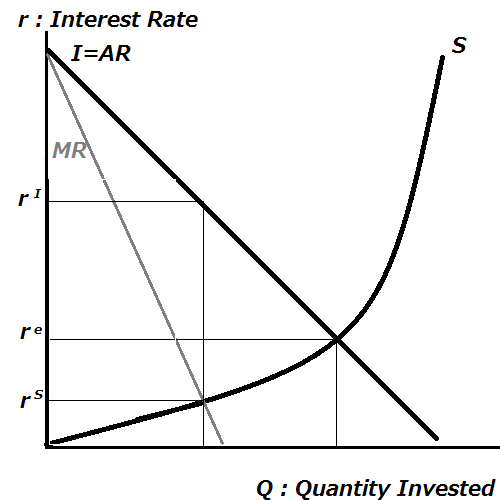
All in all, the market nature is far more monopolistic owing to these aspects. Then, the interest rates are set at the quantity of money invested where the marginal revenue becomes equal to the cost which is the interest payment for savers for this case. So, the quantity invested is lower than the quantity at the investment and saving intersection, and the interest rate charge for borrowing is always significantly way higher than the interest rate payment for savers.

The interest rate payment for savers may be affected by rise of the central bank interest rate increase but not often by fall of the central bank interest rate unless the market is very competitive. These financial service providers take advantage of this situation so that the interest rate payment for savers often tend to be notably lower than the interest rate charge to borrowers.

The following charts explain the different situations to set the final interest rates.

3.1. When the Central Bank Interest Rate is high


When the central bank interest rate is high, then the interest rate paid to savers is adjusted to be equal to the central bank interest rate.

The quantity of money invested is adjusted to the point where the marginal revenue from the return from investment intersects with the central bank interest rate, and then the interest rate charged for investment becomes higher as the central bank interest rate becomes higher.


3.2. When the Central Bank Interest Rate is low


When the central bank interest rate is low enough to be able to split from the investors' profit margin, then no change of both interest rates tends to take place as shown in the graph above.

This aspect completely contradicts what the IS-LM model assumes. As the market is less competitive, the monopoly power is stronger enough to maintain their high interest charge for investment payment unchanged.


3.3. The extreme case: The Central Bank Interest Rate is either zero or minus


In this extreme case which seems to occur frequently under the world economic crisis period nowadays, many central banks of this world have set their interest rate notably close to zero. Even some claim that they should set the rate zero.

Nonetheless, as shown in the previously mentioned mechanisms, the previously mentioned interest rate setting under the low liquidity, the money supply offered by the central bank with a sizably low interest rate hardly stimulates economy.

The interest payment for savers cannot be set below zero because they will no longer save in these banks or any other financial institutes setting such a negative interest rate.


4. Risk Taking Patterns

On the top of the gap between the interest rates, the IS-LM model over-simplifies the investment pattern influenced by the psychological characteristics of banks, investors, and other financial administrators.

What should be concerned is that the interest rate setting based on the investment volume is not always counter-cyclical to the business cycle, and not all economic agents are risk neutral as many mainstream macro-economists tend to assume.

The following examples are based on the situation of the fiscal and monetary policy is tightened to repress the economic boom or the recession repressing the aggregate income level.

The Y_t denotes the aggregate income invested to economy by these investors, and X_t denotes the investment safety (A higher value indicates the lower investment risk).


4.1 Risk Neutral: The IS-LM Curve assumes all agents are as such


This is the way which the risk neutral agents regularly react to the business cycle downturn causing the aggregate income shrinking.

They simply reduce the investment volume, and passively react to the investment risk change.

The IS-LM model may work as long as all the economic agents act as such.


4.2. Risk Averse


The risk averse economic agents put priority on their investment safety to their nominal income gain from their investment volume.

When their investment opportunity becomes more limited, they tend to take this situation warning of losing their business opportunity and potential collapse of their investing clients.

Even in the case where the fiscal and monetary policy represses the booming economy, they imagine about the negative side effect of the over-expansion which the policy alerts, and then they prefer preparing for the worst case scenario.

In particular during the recession, more agents tend to become the risk averse because their perspective tends to be more pessimistic about the future.

All in all, the income downturn exaggerates the investment discouragement furthermore.


4.3. Risk Lover


What the mainstream macro-economists supporting the IS-LM model ignores is this psychological characteristics of economic agents the risk loving attitude toward investment.

When the macroeconomic level of the aggregate income goes down during either the policy tightening or the recession, these risk loving investors start investing more in order to compensate for their loss by the downturn. Even though their action notably increases, they tend to be willing to invest a lot for increase the nominal investment return furthermore.

Their prior objective is to maximise the gross income growth despite the high risk reducing the average expected investment return. So, they will either maintain the current investment volume or even increase the volume in spite both the investment risk, the high central bank interest rate, and the high tax and/or the less government expenditure.

In particular during the economic bubble, an euphoria severely affects people's mind enough to lose their rationality. So, they often tend to become the risk lovers while the economic bubble.


5. Risk Premium in case of the Perfect Competition

Even in the Perfect Competition Model fails in the real investment mechanism because it ignores the interest rate influenced by the risk premium of investment. When renders invest, they add the extra interest rate charge on the top of the risk free interest rate which the mainstream economists supporting the IS-LM model use in the macroeconomic model.

The graph indicates the interest rate setting of a bank under the monopoly:

Under the monopoly or a less competitive market, these firms simply takes the cost incurred by the investment risk by spiriting the expense from their profit.

By contrast, in the perfect competition, it is very complicated to explain with only the saving=investment curves so that the graph will be a overly complicated mess if it attempts to explain the risk premium rate setting under the perfect competition.

So, this analysis introduces the cost denoted as C, which indicates the cost of attracting savers, the interest payment to the central bank, and then the risk premium all together.

The graph below sets the saving motive and the central bank interest rate as rigid so that takes account of only the investment motive and the risk premium.


In this case, the interest rate is not guaranteed to be counter-cyclical to the business cycle, and it can be acyclical or even possibly pro-cyclical to the business cycle.

Some economists argue that the risk premium factor may affect the investment cost more than the other factors such as the central bank interest rate, the saving ratio, and the aggregate income/productivity level.

So, the final interest rate influencing the investment volume may rather rise during the recession because the risk premium rises meanwhile the rate may fall due to the lower risk premium during the stable or booming period.