1. Birth of the Western Ethics and Libertarianism
How can human-beings become good? How can the life of human-beings become good? These two essential questions have arisen since Socrates invented his philosophy as the fundamental basis of the Western ethics. Plato, Socrates’s student, developed his teacher’s philosophy to offer a more structured ethical theory which explains about an ideal nation human-beings can live in an ideally good way. He claimed to design and construct a complete structure of politics and economics which command all human-beings to do what they have to do (Duty) and gain (Reward). Their duty varies across their ability, and their reward varies across their merit contributing the whole political and economic system. In order to enable human-beings to live in an ideal life style, they are supposed to have their own loyal reason for something productive they wish if they could achieve in their long term. This was the birth of the Western political philosophy.
Aristotle, Plato’s student, focuses more on understanding human-beings themselves and their inevitable human nature. Unlike his teacher, he was sceptical about instructing all human-beings to do what the system supposes each of them to do. So, he rather claimed to let them do think, decide, and act freely owing to their natural desire, talent, and life situation. Plato’s command politics and economy are fragile against the unpredictable spontaneously occurring changes of natural environments, technological advancement, and norms and values. Instead of suggesting all human-beings to share the common reason to pursue collectively, he argued that all different human-beings, i.e. individuals, must proactively look for and find out their own reasoning to live themselves.
Human-beings always suffer from an inevitable barrier of ignorance so that there is no human beings who can be in charge of controlling their living environment in a perfectly productive way. Furthermore, the human-beings themselves are also unpredictable and not precisely known. So, they need to study and know more about their own natural characteristics and quality rather than assuming they have already known. Then, they had better let the natural flow determine the natural optimum condition, and then let human-beings compete and cooperate, rather than command and obey, to determine their life path. Thus, he suggested to just let human-beings do freely by adapting their constantly changing natural environments and follow their basic rules they have to compete fairly and cooperate familiarly. Then, eventually, the natural equilibrium will provide them with their suitable duty owing to their ability and rewards owing to their merit. Then, they become competent to become active, self-determined, sincere, intellectual, and productive.
Aristotle argued that, even though human-beings are ignorant and unstable, they have their innate essential ability to know how to live well. Virtue is their good way to live, and virtuous ones are those who live in this way. The definition and conditions of virtue change across different times, places, and occasions, but the existence and its fundamental essence will still always stay with virtuous humans. What they only need is the helpful tip to advise them how to pursue in their virtue. Thomas Aquinas, a devote follower of Aristotle, affirmed that Christianity ought to modify itself to be this tip. Islamic philosophy of teaching how to live virtuously in its own unique way was inspired by Aristotle’s virtue ethics. These religious teachings influenced by Aristotle regard that human-beings should voluntarily do good instead of being commanded by the other.
The voluntary will should be the main engine for human-beings to live virtuously, and ethics and religions should only be the basic but essential principle for them to always remember to refer back to. These thoughts have been invented and developed in the occidental world (The Western and the Middle Eastern areas). Since Aristotle and his followers inspired human-beings to start thinking highly of the voluntary will, humans in the occidental world have been enlightened to realise that each different human-being ought to have her/his own voluntary will and thoughts. This was considered as the main cause of the event that the concept of “individual” emerged in the occidental world.
Since this idea of virtue i.e. good living was spread out, people living in various savage tribunal communities have been emancipated from the irrational mysticism and the brutal traditions. The light of virtue ethics has awaken all humans’ spirit from the darkness of their ignorance about the virtue and the freedom. Since savages living in these tribes started knowing their life is not just to live to die, they have realised that they should have something noble to pursue and aspire in their life. Since the concept of virtue and voluntary will was known by them, they have become “individuals” who have their own spirit detached from the dark mystic illusion, and then become able to have a free voluntary will to choose their own virtuous life style.
This idea of promoting the free voluntary will under the virtuous ethical principle has been retained by the modern Western ethics. John Locke invented the new form of ethics which would be suitable for the new age of the modernity with a fast technological progress. The virtue required in the norm and the value in this modern age significantly different from the ancient and the medieval. Therefore, he realised that the different progressive forms of ethics needed to emerge. In addition, Scottish enlightenment has emancipated humans from the dogmatism which used to be dominant in the human world, and created the new study of economy called economics based on humans’ voluntary will and virtue.
Afterward, there was a big surprise in this world which was the birth of the nation called America. This nation was built upon the ideal objective of promoting humans’ free voluntary will to develop and maintain their own nation without either any autocratic monarchy or oligarchy commanding them. As Rousseau explained, Athenian democracy was oligarchic was tyrannically oligarchic. So, up to the contemporary time period, American democracy could be the first liberal democratic nation which had ever been established.
America was not bound by the old traditionalism and rigid norm and value imposed by a hereditary monarchy, the oppressive centralised oligarchy, and the mysticism believed by irrational tribunal savages. Therefore, America and her people could establish their ideal nation based on their aspiring virtuous free voluntary will from scratch. This American ideal is called liberty, and America was born as a nation of liberty. Liberty is the combination of the wisdom retained from the ancient Western philosophy and the enlightenment in the modern Western political philosophy and economics. American people’s aspiration of living not only to simply live and die but also to live as virtuous beings seeking something good and productive as well as establishing and maintaining their ideal free nation. This loyal reason has been named Libertarianism since American people started calling their ideology of reincarnating this American original ideal objective.
2. No individuality, No ideal of liberty in Asian politics and culture
Asia of this world is materially thriving, and overwhelming the West for their strength in the high material productivity. There have already been many remarkable forms of sophisticated civilisation in Asia, and their cultural influence is equivalently strong and attractive enough to compete with the occidental counterpart. The unique long history of their mature culture and their strong family tie with each other has also sustained the stability of their civilisation which is essential for the growth in the material prosperity.
Nonetheless, by means of their level of happiness and freedom, they do not seem to be well off. Even though they have become materially well off, majority of people there do not seem to enjoy their satisfactory life. Even though they have adapted and become familiar with economics invented in the West, their community and mentality seem to still be governed by the feudalist kind of static norm and value and lack their devotion to their ideal objective.
Someone would claim that Buddhism is the Asian original enlightening philosophy inspiring human-beings to live virtuously and their enlightenment to perceive their individuality. However, Buddhism opposes individuals protesting against the oppression, and then suggests them to tolerate the oppression against them in the terrestrial (substantial) world. In Buddhism, they can obtain individual liberty but only in their spiritual level so that its pursuit of happiness is extremely limited to the spiritual level and not extended to their material and substantial life. Therefore, it has hardly motivated individual human-beings to provoke a revolution to reform their politics and personal life to liberate their living environment.
Confucianism is limited to maintaining the stable institutional structures such as family and smooth political and business administrations, and so neglects about individuality of human-beings. The similarity of Confucianism to the occidental philosophy is that it encourages human-beings to believe in the ideal political objective providing majority human-beings with a stable peace environment and a material prosperity. By contrast, Confucian objective does not take account of each individual human’s happiness and the virtue of their political establishment. Confucianism suggests individual human-beings to be always ready to sacrifice themselves for sustaining their belonging institute. Various injustice is highly tolerated or even promoted in order to sustain the existence of these institutes and deserving for their interests in Confucian ethics. All in all, Confucianism is beneficial to preserving the stability but severely lacks the notion of individual liberty which is critically necessary for the progress of the human world.
The majority of people there seem to be just let to live i.e. there is no voluntary will to live for the reason of seeking individual liberty. These minority elites also seem to just live and die without seeking their alternative life style better than they are enjoying now. The history has shown that these elites are too servile to keep their own autonomy with their strong will. So, without nobly resisting against the invasion, they easily start obeying the powerful invaders who conquer them and their land and are willing to sacrifice their ruling majority people for the interest of their new rulers. All in all, they seem to have only their interests and primary desires, and lack their belief in their proud sovereignty and noble ideal objective.
The power balance between the majority people and the minority elites in Asia is also important to know. Although, predominantly, the minority elites have been the ruling class taking an advantage of politics ruling the majority people, the interest of the majority people has certainly been influential to the whole politics. There are two different ways affecting their politics and culture: The one seen in the old feudalism and many current modern Asian nations.
In the feudalism and still in many modern Asian nations, whenever some political havoc threatened the ruling minority elites for the loss of their ruling power, the favour of the majority people suddenly became important to determine which side, the status quo or the new ruling elites would win over the conflict. All in all, whenever the elites of the ruling class are replaced by the newly emerging elites, their political structure and its cultural influence are completely switched from the old one to the new one. The important aspect is that the essential quality of both the old and the new characteristic is identical even though their characteristic is different from each other.
In the current modern Japan, the interest of Japanese mobs, the Japanese majority, is the dominant factor determining political and cultural trends there. Japan is one of very few nation controlled by the tyranny by mobs. Because there is neither tradition nor political ideology attached to both politics and elites’ characteristics, the interest of the mobs’ own primary desire and family interest are the main motive of politics and their personal life.
One of this causes of Japan’s tyranny by mobs is that Japan has historically been the remarkably diversified civilisation. So, there is no aristocrats whose family has been dominated over centuries. In addition, the charisma of Japanese monarchy is weak, despite its fame for having survived since the establishment of Japanese civilisation, due to the two historical reasons. Firstly, the time that Japanese monarchy held the actual political power was long. During the Shogunate feudalism, from 12th century to 19th century, although Japanese monarchy was known to be the official head of Japan, various Samurai clans held the real political power. Secondly, the responsibility of Japanese monarchy before the end of the World War 2 was heavy enough to dramatically lose its charisma which used to be strong during 19th and 20th century. All in all, the mobs’ interests are not attached to any monarchy or aristocrats in Japan. These aspects are ones of the causes inducing the tyranny by mobs in Japan.
Having mentioned about these cultural, historical, and political characteristics of these civilisation forms in Asia, politics, culture, and personal life styles tend to be determined by the mere interest of groups in Asia. The interest is based on the mere primary desire; it does not seem to be based on their belief in an ideal objective or a strong will of individuals. No reason of pursuing in individual liberty has emerged from Asia. Asians have partially adapted the concept of individualism and liberty from the West, and some nations have succeeded in the overwhelming material growth. Nevertheless, their material growth does not seem to grow furthermore without copying the technology and the management knowledge from the West. Asia still seems to lack the reason of believing in their ideal objective and the attitude of respecting individual liberty. Both the reason and individual liberty are critically important for encouraging the further inventions, innovations, and the invincible will to overcome the challenging limit of the growth, and more importantly for providing human-beings with their own happiness.
3. The rise and fall of Japanese Westernisation
Japan has been seen as one of the successful Westernised Asian nations and has been the only one developed independent Asian nation. There was a certain time period that Japan adapted the strong political objective and some enlightened Japanese (Not many), who aspired to pursue in their virtuous life, existed. Unfortunately, it was not a liberal politics encouraging individual liberty even though there was a strong principle of seeking an ideal political objective and a virtuous life. But, it has enabled Japanese to form their modernised politics and promoted individual citizens’ property right and the civil liberty to the certain extend. Then, from the Meiji establishment period to the end of 20th century, the reformers of Japan have temporarily succeeded in the rapid growth and the quasi-Westernisation.
Japanese political advocates of modernising Japan were eager to learn all the advanced technology and the mentality of the contemporary Western strongholds. At that time period, the Western colonisers threatened Japan for their conquest under the name of opening Japan for the international trade. Then, these enlightened Japanese attempted to reform Japan to transform it to be able to compete with the Western strongholds militarily and commercially. Therefore, they adapted the technology and the knowledge about the Western philosophies for encouraging their economic and cultural development and the contemporary Confucianism of the Continental Asia for keep their political stability.
This is why the Western philosophy and Confucianism are the fundamental backbone of Japan from Meiji to Showa periods (19th century to 20th century). So, even majority of the self-proclaimed Japanese conservative nationalists misunderstand this aspect. They tend to assume that their believing political philosophy is the Japanese original. However, the contemporary Meiji restorers were the advocates of the modernisation who thought that replacing the traditional Japanese feudalism and mass culture with the Western ideas and the Chinese Confucian disciplines.
In particular, when they form the government and legal structures, they frequently referred to Prussian politics and its basis the Neo-Roman law which follows the Legal Positivist ethics. This means that, even though the contemporary Japanese intellectuals and government officials simply copied the forms of the contemporary European politics, they could learn about the contemporary European legal positivist politics and ethics. The Legal Positivism contains intensively important essences for individual liberty such as the property right, the fair justice based on the equity law, the free trade contracts between individual citizens, and rational reasoning processes to follow ideal objectives.
The efforts of these Japanese advocates of the Westernisation have encouraged the rapid growth of modern Japan. The Western ethics combined with the wisdom of the Confucianism have stabilised and accelerated Japanese industrialisation and rationalisation of Japanese political administration. Because Japan had never been colonised, Japan could use their full national resources for their own development without being exploited by any foreign colonisers. Then, the contemporary Japanese intellectuals could enjoy their plenty time and resources to invest for their national developing plans. The contemporary Japanese entrepreneurs and politicians were so eager to learn the advanced Western national policies and ethics that Japan could become the first world nation at once.
Nevertheless, the critical and inevitable difference between the Western nations and Japan is that the Western ethics is only understood by the minority members of Japanese. The majority mass are ignorant about the virtue of the Western ethics. These mass have only been happy to enjoy the development of their material prosperity grown by the economic and political development lead by the minority elites in Japan since the beginning of the Westernisation. So, for the political decision makings, these Japanese mass have always been reliant on what the elite members of their living country. Therefore, individual sovereignty has never born among the majority mass in Japan. Japanese mass tend to think that their mindless hard labour without creative innovation can still sustain a stable fast economic growth, and the foreign diplomatic deals are not their business to consider about. They seems to be little interested in their own voluntary innovation and the rational decision making processes in their own foreign affairs.
When Japanese economic and military power became strong enough to compete with some of the Western nations, Japanese mass became recklessly arrogant enough to be under the illusion that Japan could defeat the Western nations. This illusion has taken place in Japan twice: The first time was the military aggression and the second time was the economic over-expansion. These fanatic phenomena were provoked by the pressure of Japanese mass.
Since the end of Japanese feudalism, there has been neither a charismatic sovereign nor a convincing ethical principle instructing these majority mass, their primary desire and the irrational whim based on their mysticism and superstition has been dominating over their mind. So, as soon as their material living standard is improved, they start looking for an event they can vent their irrational frustration on.
These Japanese mass should be called the mobs forming their tyranny. When they become well off enough to feed themselves, they start claiming for furthermore wealth without taking consideration of exchange of their wealth with their cost and responsibility. Then, they demand their government officials to fulfil their irresponsible desire with their overwhelming pressure of the tyranny by mobs. This has induced various political and economic overheats, and then eventually the severe downfalls.
The individual responsibility, which is required for the development of individual liberty, has yet never been developed in a nationwide scale in Japan. The majority of mass only irrationally mourn about their stagnating economy and their political corruption. They do not seem to feel responsible about their choice reflecting their own national economics and politics. This proves that Japanese economy and foreign diplomatic power were not endogenously grown. Majority of Japanese are still not competent enough to develop their economy and politics with their voluntary will. Under this condition, Japan will keep being stagnated. The other emerging Asian nations will also follow the same severe downfall and the long stagnation unless they learn from Japan’s failure.
* Ref:
The Objective Standard: Aristotle Versus Religion
http://www.theobjectivestandard.com/issues/2014-spring/aristotle-versus-religion/
Saturday, May 17, 2014


Saturday, March 29, 2014
America and her base ideological principles: Pt4
4.1. The moral universalism + An ultra individualism = The collectivist force
 American Communists might argue that the original political ideal of American founding fathers was like Communism. This makes sense because Communism is a political ideology which regards highly of individualism and individuals’ right naturally endowed to all individuals as much as the original Jeffersonian ethical ideal.
Regardless of the consequential outcomes induced by Communist policies, the original aim of communism is to unconditionally guarantee the right for all human kinds of individuals to protect their autonomy. Communism supports individuals’ freedom of choice as long as they do not invade others’ right for it and they do not deviate from the universal moral standard implies. This characteristic of Communism is resemblance to the two schools of American idealism, Wilsonian (The mainstream Federalist ideal) and Jeffersonian (Libertarian Rebels).
Both Communism and American idealism pursue in defending their believing universal right and morality. The critical difference between Communism and American is their view on individuals’ property right. Communism claims that individuals’ property right is distributed and monitored by the centralised state authority to each individual according to their rightful need, and then supports redistributing their property by the state’s involuntary force if anyone’s autonomy is threatened. By contrast, American idealism regards that the state should only impose the legislature to protect individuals’ right to keep holding their property, and generally disagree with the frequent usage of the involuntary force of the redistribution.
Libertarians, Jeffersonians and Jacksonians (The realist derivation of Jeffersonians), are against the excess expansion of American economic activity which will cause devaluing any individuals’ property right due to the increasing need for public goods and services in a huge scale. They claim that the redistribution and investing to the public goods and services should be carried out by the voluntary participation by individual citizens. They support the existence of the bourgeoisie, the rich cohort of citizens owing a huge volume of property. But, because these bourgeoisie need to live in such a small scale of economy and community which Libertarians strongly aspire to establish, they will be easily purged when they are seen as uncooperative and they will have less opportunities for their wealth manipulation.
Wilsonians, the mainstream in the current US politics, support the feasible level of the government intervention into the distribution of individuals’ property right even with the involuntary force. As same as Hamiltonians, the pragmatists, Wilsonians aspire to increase the aggregate wealth of the USA in order to gain the economic and political power enough to spend for achieving in establishing their ideal. Even though it is not the same level as Communism, Wilsonians are eager to use the collective force to redistribute individuals’ property by the centralised power of the state authority. Even though Wilsonian modern liberalist ideal is not same as Communism, it is very similar to what Communism originally aspired to achieve in.
When politicians aggressively pursue in the individual right and the individual autonomy, then their policy-outcome will eventually result in either the isolationism based on a small scale economy or the world moral imperialism hypocritically enforcing its universal moral value upon the entire world. In terms of American philosophy of Natural Right, the former is Jeffersonian Libertarian and the latter is Wilsonian political liberalism. In terms of Communism, the former is Marx-Leninism and the latter is Trotskyism as well as the Soviet Communism after the end of WW2.
The modern idealism initially invented by Locke and then innovated by Kant afterward, is based on the staunch belief in Natural Right as the absolute universal morality. This was brought into both Europe and America in different forms. It was transformed to be socialism in Europe while it was transformed to become Jeffersonian (Libertarian) at first and then Wilsonian (Political liberalism) later on. Sum up, even though their characteristics are different from each other, both Communism and American idealism essentially share the same quality of their ethical fundamental principle.
4.2. Libertarian incompatibility with Adam Smith
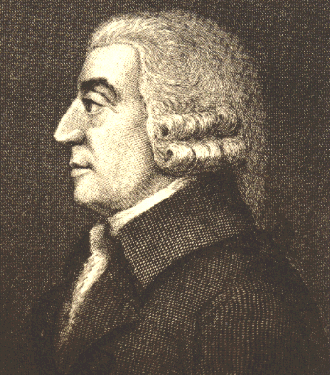 Libertarians (Not only the Libertarian Party members and supporters but also Libertarian leaning Republicans, and many close allies with Libertarians are called Libertarians in this essay) are those who fight against the totalitarianism dominating over America by restoring Classical Liberalism. But, they have not realised that, as explained in the last chapter, the fundamental principle of America fated their nation to become such a paternalist nation. The fundamental problem is that American Classical Liberalism is different from European Classical Liberalism.
Adam Smith is the father of economics as well as one of the remarkable scholars of British Liberalism. So, his philosophy is a good example of the Classical Liberalism, and his Scottish background will help to compare and contrast American idealism with his philosophy. This comparison attempts to show how incompatible American idealism and Smith's liberalism.
Firstly, more than English and American legal system, Scotland has had a closer relationship with Continental European counterpart. So, the influence of Continental Europe on Scotland is still strong, and Scotland adapted both Enlightenment Philosophy and Legal Positivism much faster than England. For example, Scottish regional law is based on Legal Positivism as same as Continental Europe, and the concept of Separation of church from state strongly exists in Scotland unlike the rest of Great Britain.
This is the aspect that Smith's Liberalism became eventually different from Lockean and Jeffersonian liberalism. Adam Smith’s philosophy was highly inspired by Scottish and European enlightenment (The enlightenment) and Legal Positivist philosophy. So, they insisted that only the optimum way is to let all be free to do what they want instead of relying on a particular moral and legal entrepreneur to command all. By contrast, American Libertarianism is based on the concept that the absolutely and universally right morality exists, and this political philosophy regards that all nations ought to follow. So, despite Libertarians’ belief in freedom of choice, their belief in the universal moral principle leads to a moral paternalism.
Adam Smith’s philosophy cannot be compatible with both Wilsonian Liberalism as well as Libertarianism. He would have argued that American idealism including Libertarian put excessive emphasis on paternalism to command humans to follow the natural right as the universal moral principle. He would have pointed out that there is no guarantee to accomplish American idealist paternalism without any sacrifice of either the material prosperity or the big collective involuntary force. Because humans are not God, it is impossible to control their surrounding nature and unseen future. Therefore, by referring to his theory of the Invisible Hand, he explained that there is no absolute moral or legal command which creates a perfect world.
4.3. Ayn Rand’s Dilemma between American legal philosophy and Legal Positivism

Ayn Rand is the most remarkable philosopher who rationally pointed out that the subjective moral universalism was the main cause of the economic and cultural collapse of the modern world from 20th century onward. She tried to reincarnate the Classical Liberalism to free individuals from the moral constrained imposed by various kinds of the modern idealism explained in this essay. Nevertheless, she seemed to have not determined which ethical principle she should have followed, the European Classical Liberalism based on Legal Positivism or the American Natural Right Liberalism based on the moral universalism. Then, even though her work was enlightening as well as artistically beautiful, her theory suffered from the inconsistency in her ethical principle.
Ayn Rand admired America as her ideal nation. She fought against those who replace her ideal capitalist nation the United States of America with a Staticist nation. But, she had not realised that America was fated to become a Staticist nation despite her wish. Meanwhile she always condemned Collectivism, she missed out how the fundamental belief in natural right results in the Collectivism of moral and legal philosophy.
Unlike libertarians, she seemed to have realised that the moral collectivism can easily lead a civilisation to the material collectivism. So, she described herself as a Roman Realist (Another word to describe the Legal Positivist) who is oppose to the Natural Law legalism which is the legal philosophy Natural Right is based on. However, even though she condemned Aquinas's Natural Law and Kantian Deontology (The Human Right), she tended to neglect about Lockean and Jeffersonian Natural Right.
What she called “Welfare Staticism” exactly describes about American idealism. She called Communism and the old 20th century style Socialism, where the property right is redistributed by the central state authority or the communitarian cooperative force, the Collectivism. By contrast, she used the world "Welfare Staticism" to describe the political system which allows individuals' own voluntary will and responsibility to own their property. But, this staticism induces them to engage to become altruistic to support the others.
Meanwhile the traditional (material) collectivism regards highly of the equality in outcomes, the Welfare Staticism insists on the equality in opportunity. Then, in order to accomplish the equality in opportunity, individual citizens and their living environment require a certain high degree of the equality in outcome. Then, this equality of opportunity is seen as one of the fundamental of the Natural Right.
Welfare staticism admits the market mechanism encouraging the individual citizens' property right and their free will to exchange it. It encourages the gradual transition from this world to a more egalitarian one. Then, Welfare Staticists have introduced the two major political tools which are the forcible government intervention and the altruism. Regardless of their methods, in order to convince individual citizens to participate into their policy, these Welfare Staticists often quote altruism, and then defines their controlling state authorities including government and law enforcement units as the guardians of the Natural Right.
The modern Welfare Staticists use the government force taxation and the heavy regulation as means of the redistribution of individuals' wealth and expanding the public goods and services in order to secure the natural rights for all individual citizens. Even though Welfare Staticism accepts the property ownership and some level of income inequality, it claims for minimising the inequality gap and providing the publicly shared goods and services which all individual citizens have an equal access. It imposes the heavy regulations on the activities of individual citizens in order to restrict anyone deviating from Welfare Staticist programme, and their state authority always monitors their flow system. The private individual citizens can be eventually frustrated by the extraction by taxation and the censorship by regulation. Then, in order to reduce their frustration, this politics indoctrinates them to believe its programme is designed to be good for all i.e. altruistic.
This type of the Welfare Staticism did not exist in America because the contemporary Americans detested both their property extortion by tax and the restriction on their actions and free will by either regulations or the hands of the others. However, they still considered the equality in opportunity is the fundamental Natural Right for all individuals. So, Americans used to implicitly enforce all individual Americans to voluntarily participate to minimise the inequality in outcome and regulate their actions and wills. This policy actually requires much higher degree of altruism than the modern Welfare Staticism, and then the moral enforcement upon individuals' mind has been the key necessity to maintain American ideal. Therefore, even though American were materially free to do and think, they were mentally and spiritually commanded by their moral entrepreneurial authority.
Ayn Rand admired America as her ideal nation, and fought against those who replace her ideal capitalist nation with a Staticist nation. But, she had not realised that America was fated to become a Staticist nation. America has already been Welfare Statist nation since its establishment. She explained that the (modern/political) liberals rule our bodies meanwhile conservatives rule our consciousness/soul. Even the freedom of body is given to individuals, their action and wills are highly restricted or even controlled under the name of the Natural Right, the nonhuman sovereign functioning as their moral entrepreneurial authority which can be a rational secular one but will be like the Godless-monotheism which was explained in Ethical Principles explained by Mathematical Logic Pt3.
Libertarians, the modern Jeffersonian political activists, argue that they will only remain the equality in opportunity and deny imposing the equality in outcome. However, when they persist in sticking to their Natural Right ideals as explained in the Part 1, some form of collective intervention forces will be inevitably necessary to correct the errors from their claiming universally valid morality.
Despite Ayn Rand always having condemned Collectivism, she missed out how the fundamental belief in natural right results in the Collectivism of moral and legal philosophy. Then, this is why, instead of categorising Ayn Rand into Libertarian, she is categorised into Hamiltonian on this spectrum.

Although Ayn Rand is not quite equitable to Hamiltonian because she distinguished herself from Pragmatism, she supported both big scale economies and big public sector institutes as long as rational individuals and any objective realities such as the market demand for in order to achieve in their prosperity. Nevertheless, it has been debated to think whether or not Ayn Rand is a mainstream school of American political philosophy. Even though she worshiped her new home nation America, the fundamental characteristics of America does not fit in with her desiring world view.
Regardless of the consequential outcomes induced by Communist policies, the original aim of communism is to unconditionally guarantee the right for all human kinds of individuals to protect their autonomy. Communism supports individuals’ freedom of choice as long as they do not invade others’ right for it and they do not deviate from the universal moral standard implies. This characteristic of Communism is resemblance to the two schools of American idealism, Wilsonian (The mainstream Federalist ideal) and Jeffersonian (Libertarian Rebels).
Both Communism and American idealism pursue in defending their believing universal right and morality. The critical difference between Communism and American is their view on individuals’ property right. Communism claims that individuals’ property right is distributed and monitored by the centralised state authority to each individual according to their rightful need, and then supports redistributing their property by the state’s involuntary force if anyone’s autonomy is threatened. By contrast, American idealism regards that the state should only impose the legislature to protect individuals’ right to keep holding their property, and generally disagree with the frequent usage of the involuntary force of the redistribution.
Libertarians, Jeffersonians and Jacksonians (The realist derivation of Jeffersonians), are against the excess expansion of American economic activity which will cause devaluing any individuals’ property right due to the increasing need for public goods and services in a huge scale. They claim that the redistribution and investing to the public goods and services should be carried out by the voluntary participation by individual citizens. They support the existence of the bourgeoisie, the rich cohort of citizens owing a huge volume of property. But, because these bourgeoisie need to live in such a small scale of economy and community which Libertarians strongly aspire to establish, they will be easily purged when they are seen as uncooperative and they will have less opportunities for their wealth manipulation.
Wilsonians, the mainstream in the current US politics, support the feasible level of the government intervention into the distribution of individuals’ property right even with the involuntary force. As same as Hamiltonians, the pragmatists, Wilsonians aspire to increase the aggregate wealth of the USA in order to gain the economic and political power enough to spend for achieving in establishing their ideal. Even though it is not the same level as Communism, Wilsonians are eager to use the collective force to redistribute individuals’ property by the centralised power of the state authority. Even though Wilsonian modern liberalist ideal is not same as Communism, it is very similar to what Communism originally aspired to achieve in.
When politicians aggressively pursue in the individual right and the individual autonomy, then their policy-outcome will eventually result in either the isolationism based on a small scale economy or the world moral imperialism hypocritically enforcing its universal moral value upon the entire world. In terms of American philosophy of Natural Right, the former is Jeffersonian Libertarian and the latter is Wilsonian political liberalism. In terms of Communism, the former is Marx-Leninism and the latter is Trotskyism as well as the Soviet Communism after the end of WW2.
The modern idealism initially invented by Locke and then innovated by Kant afterward, is based on the staunch belief in Natural Right as the absolute universal morality. This was brought into both Europe and America in different forms. It was transformed to be socialism in Europe while it was transformed to become Jeffersonian (Libertarian) at first and then Wilsonian (Political liberalism) later on. Sum up, even though their characteristics are different from each other, both Communism and American idealism essentially share the same quality of their ethical fundamental principle.
4.2. Libertarian incompatibility with Adam Smith
Adam Smith is the father of economics as well as one of the remarkable scholars of British Liberalism. So, his philosophy is a good example of the Classical Liberalism, and his Scottish background will help to compare and contrast American idealism with his philosophy. This comparison attempts to show how incompatible American idealism and Smith's liberalism.
Firstly, more than English and American legal system, Scotland has had a closer relationship with Continental European counterpart. So, the influence of Continental Europe on Scotland is still strong, and Scotland adapted both Enlightenment Philosophy and Legal Positivism much faster than England. For example, Scottish regional law is based on Legal Positivism as same as Continental Europe, and the concept of Separation of church from state strongly exists in Scotland unlike the rest of Great Britain.
This is the aspect that Smith's Liberalism became eventually different from Lockean and Jeffersonian liberalism. Adam Smith’s philosophy was highly inspired by Scottish and European enlightenment (The enlightenment) and Legal Positivist philosophy. So, they insisted that only the optimum way is to let all be free to do what they want instead of relying on a particular moral and legal entrepreneur to command all. By contrast, American Libertarianism is based on the concept that the absolutely and universally right morality exists, and this political philosophy regards that all nations ought to follow. So, despite Libertarians’ belief in freedom of choice, their belief in the universal moral principle leads to a moral paternalism.
Adam Smith’s philosophy cannot be compatible with both Wilsonian Liberalism as well as Libertarianism. He would have argued that American idealism including Libertarian put excessive emphasis on paternalism to command humans to follow the natural right as the universal moral principle. He would have pointed out that there is no guarantee to accomplish American idealist paternalism without any sacrifice of either the material prosperity or the big collective involuntary force. Because humans are not God, it is impossible to control their surrounding nature and unseen future. Therefore, by referring to his theory of the Invisible Hand, he explained that there is no absolute moral or legal command which creates a perfect world.
4.3. Ayn Rand’s Dilemma between American legal philosophy and Legal Positivism

Ayn Rand is the most remarkable philosopher who rationally pointed out that the subjective moral universalism was the main cause of the economic and cultural collapse of the modern world from 20th century onward. She tried to reincarnate the Classical Liberalism to free individuals from the moral constrained imposed by various kinds of the modern idealism explained in this essay. Nevertheless, she seemed to have not determined which ethical principle she should have followed, the European Classical Liberalism based on Legal Positivism or the American Natural Right Liberalism based on the moral universalism. Then, even though her work was enlightening as well as artistically beautiful, her theory suffered from the inconsistency in her ethical principle.
Ayn Rand admired America as her ideal nation. She fought against those who replace her ideal capitalist nation the United States of America with a Staticist nation. But, she had not realised that America was fated to become a Staticist nation despite her wish. Meanwhile she always condemned Collectivism, she missed out how the fundamental belief in natural right results in the Collectivism of moral and legal philosophy.
Unlike libertarians, she seemed to have realised that the moral collectivism can easily lead a civilisation to the material collectivism. So, she described herself as a Roman Realist (Another word to describe the Legal Positivist) who is oppose to the Natural Law legalism which is the legal philosophy Natural Right is based on. However, even though she condemned Aquinas's Natural Law and Kantian Deontology (The Human Right), she tended to neglect about Lockean and Jeffersonian Natural Right.
What she called “Welfare Staticism” exactly describes about American idealism. She called Communism and the old 20th century style Socialism, where the property right is redistributed by the central state authority or the communitarian cooperative force, the Collectivism. By contrast, she used the world "Welfare Staticism" to describe the political system which allows individuals' own voluntary will and responsibility to own their property. But, this staticism induces them to engage to become altruistic to support the others.
Meanwhile the traditional (material) collectivism regards highly of the equality in outcomes, the Welfare Staticism insists on the equality in opportunity. Then, in order to accomplish the equality in opportunity, individual citizens and their living environment require a certain high degree of the equality in outcome. Then, this equality of opportunity is seen as one of the fundamental of the Natural Right.
Welfare staticism admits the market mechanism encouraging the individual citizens' property right and their free will to exchange it. It encourages the gradual transition from this world to a more egalitarian one. Then, Welfare Staticists have introduced the two major political tools which are the forcible government intervention and the altruism. Regardless of their methods, in order to convince individual citizens to participate into their policy, these Welfare Staticists often quote altruism, and then defines their controlling state authorities including government and law enforcement units as the guardians of the Natural Right.
The modern Welfare Staticists use the government force taxation and the heavy regulation as means of the redistribution of individuals' wealth and expanding the public goods and services in order to secure the natural rights for all individual citizens. Even though Welfare Staticism accepts the property ownership and some level of income inequality, it claims for minimising the inequality gap and providing the publicly shared goods and services which all individual citizens have an equal access. It imposes the heavy regulations on the activities of individual citizens in order to restrict anyone deviating from Welfare Staticist programme, and their state authority always monitors their flow system. The private individual citizens can be eventually frustrated by the extraction by taxation and the censorship by regulation. Then, in order to reduce their frustration, this politics indoctrinates them to believe its programme is designed to be good for all i.e. altruistic.
This type of the Welfare Staticism did not exist in America because the contemporary Americans detested both their property extortion by tax and the restriction on their actions and free will by either regulations or the hands of the others. However, they still considered the equality in opportunity is the fundamental Natural Right for all individuals. So, Americans used to implicitly enforce all individual Americans to voluntarily participate to minimise the inequality in outcome and regulate their actions and wills. This policy actually requires much higher degree of altruism than the modern Welfare Staticism, and then the moral enforcement upon individuals' mind has been the key necessity to maintain American ideal. Therefore, even though American were materially free to do and think, they were mentally and spiritually commanded by their moral entrepreneurial authority.
Ayn Rand admired America as her ideal nation, and fought against those who replace her ideal capitalist nation with a Staticist nation. But, she had not realised that America was fated to become a Staticist nation. America has already been Welfare Statist nation since its establishment. She explained that the (modern/political) liberals rule our bodies meanwhile conservatives rule our consciousness/soul. Even the freedom of body is given to individuals, their action and wills are highly restricted or even controlled under the name of the Natural Right, the nonhuman sovereign functioning as their moral entrepreneurial authority which can be a rational secular one but will be like the Godless-monotheism which was explained in Ethical Principles explained by Mathematical Logic Pt3.
Libertarians, the modern Jeffersonian political activists, argue that they will only remain the equality in opportunity and deny imposing the equality in outcome. However, when they persist in sticking to their Natural Right ideals as explained in the Part 1, some form of collective intervention forces will be inevitably necessary to correct the errors from their claiming universally valid morality.
Despite Ayn Rand always having condemned Collectivism, she missed out how the fundamental belief in natural right results in the Collectivism of moral and legal philosophy. Then, this is why, instead of categorising Ayn Rand into Libertarian, she is categorised into Hamiltonian on this spectrum.

Although Ayn Rand is not quite equitable to Hamiltonian because she distinguished herself from Pragmatism, she supported both big scale economies and big public sector institutes as long as rational individuals and any objective realities such as the market demand for in order to achieve in their prosperity. Nevertheless, it has been debated to think whether or not Ayn Rand is a mainstream school of American political philosophy. Even though she worshiped her new home nation America, the fundamental characteristics of America does not fit in with her desiring world view.
Sunday, March 02, 2014
Four Evangelists on Keirsey Temperament

* These following sites are referred to create this chart:
- About Four Evangelists:
Faith, Hope, Belief, Prayers, Miracles: Saturday, March 24, 2012: Why are they called "Evangelists?
- About Keirsey Temperament:
Keirsey Temperament (Google Image Search)
The following describes the difference among the four evangelists, Matthew, Mark, Luke, and John.
--- Matthew: Rationalist ---The author of the first gospel thought of Jesus Christ as the messiah whom the Old Testament predicted that God sent to our would, and retains so many elements of the old testament. In his book, Jesus Christ is described as an offspring of Abraham, the legitimate messianic king, and his story is shown as the continuation of the old testament. Matthew's theory regards of Christianity as the reason for salvation.
The way he wrote his book is like the contract between individual human beings and the divine beings, and put emphasis on the conditions to be saved. Some readers may think Matthew's evangelism is the most traditional and conservative among all these four variations of the evangelism. The style of its messages is very identical to the old testament which is very rigorous to follow the contract and logically explains the condition for humans to be saved.
Unlike Luke's commandment, it affirms that it is dependent upon each individuals' own choice, effort, and will to decide weather or not this person can be saved or not. Because of his pragmatical personality, which comes from his previous occupation (tax collector), he seemed to think that the bible needs to preach humans based on what works to make them understand and follow Christian way.
Like Luke's, Matthew's testimony is intensive and powerful. Matthew's ressentiment against all anti-Christian Jewish whom he saw as the ultimately evil heretics who betrayed their promised messiah. He always insisted on Christ as a chosen king appointed by God, and chosen individuals who are destined to follow Christian life. He enthusiastically pursued the reason behind actions and words of both God and his master Jesus Christ.
Unlike Mark and Luke who rather focused on what human-beings can sense, Matthew focused on the meaning of what God and Jesus Christ have done. Like John, he attempted to draw the map of our present world related to the world of God which is quite abstract to imagine and show. In addition, his writing style is analytical because it frequently indicates the sequence of past and future events in relation to the miracle of God and Jesus Christ.
All in all, Matthew is the Rationalist who is individualistic, puts priority on what works, thinks abstract, and frequently refers to the analytical method.
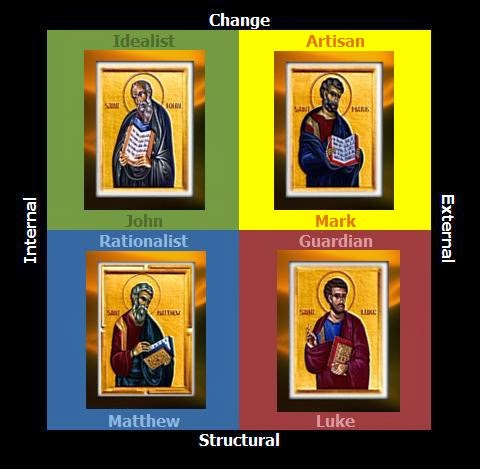
--- Mark: Artisan ---The author of the second gospel thought of Jesus Christ as a messianic servant. Mark was a disciple of Peter, one of Christ's disciple. Also, Peter did not understand his master Jesus Christ so much. Therefore, theologians and the other academics still debate about whether or not Mark could have understood Christianity. His gospel is actually the shortest among the four variations. Nevertheless, Mark's evangelism is still an interesting and worth off reading because of its objectiveness and based on the third person perspective and its relative clear and simple style of writing.
In his book, the image of the aggressively preaching John, the baptist, is strong enough to be well remembered by bible readers. The remarkable point of Mark's work is that it expresses the characteristics of not only Jesus Christ but also his surrounding individuals. Unlike the other evangelists, Mark is like a story teller who attempts to show a colourful story of Jesus Christ and his fellows. This gospel is useful to learn to remember the basic flow of Christ's missionary life.
Mark seemed to be a wanderer who keeps making efforts to try understanding Jesus. His attitude and struggle encourages sympathy from not only devout Christians but also those who are seeking their Christian way and those who are less interested in Christianity.
Mark should be called Artisan who like expressing things with a clear, observable, and sensing way. His style also offers readers the highest degree of freedom to become familiar with Christianity. Mark's gospel is the least preaching and the least restraining so that Mark's gospel should be the first one to read for those who persist to be free as much as possible and seek a familiar staff.
--- Luke: Guardian ---The author of the third gospel thought of Jesus Christ as a universal saver as well as a doctor/healer and a martyr. He saw God gave so many good things and saved humans so many times that human beings must obliged to give God back with our self-sacrifice. Luke's evangelism is the most generous and the most passionate among all the four versions. He has an invincible will to establish Christianity as the universal religions and the salvation for all those human kinds who are suffering from the pains in this world. Thus, he claimed that, God will unconditionally save those deprived ones and have sent Jesus Christ as a revolutionary to help all victims of oppression.
His messages and the passion in them are intensive and powerful than any other evangelists', and then enticed many Christians into his story writing. He insisted on what shall really be right for humans under God's will, and aspired to eliminate all unfairness and inequality. He also argued that all of human-beings have the unavoidable duty to compensate for the generosities and the aids the lord of mercy Jesus Christ and the only one God have provided humans with. Unlike Matthew and Mark, individuals' choice and will are irrelevant to the salvation because it is unconditional that all humans will be sanctioned by God and have to accomplish their duty for Jesus Christ and God.
Luke frequently introduced the stories of Jesus Christ healing sick and injured people. He preferred showing the observable actions and benefits of Jesus Christ demonstrated and provided in front of people in real to explaining abstract and analysis. This method has been easy for majority people to understand and become familiar with Christianity, and then successfully attracted them with his passion.
At the same time, Luke's testimony seems to be the most subjective among the four versions of the evangelism because all his statements are highly judgmental. The way he explained all things are certain, determined, and straight forward. Unlike Matthew, there is no individuality influencing their life, and the contract is less emphasised than Matthew. Obviously, Luke's story is more clear and based on what human-beings want Jesus Christ and God to do. This aspect significantly differs Luke from John who described Jesus Christ as something distant from humans. Both Mark and Luke wrote the story based on the perspective from what they and the other people observed. But, Luke was far more judgmental and big picture focus than Mark.
Luke was, and expected Jesus Christ to be, the Guardian who is generous and strict, and firmly assists and commands people by following rigorously established rules.

--- John: Idealist ---The author of the fourth gospel thought of Jesus Christ as an angel, the holy son of God. His gospel is very mythological as he frequently referred to angels and eternity. Meanwhile the other evangelists explained what human-beings ought to do to follow Christianity, he focused more on how special Jesus Christ was. His story indicates Jesus Christ came down to the earth to demonstrate how higher being behaves and thinks. Moreover, his gospel tells about Jesus Christ resurrection longer with more details than the others.
The interesting characteristics of John is that humans are already divided into those who can be saved or not. Meanwhile, Matthew and Luke precisely that particular kinds of individuals are saved owing to their effort and self-sacrifice, John did not mention the categories introduced by both Matthew and Luke. John put high priority on the spirituality and something not measurable in the substantial world. So, his expression was high abstract as well as mystical. It can be suspected that he intentionally did not clarify who will and not in order to avoid the hypocritical judgement. He attempted to reduce the sensible pain for those who suffer from pains in the substantial world by telling that events in the substantial world does not matter for their well being in their promised after life in the heaven.
Like Luke, John focuses on the big picture and the universality of Christianity. Like Mark, John created Jesus Christ's story based on his own creative interpretation and offer reads flexibility to learn Christianity. Like Matthew, John put emphasis on the sequence of the stories, and used an introspective method to induce reader to understand the deep meaning of the story. The unique characteristics of John's gospel is that it is far more abstract than any others because it connects Christian story to the heaven, the kingdom of God.
Moreover, in his story, he described Jesus to be remote from all the other humans unlike the other evangelists. Jesus Christ demonstrated something the ordinary people cannot easily do and commanded humans to do something. So, like an Angel, he presented himself to be like an angel, a mystic creature who is abstract to describe and difficult to contact with.
His expression style is less masculine than the other evangelists because his method of writing is less logical, less aggressive, and more emotional and mystical. His story is full of passion and mysterious fantasy which are more understandable with feeling approach more than thinking approach. The beauty of mysticism and spontaneously created emotions are the remark of John's evangelism. This characteristics may have attracted more female fellows to his gospel. This can be the reason why John was successful to write about the story about Mary Magdalena 's relationship with Jesus Christ.
The most interesting part of John's gospel is Christ's relation with Mary Magdalena in his last chapter. Because he wrote about after Christ's resurrection, there is a more hidden story regarding to the relationship between Jesus and Mary then.
Without a doubt, John should be categorised as the Idealist who supports what is right, equality among all, mysticism, and spontaneously created emotional expressions. Females also tend to be more feelers than thinkers so that the idealist characteristics matches with John's relatively more feminine style of gospel writing.
Thursday, January 02, 2014
The 2014 New Year Forecast, and The World War III (WW3) Predicted
*** The World War III (WW3) Predicted ***

* This is just a simulation, and I hope this world war will not happen in real.
1. The 2014 New Year Forecast:
As it has been mentioned in an article "Sunday, June 27, 2010: According to Kondratieff cycle, the Spring won't come until 2014 at the earliest", the year in the Spring will not come until 2014 at the earliest owing to the analysis based on the combination of Kondratieff 's economic cycle theory, the New Economic Geography theory, and Emile Durkheim 's sociological theory of Anomie. The economic downturn in this half decade was the severest in the world history due to its scale of the impact.
Fortunately, in the world average, the economic downturn seem to have hit the bottom, and some countries' economy seems to have started recovering little by little. America, Britain, and Japan seem to have rode on the track of the recovery according to the various numerical data sets shown by many institutions. The Eurozone is still stagnating due to their undetermined attitude of reforming their economy and the inflexibility caused by the current unstable fiscal policy management. But, the Eurozone seems to put more priority on the stability over the artificially stimulated recovery and strictly impose the austerity plan conducting them to rationally manage their fiscal policy. So, the Eurozone economy will neither rapidly recover nor dramatically fall down. The economy of both the emerging economies and the LDCs still keeps its steady economic growth, even though its speed became lower than it used to be, thanks to the abundant investment flow there in the globalised world economy.
Nevertheless, as the commonsense of economics tells, the effect of an economic downturn are usually lugging over the future time periods, and their scale is huge when the time of downturn is long and the scale is wide. For example, the unemployment created in the previous years will still remain to be high in the present and the near future time period.
The changing effect of the advanced economies over the emerging and LDC economies is also lugging. At the first step of the economic downturn of the advanced economies, the investors usually switch their investing countries from the advanced regions to the emerging or the LDC regions. However, when the marginal return from these investments starts declining, these investors stop investing especially when their income gain from their own home country keeps declining. In addition, when the advanced economies starts showing the sign of economic recovery after hitting the bottom of the recession, the money lenders in the emerging and the LDC economies severely suffer as shown in Asia in 1990s. Because the interest rate of the emerging and the LDC economies are dependent on the investment from the advanced economies, the interest rates of both regions are often highly positively correlated. Therefore, the sudden interest rate rise of any central banks of the advanced economies will increase the total costs of firms in these emerging and LDC economies.
All in all, the backlog effect of the past economic downturn of the advanced economies will hit the emerging economies and LDCs from this year onward. So, the tension caused by this backlog effect of the economic downturn might cause the world political havoc.
2. Potential Conflict between China and India over the fresh water resource:
Both China and India are the countries which are experiencing a rapid economic growth in a huge scale and have a huge population more than 1 billion. When the economic growth of both starts going down, the scale of the negative effects caused by the downturn will be enormous enough to increase the mass's frustration. Even though the economic growth speed goes down compared to the previous years, their government and corporations will inject their economic stimulus to keep their economy growing. They still aspire to encourage their further industrialisation process, and then the natural resource will be furthermore demanded increase their overall productivity.
 The most fundamentally required natural resource for industrialisation is fresh water. The other kinds of natural resources are relatively more substitutable than fresh water. The interesting fact is that both China and India, two massive nations, share the same location of their fresh water supply source which is Himalayas. Because both economies are slowly but steadily grows and the population of these two nations are still rapidly growing, these countries will require to secure gaining the water supply. These two countries will want to obtain more territories in Himalayas than the counterpart. So, they may attempt to monopolise the fresh water supply even with force.
The wage growth may start to be lowered with comparison to the price inflation, and the involuntary unemployment may start increasing due to the real wage decline and the switch from the labour intensive to the capital intensive owing to the technological advancement. Because of this slow growth, the social mobility among people of these two nation also will be significantly lowered than the previous years. This economic aspect will cause the frustration among the majority people in these two nations.
On the top of economics, there is an interesting demographic situation of these two nations related to increasing frustration there which may cause the war. Both China and India have a proportionally very high male population as shown in the table below:

The amazing fact is that the male population minus the female population of the 0 - 54 years old is 43 millions in China, and 49 millions in India. The sexually active male population in the present and the near future is enormously high compared to the female counterpart. This indicates that more young males in these two nations will be sexually frustrated.
The majority mass start expecting their nation to expand their business opportunities and to obtain a bigger land mass and more natural resources. On the top of this material needs and wants, the tremendously high young frustrated male population will transform their personality to be more aggressive.
The combination of these frustrations often increases the tension provoking a big war even by causing a small friction between these two nations. Therefore, the friction caused by the competition to secure the potential conflict over the precious fresh water resource in Himalaya looks like a trigger of a war between them.
3. Russian assists India, and they form the India & Russia Alliance:
The geopolitical situation of this world from 20th century onward encourages the antagonism between China and Russia. They occasionally formed an unfriendly alliance, but have never been friendly to each other and often attempted to sabotage the other in the foreign diplomacy. Both China and Russia are the nations who have a strong feeling of pride in themselves. They always maintain their dominance to be a suzerain nation, and so have never approved to be fully controlled by any other nation. Therefore, China and Russia have been competing with each other as the rivals or even the potential enemies of each other. During the time when they formed the alliance, they looked for an enemy of their rival to create a friendly diplomatic tie with to sabotage their rival even though this act could abandoning their alliance.
The other reason why Russia will participate against China is the economically and militarily strong strategic bilateral relationship between India and Russia. Since the cold war, Russia has aided various LDCs to attract them to supporting the Russian side. Even though India kept its solid politically neutral stance in the Cold War, the diplomatic relation between India and Russia became friendlily attached to each other. India was the best alternative LDC to form an alliance with when China was not reliable. So, Russia was eager to establish a close friendly bilateral relation with India. Then, Russia acted as a foreign diplomatic mediator peacefully intervening between India and Pakistan, and helped Bangladesh to be independent from Pakistan. Even though Russia tried to keep this matter fair and peaceful, the contemporary Russian attitude in India continent looked India leaning doing more favour for India.
Furthermore, because China and India have been conflicting over the territories near their national boarder for a long time, China felt unpleasant about Russian friendship with India. This story has induced China and Pakistan to form the alliance as both recognised each other under the doctrine "An enemy of their enemy is their friend".
Even nowadays, this geopolitical situation has been kept as same as it was during the Cold War. This is because that their political alliance is not based on the shared political ideology: Their diplomatic relation is based on the materialistic interest in each other. India needs Russian technological aids and Russian assistance to fight against both China and Pakistan. Russia needs India as a trade partner who has the economic advantages which Russia does not have as well as to avoid China being monopolistic.
4. Reaction of the world:
Because China and Pakistan form a very close bilateral relationship, they will also form the strong friendly alliance together in the predicted war. By means of the size of a nation, their bilateral relationship will be based on an unequal relationship unlike the India&Russian alliance, and so Pakistan will be rather treated as a satellite nation of China. The interesting aspect of the international politics is that China has developed the remarkable trade relationship with the Middle East and Africa for over a millennium. Nowadays, China still retains this tradition so that China has been aggressively aiding and investing to these nations in the Middle East and Africa since China succeeded in its rapid industrialisation. Even while the USA encouraged all over the world to negatively sanction many of these nations, China did not stop its relationship with them.
The role of the developing countries with the emerging economy will be more significantly important in the new world political economic situation. Under this globalisation, the gap between the advanced economies and the LDCs will be furthermore minimised. The advanced countries will no longer experience the rapid economic growth meanwhile the rest of the world will still grow. So, attracting the support of the emerging market will be the key to hold the initiative in this predicted war as well. Therefore, both sides, the India&Russian alliance and China, will more focus on attracting the attention of these emerging market than the North America and Europe.
The key factors to forecast which countries in the world support which side, the India&Rusian alliance or China, are the historically long relationship, the proportion of the shared common ethnic group, how much China has invested to Africa, the Middle East, the Central Asia, and South America, and how different nations value China as
The majority of the European European countries will be Russian satellites due to the close ethnic and political characteristics. Even though these country have some citizens who wish to keep a distance from Russia, the political pressure groups there will be proactive to maintain their country to be loyal to Russia.
Myanmar and many central Asian countries will be China's satellites because of the massive investment from China. Malaysia and Singapore will be China leaning because of the high Chinese population. Indonesia will suffer from the dilemma between supporting the joint cause of China and Islamic countries and remaining the anti-China policy for its independent sovereignty.
Africa is the mixture of pro-China and anti-China nations. Even though majority of African countries will support China due to China's rampart investment there, there still sufficient number of countries which remain their diplomatic attitude as anti-China.
South America will be divided into the two side. Brazil's political attitude of anti-China and pro-Russia will encourage Brazil to be a remarkable satellite nation of the India&Russia alliance. Chilli also shows far away from the relationship with China. The totalitarian countries whose political tie with China is strong such as Cuba and Venezuela will become China's satellites. The other countries not politically but very economically close relationship will be China leaning.
The United States of America (The USA) will neither aggressively nor directly intervene this war between the India&Russia alliance and the alliance of China and its satellites. It does not fulfill the USA's national interest by leading either side to completely win over the others. The intervention of the USA will be indirect and implicit. The perpetuation of this war will benefit to the weapon factories in the USA so that these US war merchants will secretly sell their weapons to abroad. However, relatively speaking, the USA will be more supportive to the India&Russia alliance for the strategic reason. The USA will attempt to maintain Taiwan's independence and secure the existence of Israel, and this action will antagonise both China and Islamic nations in the Middle East.
Japan will keep its indecisive attitude in the foreign diplomatic relations, and let the others to determine how Japan should react. During the Cold War, while Russia was threatening Japan, China came close to establish a friendship with Japan. From the end of the Cold War to the current time period, China started threatening Japan. Then, since the USSR collapsed, Russia and Japan have no longer become a significant political enemies any more. So, Russia stated to attempt to approach to Japan for a friendly diplomacy in order to counter China's threat together. India also shows its interest in assisting Japan militarily threatened by China.
Europe will be divided into three groups, China-leaning, Russia-leaning, and neutral. Because Europe has no longer hold a strong initiative over the world economy and politics, European influence will be not significant compared to countries in Asia, Africa, and South America. The core member states of the EU such as France, Germany, and Benelux countries will be relatively more China leaning because of their conflicting relationship with Russia. Some EU nations which have a strong anti-China sentiment among their citizens will be relatively more Russian leaning. The deep Eastern Europe will be under control of Russia. The UK and Ireland will keep their neutrality, and attempt to keep the diplomatic tie with both sides. Overall, Europe's involvement into this predicted warfare is very minimal because they will be too preoccupied to solve their own ongoing economic and political problems.
The map below is drawn by the previously mentioned analyses:

5. Hot, Cold, or Mild War?
If it is to happen in real, this war will be the mild war. The number and the size of the total wars which will take place will not be big as much as the previous two world wars but will be bigger than the Cold War. There will be guerrilla warfare frequently as much as the Cold War. This war will be more intense and direct than the Cold War. The temperature of this predicted war will be mild, neither hot as much as the previous two WWs nor the Cold War.
This analysis is just a simulation to forecast what will happen if the aforementioned tensions become serious so that the war is not officially predicted to be provoked. Nonetheless, this analysis will help to forecast the economic and political dynamic changes in this world from 2014 onward.

* This is just a simulation, and I hope this world war will not happen in real.
1. The 2014 New Year Forecast:
As it has been mentioned in an article "Sunday, June 27, 2010: According to Kondratieff cycle, the Spring won't come until 2014 at the earliest", the year in the Spring will not come until 2014 at the earliest owing to the analysis based on the combination of Kondratieff 's economic cycle theory, the New Economic Geography theory, and Emile Durkheim 's sociological theory of Anomie. The economic downturn in this half decade was the severest in the world history due to its scale of the impact.
Fortunately, in the world average, the economic downturn seem to have hit the bottom, and some countries' economy seems to have started recovering little by little. America, Britain, and Japan seem to have rode on the track of the recovery according to the various numerical data sets shown by many institutions. The Eurozone is still stagnating due to their undetermined attitude of reforming their economy and the inflexibility caused by the current unstable fiscal policy management. But, the Eurozone seems to put more priority on the stability over the artificially stimulated recovery and strictly impose the austerity plan conducting them to rationally manage their fiscal policy. So, the Eurozone economy will neither rapidly recover nor dramatically fall down. The economy of both the emerging economies and the LDCs still keeps its steady economic growth, even though its speed became lower than it used to be, thanks to the abundant investment flow there in the globalised world economy.
Nevertheless, as the commonsense of economics tells, the effect of an economic downturn are usually lugging over the future time periods, and their scale is huge when the time of downturn is long and the scale is wide. For example, the unemployment created in the previous years will still remain to be high in the present and the near future time period.
The changing effect of the advanced economies over the emerging and LDC economies is also lugging. At the first step of the economic downturn of the advanced economies, the investors usually switch their investing countries from the advanced regions to the emerging or the LDC regions. However, when the marginal return from these investments starts declining, these investors stop investing especially when their income gain from their own home country keeps declining. In addition, when the advanced economies starts showing the sign of economic recovery after hitting the bottom of the recession, the money lenders in the emerging and the LDC economies severely suffer as shown in Asia in 1990s. Because the interest rate of the emerging and the LDC economies are dependent on the investment from the advanced economies, the interest rates of both regions are often highly positively correlated. Therefore, the sudden interest rate rise of any central banks of the advanced economies will increase the total costs of firms in these emerging and LDC economies.
All in all, the backlog effect of the past economic downturn of the advanced economies will hit the emerging economies and LDCs from this year onward. So, the tension caused by this backlog effect of the economic downturn might cause the world political havoc.
2. Potential Conflict between China and India over the fresh water resource:
Both China and India are the countries which are experiencing a rapid economic growth in a huge scale and have a huge population more than 1 billion. When the economic growth of both starts going down, the scale of the negative effects caused by the downturn will be enormous enough to increase the mass's frustration. Even though the economic growth speed goes down compared to the previous years, their government and corporations will inject their economic stimulus to keep their economy growing. They still aspire to encourage their further industrialisation process, and then the natural resource will be furthermore demanded increase their overall productivity.

The wage growth may start to be lowered with comparison to the price inflation, and the involuntary unemployment may start increasing due to the real wage decline and the switch from the labour intensive to the capital intensive owing to the technological advancement. Because of this slow growth, the social mobility among people of these two nation also will be significantly lowered than the previous years. This economic aspect will cause the frustration among the majority people in these two nations.
On the top of economics, there is an interesting demographic situation of these two nations related to increasing frustration there which may cause the war. Both China and India have a proportionally very high male population as shown in the table below:
The amazing fact is that the male population minus the female population of the 0 - 54 years old is 43 millions in China, and 49 millions in India. The sexually active male population in the present and the near future is enormously high compared to the female counterpart. This indicates that more young males in these two nations will be sexually frustrated.
The majority mass start expecting their nation to expand their business opportunities and to obtain a bigger land mass and more natural resources. On the top of this material needs and wants, the tremendously high young frustrated male population will transform their personality to be more aggressive.
The combination of these frustrations often increases the tension provoking a big war even by causing a small friction between these two nations. Therefore, the friction caused by the competition to secure the potential conflict over the precious fresh water resource in Himalaya looks like a trigger of a war between them.
3. Russian assists India, and they form the India & Russia Alliance:
The geopolitical situation of this world from 20th century onward encourages the antagonism between China and Russia. They occasionally formed an unfriendly alliance, but have never been friendly to each other and often attempted to sabotage the other in the foreign diplomacy. Both China and Russia are the nations who have a strong feeling of pride in themselves. They always maintain their dominance to be a suzerain nation, and so have never approved to be fully controlled by any other nation. Therefore, China and Russia have been competing with each other as the rivals or even the potential enemies of each other. During the time when they formed the alliance, they looked for an enemy of their rival to create a friendly diplomatic tie with to sabotage their rival even though this act could abandoning their alliance.
The other reason why Russia will participate against China is the economically and militarily strong strategic bilateral relationship between India and Russia. Since the cold war, Russia has aided various LDCs to attract them to supporting the Russian side. Even though India kept its solid politically neutral stance in the Cold War, the diplomatic relation between India and Russia became friendlily attached to each other. India was the best alternative LDC to form an alliance with when China was not reliable. So, Russia was eager to establish a close friendly bilateral relation with India. Then, Russia acted as a foreign diplomatic mediator peacefully intervening between India and Pakistan, and helped Bangladesh to be independent from Pakistan. Even though Russia tried to keep this matter fair and peaceful, the contemporary Russian attitude in India continent looked India leaning doing more favour for India.
Furthermore, because China and India have been conflicting over the territories near their national boarder for a long time, China felt unpleasant about Russian friendship with India. This story has induced China and Pakistan to form the alliance as both recognised each other under the doctrine "An enemy of their enemy is their friend".
Even nowadays, this geopolitical situation has been kept as same as it was during the Cold War. This is because that their political alliance is not based on the shared political ideology: Their diplomatic relation is based on the materialistic interest in each other. India needs Russian technological aids and Russian assistance to fight against both China and Pakistan. Russia needs India as a trade partner who has the economic advantages which Russia does not have as well as to avoid China being monopolistic.
4. Reaction of the world:
Because China and Pakistan form a very close bilateral relationship, they will also form the strong friendly alliance together in the predicted war. By means of the size of a nation, their bilateral relationship will be based on an unequal relationship unlike the India&Russian alliance, and so Pakistan will be rather treated as a satellite nation of China. The interesting aspect of the international politics is that China has developed the remarkable trade relationship with the Middle East and Africa for over a millennium. Nowadays, China still retains this tradition so that China has been aggressively aiding and investing to these nations in the Middle East and Africa since China succeeded in its rapid industrialisation. Even while the USA encouraged all over the world to negatively sanction many of these nations, China did not stop its relationship with them.
The role of the developing countries with the emerging economy will be more significantly important in the new world political economic situation. Under this globalisation, the gap between the advanced economies and the LDCs will be furthermore minimised. The advanced countries will no longer experience the rapid economic growth meanwhile the rest of the world will still grow. So, attracting the support of the emerging market will be the key to hold the initiative in this predicted war as well. Therefore, both sides, the India&Russian alliance and China, will more focus on attracting the attention of these emerging market than the North America and Europe.
The key factors to forecast which countries in the world support which side, the India&Rusian alliance or China, are the historically long relationship, the proportion of the shared common ethnic group, how much China has invested to Africa, the Middle East, the Central Asia, and South America, and how different nations value China as
The majority of the European European countries will be Russian satellites due to the close ethnic and political characteristics. Even though these country have some citizens who wish to keep a distance from Russia, the political pressure groups there will be proactive to maintain their country to be loyal to Russia.
Myanmar and many central Asian countries will be China's satellites because of the massive investment from China. Malaysia and Singapore will be China leaning because of the high Chinese population. Indonesia will suffer from the dilemma between supporting the joint cause of China and Islamic countries and remaining the anti-China policy for its independent sovereignty.
Africa is the mixture of pro-China and anti-China nations. Even though majority of African countries will support China due to China's rampart investment there, there still sufficient number of countries which remain their diplomatic attitude as anti-China.
South America will be divided into the two side. Brazil's political attitude of anti-China and pro-Russia will encourage Brazil to be a remarkable satellite nation of the India&Russia alliance. Chilli also shows far away from the relationship with China. The totalitarian countries whose political tie with China is strong such as Cuba and Venezuela will become China's satellites. The other countries not politically but very economically close relationship will be China leaning.
The United States of America (The USA) will neither aggressively nor directly intervene this war between the India&Russia alliance and the alliance of China and its satellites. It does not fulfill the USA's national interest by leading either side to completely win over the others. The intervention of the USA will be indirect and implicit. The perpetuation of this war will benefit to the weapon factories in the USA so that these US war merchants will secretly sell their weapons to abroad. However, relatively speaking, the USA will be more supportive to the India&Russia alliance for the strategic reason. The USA will attempt to maintain Taiwan's independence and secure the existence of Israel, and this action will antagonise both China and Islamic nations in the Middle East.
Japan will keep its indecisive attitude in the foreign diplomatic relations, and let the others to determine how Japan should react. During the Cold War, while Russia was threatening Japan, China came close to establish a friendship with Japan. From the end of the Cold War to the current time period, China started threatening Japan. Then, since the USSR collapsed, Russia and Japan have no longer become a significant political enemies any more. So, Russia stated to attempt to approach to Japan for a friendly diplomacy in order to counter China's threat together. India also shows its interest in assisting Japan militarily threatened by China.
Europe will be divided into three groups, China-leaning, Russia-leaning, and neutral. Because Europe has no longer hold a strong initiative over the world economy and politics, European influence will be not significant compared to countries in Asia, Africa, and South America. The core member states of the EU such as France, Germany, and Benelux countries will be relatively more China leaning because of their conflicting relationship with Russia. Some EU nations which have a strong anti-China sentiment among their citizens will be relatively more Russian leaning. The deep Eastern Europe will be under control of Russia. The UK and Ireland will keep their neutrality, and attempt to keep the diplomatic tie with both sides. Overall, Europe's involvement into this predicted warfare is very minimal because they will be too preoccupied to solve their own ongoing economic and political problems.
The map below is drawn by the previously mentioned analyses:

5. Hot, Cold, or Mild War?
If it is to happen in real, this war will be the mild war. The number and the size of the total wars which will take place will not be big as much as the previous two world wars but will be bigger than the Cold War. There will be guerrilla warfare frequently as much as the Cold War. This war will be more intense and direct than the Cold War. The temperature of this predicted war will be mild, neither hot as much as the previous two WWs nor the Cold War.
This analysis is just a simulation to forecast what will happen if the aforementioned tensions become serious so that the war is not officially predicted to be provoked. Nonetheless, this analysis will help to forecast the economic and political dynamic changes in this world from 2014 onward.
Wednesday, November 27, 2013
America and her base ideological principles: Pt3

3.1. Wilsonianised Status-quo

Majority of the Democratic supporters, Modern Liberals (also known as Political Liberalists), and socialists in all over the world tend to think that the Republicans are war-mongers and fiscally extravagant. Nonetheless, the time when the Republicans were aggressive and extravagant are the Lincoln's administration time periods and the time periods from 1980s onward. By contrast, the Democrats, since Wilson was elected as the president, have been far more aggressive and fiscally extravagant than any other political parties. In particular, since Franklin Delano Roosevelt became the president, the Democrats have always engaged enemies, and started the war.
The Republicans also provoked some wars, but they cared about the fiscal prudence and the productive consequence derived from their cause and action. Therefore, the Republicans used their force to a certain limit to secure the safe trade routes and American national defence. Like Theodore Roosevelt's administration, their ulterior motive of provoking wars in outside America was to deserve their national material interests, and they were only eager to defend the liberal democracy and the natural right in inside America.
The reason why they intervened to the South America and the pacific ocean was that building relationship with these nations there would be the necessary condition to compete with the contemporary European empires and also highly beneficial for American future. These nations were struggling with the contemporary unilateral diplomatic relationship with Europe which deserves European sides more than their South American counterparts. Then, America emancipated them from the occupation under European colonisers by fighting against their European rulers. However, Theodore Roosevelt avoided intervening to both Atlantic Ocean and Europe itself by following Monroe Doctrine. He and the old Republicans knew that the excessive intervention and the devotion in moral objective would result in unproductive consequences.
The Democrats have been far more aggressive and fiscally imprudent and provoked wars. These wars provoked by the Democrats resulted in various unproductive consequences for both America and the others and the heavy reliance of citizens and American economy on the federal government. The aggression of the Democrats were motivated by their devotion in the universal moral principle which Wilsonian Democrats demand to encourage the entire world to follow.
In the domestic policy, Wilson also put a harsh persecution against his opponents and severely restricted freedom of speech among citizens during his regime. He even imprisoned those whom he suspected as oppositions to his politics under the name of his devout cause in the Natural Right. As explained in Ch1, the Natural Right principle basing American Liberal Democratic ideal itself is a very attractive cause. Nevertheless, having learned from the history, any enthusiasm based on good cause and principle may lead to a bloodshed when these devout supporters become fundamental to stick to it. Then, they tend to ignore the prudence and the consequence derived from their zealous action.
Wilson's intervention to the European war in the Wold War I (WW1) was encouraged by a good loyal cause to defend the Liberal Democratic alliance oppressed by the old monarchist totalitarians based on the Continental Realism. Despite of his good cause, the excess negative sanction toward the enemy nations created a strong antagonism and ressentiment of these former enemy nations enough to let them establish a new form of the oppressive politics. In addition, the ally nations have became excessively dependent on American foreign aids since then. All in all, America have been obliged to keep intervening to European politics in order to aid the dependent allies and repress the old and the new oppressive nations. Monroe Doctrine had avoided inducing this kind of result so that Americans had followed Monroe Doctrine as their wisdom to avoid their excessive intervention to the world outside America. But, Wilson ignored and destroyed the teaching of this wisdom.
Wilson himself faced a lot of enemies in his own party. In the contemporary Democratic party, there were still a large proportion of Jeffersonian and Jacksonian members who opposed the federal government power expansion. Wilson's reformation was a revolutionary movement in inside the Democratic party, which was transformed from the old conservative isolationist party to the aggressive progressive party. The Democratic party in 20th century onward completely follow the latter model, and the former model has been repealed off gradually from Wilson's administration to F.D.Roosevelt's administration. Afterward, the Democratic party has completely turned up to be a pure Wilsonian party.

Bush Jr. seemed to attempt to look like a Jacksonian (A moral relativist isolationist populist) in order to pretend a populist to attract countryside Americans and urban American mobs. At the same time, he restored the old moralist tradition before the secular moralist like Kantinan deontologist and John Rawls's secular Political Liberalism became popular. He tried to attract Christian voters who have been disappointed by the current Democratic party which is secularised nowadays, and adapted the religious side of Wilsonian politics to his new Republican party. All in all, in order to attract those who detest the Democrats' interventionist policy, and to distinguish his new religious sort of Wilsonian policy from the Democrats' secular sort of Wilsonian, he played with the two face mask which contains the two opposing personalities. On the other hand, the outcome of Bush Jr.'s administration was completely a Wilsonian.
However, since Bush Jr. and his fellow Neoconservatives took over the office, Jacksonian votes have realised that the Bush Jr.'s administration was completely based on their opposing Wilsonian policy. Then, some Republicans started forming a new faction called the Tea Party which clearly distinguishes themselves from Bush Jr. and his fellow who pretended as though they were Jacksonians. Because both the Democrats and the Republicans are now Wilsonian, and the only difference between them is that the Democrats are secular and the Republicans are more religious, these Jacksonian votes were frustrated in finding their favourite party. Then, the Tea party members of the Republicans fulfilled their favour.
The Wilsonian transformation of the Republican party started at the time when Ronald Reagan was elected as the president. Reagan himself was not a pure Wilsonian, and reminded many characteristics of the other 3 American political party ideology groups. Reagan was a unique and flexible politician who cannot be fit in the box. His Wilsonian side of personality was recognised in his federal government policy. Many political philosophers think of his tax cut and minimising public expenditures other than the military expenditure as Jacksonian minimisation of the federal government compared to states'. Nonetheless, his policy domestic policy he introduced far more focused on the big centralised scale rather than the small decentralised scale. He verbally put emphasis on the interest of small local communities in order to attract the isolationists' voters. But, his ulterior motive was to create promoting strong individualism and big private business growth which deserved more for the individuals favouring diversity more than the communitarian traditionalism and the corporations thriving with deregulation and tax cut in the urban areas. Ronald Reagan was wearing Jacksonian Cloth but Wilsonian inside.
Reagan should rather be seen as Wilsonian by means of his economic policy. Wilson tried to regulate excessively deregulated economy meanwhile Reagan tried to deregulate excessively regulated economy. The characteristic of these two are different but their quality of policy is same. Both Wilson and Reagan were willing to achieve in the economic system following the Natural Right principle which protects the individual freedom and right. The similarity of both is that they go extreme to reform the government policy. Wilson made the government too big meanwhile Reagan made the government too small.
At the time when Wilson was in charge of politics, the federal government power of Wilson's government imposed the regulation on the contemporary capitalists and their owning private sector industries, which operated the monopoly violating majority citizens' Natural Right, to protect the individuals' Natural Right from the contemporary capitalists owing the big private sector businesses. By contrast, the structure of American capitalist economy significantly changed from that time period. Erik Olin Wright, one of Neo-Marxist sociologists, described that the bureaucrats nowadays are closely tied up with the owner of big corporations and have started controlling the means of production as the new capitalist class since the Welfare state policy was introduced to capitalist nations. Furthermore, Wright mentioned that various entrepreneurs not fortunate enough to have a close relationship tie with both the big corporate tycoons and the bureaucrat have lost their power as the bourgeoisie since then. Therefore, the federal government power of Reagan's government reduced the tax taken by the bureaucrats, the new capitalists, and deregulated the entire market to discourage the monopoly of capital by the bureaucrats and their owning public sector industries.
All in all, Wilsonian, inspired by Lincoln's policy, became the mainstream political ideology of the status-quo in the 20th century onward.
3.2. The New Rebels: Jeffersonian (Libertarians) and Jacksonians (Tea Party)

Compared to any other nation, America has been a successful modern democratic nation where majority of citizens are interested in politics and ambitious to reflect their opinion. So, unlike the other nations, America has had provided these ambitious citizens with the democratic opportunity of representing their opinon. American political structure used to allow four unique political ideology groups to compete in obtaining the political power. So, in order to defeat the opponents, these groups always had to recruit their supporters as many as possible. Therefore, this structure enabled many citizens to participate into politics by joining one of these groups.
By contrast, as the power of American politics is monopolised by fewer groups, as these mainstream groups no longer need to make an effort to either aggressively recruit supporters nor aggressively advertise for the campaign, they require less citizens to help them. Thus, nowadays, more Americans are frustrated in their ambition of reflecting their political opinions than ever.
Those who disagree with the centralised autocratic government who intensively interfere with foreign affairs now no longer trust any mainstream political parties, and lost their interest in participating in the mainstream politics. However, this does not mean these citizens have lost their interest in the entire American politics. They have started a new revolution against the mainstream American politics which has been hijacked by the monopolistic status-quo. This seems to be a new American Civil War between the federal government of the status-quo and the isolationist popular politics lead by the new rebellion groups. This new rebellion is called Libertarianism which promotes for an isolationist foreign policy and the decentralised domestic policy.
There are two streams of Libertarian movement. Majority of Libertarians belonging to the political party called the Libertarian party are Jeffersonians, the booked based Civil Libertarian idealists. Self-dependent countryside citizens and the Republicans who are disappointed with the Wilsonianised mainstream party members are Jacksonians who prefer the straightforward policy to the complicated book based idealism.
Jeffersonians had had disagreed with Wilsonian federal autocracy which violates states' right and minimises individual sovereignty. However, Jeffersonians have realised that some federal intervention is necessary to avoid the complete collapse of the United States of America, and to negatively sanction against some states starting to violate individual citizens' liberty and right. Then, Jeffersonian and Wilsonian once allied to maintain the federal government power as a guardian of Natural Right because both groups are devout worshiper of American Liberal Democratic ideal based on the Natural Right ethical principle.
Since the beginning, Jacksonian has always been the most notable antagonist against Wilsonian politics, and been once disappointed by Jeffersonian when it formed an alliance with Wilsonian. Because Jacksonian is the populist derivation of Jeffersonian ideology, Jacksonians used to consider and call themselves as Jeffersonians even though Thomas Jefferson would have disagreed because of their unsophisticated characteristics. The obvious differences between Jacksonian and Jeffersonian are as follow. Jacksonian always puts priority on the states' right unless the USA is engaging a foreign enemy. Meanwhile Jeffersonians insist on their individualism for pursing American ideal,
Jacksonians support their individuality for their own basic need and want. Of course, Jeffersonian also encourages all citizens to be honest about clinging to their need and want. But, Jacksonian cause is far more straight forward and simplistic than Jeffersonian methodology.
A while after the Cold War, since the status-quo started being controlled by Wilsonian style politics, Jeffersonians have started to be sceptical about its former ally Wilsonian due to Wilsonian's monopoly over American political power and the current intensively centralised extravagant governance. Jeffersonians have then realised that their original way of pursing American ideal has been violated, and then started thinking that Americans now need to thinking the basic and the original spirit of American establishment. This is the cause to create a new revolutionary political party called the Libertarian party which rebels against both the Democratic party and the Republican party.
The old Republicans who are more fiscal conservative and realist in politics than the mainstream Republicans started feeling insecure under their current imprudent party politics. These fiscal conservatives and political realists of the Republicans used to be Hamiltonians who claim for the foreign intervention for their national material well-being. By contrast, nowadays, they are more likely to become Jacksonians, who are more aggressively insisting on minimising the federal government expenditure than any other political ideology groups. The other reason they have decided to choose Jacksonian path instead of Hamiltonian path is to gain the popular supports from countryside citizens and urban mobs. These countryside citizens and urban mobs are considerably more frustrated in ambition than Hamiltonian leaning rationalist individuals. So, these rebellious Republicans have chosen to be Jacksonian to attract these frustrated supporters in order to accomplish in their fiscal prudence which both realist groups Hamiltonian and Jacksonian put emphasis on. Then, this derivation of the Republican party, which declares the populist Libertarianism, is called the Tea Party named after Americans' rebellion against British autocratic occupation.
Both the Libertarian party, the new Jeffersonian, and the Tea party, the new Jacksonian, ally to challenge against the current authoritarian status-quo under the same shared interest of their Libertarian movement. Although both of them are prevented from being the mainstream, their influence among ordinary American citizens has become not ignorable. Their aggression is resemblance to the American rebels who fought for American independence. They aspire to resurrect the good old American life style, which they think of as America's attractive uniqueness from the rest of this world. They are also keen to show their proud traditional American economy as the freest economic model, which is detached from a heavy government intervention to economy, where citizens and entrepreneurs freely live and thrive purely by means of their voluntary will. Their motivation is encouraged by both their nostalgia of the original America-ness and their ambition to experiment an attractive and ideal economics.
On the other hand, their insisting isolationist policy is concerned to reduce American economic strength and cause the loss of the global order maintained largely by America's intervention as a guardian of the global market and the international human right. In addition, the disintegration of the macroeconomic policy, which Libertarians claim for, will cause the domestic economic instability and reduce the aggregate productivity level of American economy. Therefore, these Libertarians' policy is pretty much a resemblance to the original Jefferson's over-idealistic proposal which was highly criticised by Hamilton due to its inability to strengthen the national economy and expand the international trade network.
On the top of the structural issue, Libertarians' fundamental belief in their universal morality is warned to repeat the similar mistake as Wilsonian, which Edmund Burke would have criticised if he had been alive then. Furthermore, Libertarian reasoning process is critically normative (Quite vague and over expecting) so that their action tends to put priority on clinging to their right regardless of its costs more than keeping their action prudent, and on accomplishing their very long term ideal more than the affordable productive consequence. Both the Wilsonianised status-quo and Libertarians share the essentially same quality which contains a worrying risk of the moral universalism previously mentioned in Ethical Principles explained by Mathematical Logic Ch3 to Ethical Principles explained by Mathematical Logic Ch4.
American idealism was a strong manifesto which successfully liberated people of this world from the old traditional tyrannical autocratic politics of the Continental Realism which bases the philosophy of monarchism, aristocracy, and socialism. However, the nonhuman sovereign power influence of Americanism consequently transformed America from a super individualist nation to a centralised aggressive nation. Some of political philosophers wonder whether or not there can be an alternative political philosophy which is neither the traditional autocratic politics based on collectivism nor the moral universalism seen in America.
3.3. Who are Hamiltonians nowadays?

Despite the situation that Hamiltonian looks like having disappeared from American politics, there is still a politically influential group which promotes Hamiltonian. What has to be focused on is that politics of a nation is no longer controlled only by the political party members elected in a representative indirect democracy. Since the end of the Cold War when the information technology started to be rapidly developed and the world economy is globalised, various world financial institutions and multinational corporations have grown big.
When the global economy became globalised, a global scale reserve bank mediates and balances global economics and financial activities in order to stabilise the business cycle of all other the world. So, the financial institutes such as the IMF and the World Bank became authorised to hold the power to influence the world monetary policy which are independent from any national politics. As their objectives are clearly indexed, their action is not motivated by the abstract moral principle which is either impossible to achieve within resource and technology available or required to fulfil in an extremely long run. So, they require a strong prudence in their fiscal policy and encourage a pragmatic method to achieve their clearly indexed objectives.
The financial institutions such as investment banks and insurance companies freely invest beyond the national border lines as long as these investments are profitable, and nations have allowed them to do since the end of the Cold War. Since the end of the Cold War, the high politics such as the military power and the charisma of an ideological belief such as religion and political ideology has become less significant to enable a nation to have a strong initiative in the international politics. Since then, the low politics such as an economic management and a financial strength has become the key to hold an initiative in the international politics. Furthermore, individuals and companies have become less loyal to their own country's national politics, and then they have started welcoming foreign investors, who provide them with the opportunity to expand their business, and willing to invest to foreigners who seem to provide them with an enough return. The global corporations also build their branches and expand their business activity owing to the same cost and benefit analysis.
Many political philosophers and student of political or any social science may disagree with the analysis of this essay categorising financial engineers and global corporate entrepreneurs as Hamiltonian because these critiques may criticise financial engineers and global corporate entrepreneurs as too speculative to be Hamiltonians. Some anti-capitalist protestors argue that their investment strategy is highly speculative so that these financial engineers cannot be Hamiltonians. These anti-capitalist protestors seem to be ignorant of an economist point of view. The investment motivation of global investors is rather transactional than speculative. Their investment resource comes from the saving income, and their job is to convert the saving income to profitable investment. The investment methodology which anti-capitalist protestors know is merely an amateur technique rather than a financially professional technique. These anti-capitalists protestors seem to only guess how the professionals trade in the real world rather than deeply researching about the basic investment analysis and the complex algorithm used in it.
Furthermore, these critiques may also criticise that financial engineers and global corporate entrepreneurs are too imprudent to be Hamiltonians. But, this argument is contradicting by means of the economic theoretical point of view. Their government expenditure to recapitalise these financial institutes in the crisis was not a loose fiscal policy: These financial engineers and financial institutes have paid a high volume of the income tax. The government have already imposed taxation on them as the insurance to be prepared to a predicted financial collapse. In addition, the financial market is the most regulated market among all kinds of market due to avoid the rick caused by the fluctuant nature of this market. Therefore, the crisis was rather the accidental outcome than the federal government’s negligence to regulate.
These politically independent financial engineers and global entrepreneurs have become more influential and accountable to the national economy than political parties and electors owing to their financial influence which has grown even bigger than national governments' economic policy. They have realised that the proactive policies by political party of their country are no longer significantly affecting their economy. Since then, they have been indirectly manipulating American politics bypassing the party politics competition based on the ideological principle.
On the other hand, despite their detachment from the party politics competition, their business activities deserve for national economy and the well-being of the entire America is more likely to depend upon them than ever. As long as these financial engineers and global corporations are American base, their individual internal profit is transferred to American public finance via taxation by government and voluntary donations of these financial engineers and global enterprises. Thus, even though they are detached from pursuing American political ideal, their material contribution to American public still benefit to America thriving as an ideal nation of Liberal Democracy based on the Natural Right principle. This pragmatic political characteristic is indeed Hamiltonian.
The reason why these financial engineers and global entrepreneurs tend to be seen with some negative image by many citizens is that they are the elite members of America whose life style is different from the average ordinary Americans'. The rest of this world has the same situation as this American situation. The elites usually enjoy their distinctive life style which is different from the local life style of their home country. Furthermore, their highly rationalist mentality tends to be incompatible with the emotional whim which these local citizens stick to.
Since America was founded, Hamiltonian has been the least American and more European ideology even though it has lead the mainstream American politics so that Hamiltonian can be seen as the least nationalistic and the least idealistic of these 4 alignments introduced in this essay. Majority of Americans still put emphasis on the spirituality and their transcendental world view which enables them to keep pursing in American ideal. By contrast, Hamiltonian severely focuses on the material interest more than the spiritual and moral interest, and on the substantial world view rather than the transcendental world view. Even though American politics is often driven by this perspective, the deep characteristics of America and Americans have not take Hamiltonian policy for granted all the time. So, the opposing competitors have always attempted to overthrow Hamiltonian regime in their government since Thomas Jefferson. The antagonism of nowadays between the ideologically apathetic elites and the rest of American citizens can be seen as the resemblance to the antagonism of the past between the contemporary Hamiltonian governors and the rest of American citizens. Thus, these financial engineers and global entrepreneurs should be called the new Hamiltonian.
As same as the old Hamiltonian, the Pragmatist philosophy of the new Hamiltonian has also caused the academic authoritarianism since the new Hamiltonian became influential after the Cold War. The philosophy of the financial engineering has transformed economics, as the academic subject, to be ignoring the philosophical aspects of it. Then, the aim of studying economics has become the straightforward method of the indexed economic outlooks. Therefore, the loyal philosophical objective, such as what Adam Smith, the father of economics, aspired in, has been ignored since the introduction of Pragmatism in economics, and then the competition among different schools of economics has ceased away due to the imposition of the intensive peer group assessment by the authorised minority academics.
The epidemic of nihilism has been spread out to all over the world due to the denial of creating and believing in each human-being's own cause and reason. Chasing after the indexed economic outlooks used to be supposed to be simply a good tool to help our life, but has been only regarded as the goal after the Pragmatist philosophy became influential. When they become materially rich, they will no longer have the aim to live. When they suffer from the financial loss due to the crisis hitting the world market, they cannot analyse the market to look for the way out from this crisis when the existing algorithm does not help them. When the existing theories in one subject does not work, the comprehensive analyses involving the other sorts of subjects helps to draw an alternative conclusion. Nonetheless, the specialisation encouraged by Pragmatism has restricted majority scholars thinking this way, and excluded many non-mainstream ambitious thinkers away from the opportunity of reflecting their opinion. Thus, many individuals have become apathetic or relying the others such as a religious hope, a government, or authorised elites.
The new Hamiltonians were successful to grow the financial strength of individuals, their belonging institutes, and their nation in the market economy. But, its Pragmatist philosophy has castrated many individuals enough to lose their interest in economics, active participation in politics, and proudly believing in themselves with their own loyal cause and reasoning. The fundamental idealism based on the universal moral principle seems to contain the risk of violence and negligence of taking the material stability and prosperity into consideration. Nevertheless, the new Hamiltonian Pragmatism also contains the risk of excessively growing the academic authoritarianism and the nihilism. Hence, again, some of political philosophers wonder whether or not there can be an alternative political philosophy helping out from this world wide crisis.
Subscribe to:
Posts (Atom)